
Radio Control: Giant Scale
Bob Beckman
OVER the past few months, I have received a lot of interesting letters, and I'd like to share a few of them with you.
Bite-size Big Bird Buggy.
Lee Taylor's letter starts out: "Here's a couple of pictures that I thought you might be able to use.
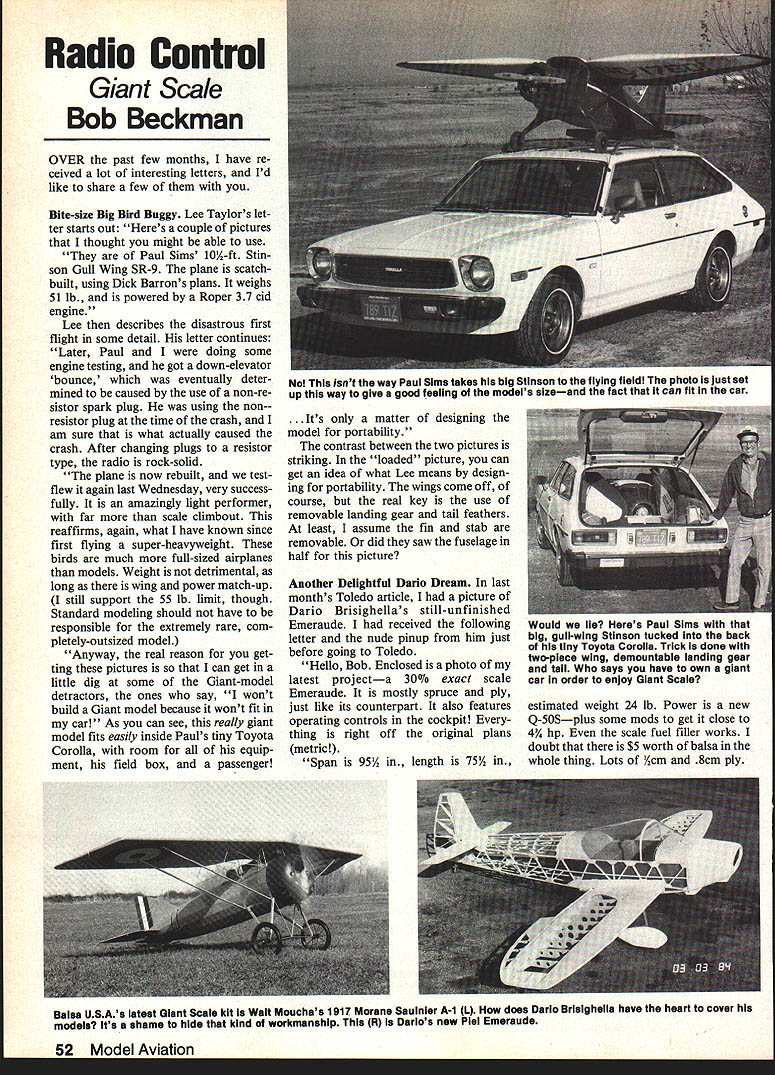
"They are of Paul Sims' 10½-ft. Stinson Gull Wing SR-9. The plane is scratch-built, using Dick Barron's plans. It weighs 51 lb., and is powered by a Roper 3.7 cid engine."
Lee then describes the disastrous first flight in some detail. His letter continues: "Later, Paul and I were doing some engine testing, and he got a down-elevator 'bounce,' which was eventually determined to be caused by the use of a non-resistor spark plug. He was using the non-resistor plug at the time of the crash, and I am sure that is what actually caused the crash. After changing plugs to a resistor type, the radio is rock-solid.
"The plane is now rebuilt, and we test-flew it again last Wednesday, very successfully. It is an amazingly light performer, with far more than scale climbout. This reaffirms, again, what I have known since first flying a super-heavyweight. These birds are much more full-sized airplanes than models. Weight is not detrimental, as long as there is wing and power match-up. (I still support the 55 lb. limit, though. Standard modeling should not have to be responsible for the extremely rare, completely-outsized model.)
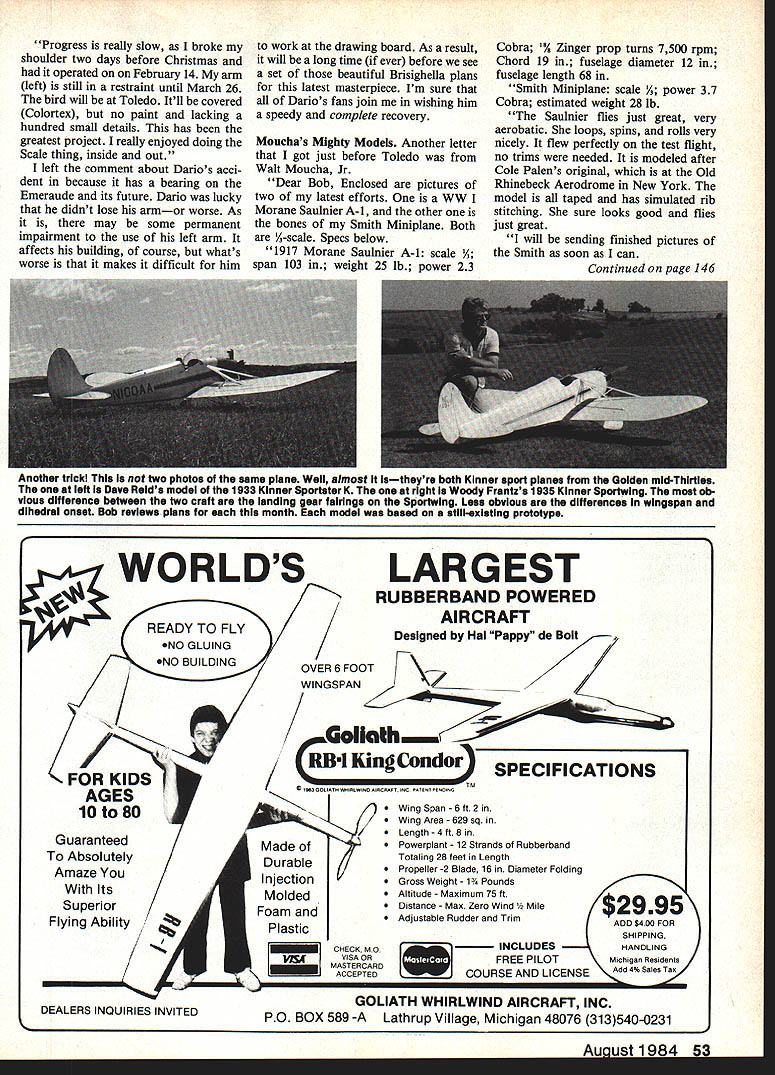
"Anyway, the real reason for you getting these pictures is so that I can get in a little dig at some of the Giant-model detractors, the ones who say, 'I won't build a Giant model because it won't fit in my car!' As you can see, this really giant model fits easily inside Paul's tiny Toyota Corolla, with room for all of his equipment, his field box, and a passenger!"
It's only a matter of designing the model for portability.
The contrast between the two pictures is striking. In the "loaded" picture, you can get an idea of what Lee means by designing for portability. The wings come off, of course, yet the real key is the use of removable landing gear and tail feathers. At least, I assume the fin and stab are removable. Or did they saw the fuselage in half for this picture?
Another Delightful Dario Dream.
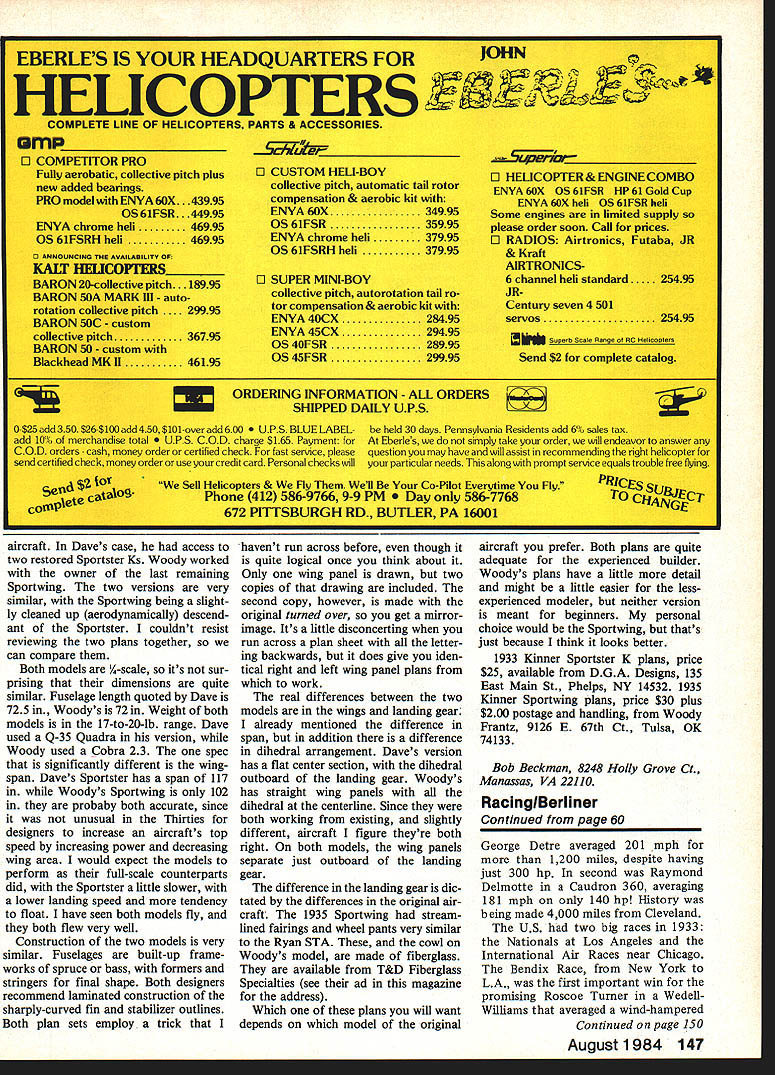
In last month's Toledo article, I had a picture of Dario Brisighella's still-unfinished Emeraude. I had received the following letter and the nude pinup from him just before going to Toledo.
"Hello, Bob. Enclosed is a photo of my latest project—a 30% exact scale Emeraude. It is mostly spruce and ply, just like its counterpart. It also features operating controls in the cockpit! Everything is right off the original plans (metric).
"Span is 95½ in., length is 75½ in., estimated weight 24 lb. Power is a new Q-505—plus some mods to get it close to 4½ hp. Even the scale fuel filler works. I doubt that there is $5 worth of balsa in the whole thing. Lots of 1/8cm and .8cm ply.
"Progress really slow; broke shoulder two days before Christmas, operated on February 14 and left still restrained until March 26. Bird will go to Toledo. It'll be covered Colortex, no paint, lacking hundred small details. Has been the greatest project I really enjoyed doing. Scale thing inside out. Left comment about Dario's accident because it has bearing on the Emeraude's future. Dario lucky didn't lose any more; worse, as may be some permanent impairment of use of left arm affects building, of course. What's worse, makes it difficult for him to work the drawing board. As a result, will take long time before we ever see set beautiful Brisighella plans latest masterpiece. I'm sure Dario's fans join wishing him speedy complete recovery."
Moucha's Mighty Models
Another letter got to me just before Toledo from Walt Moucha Jr.
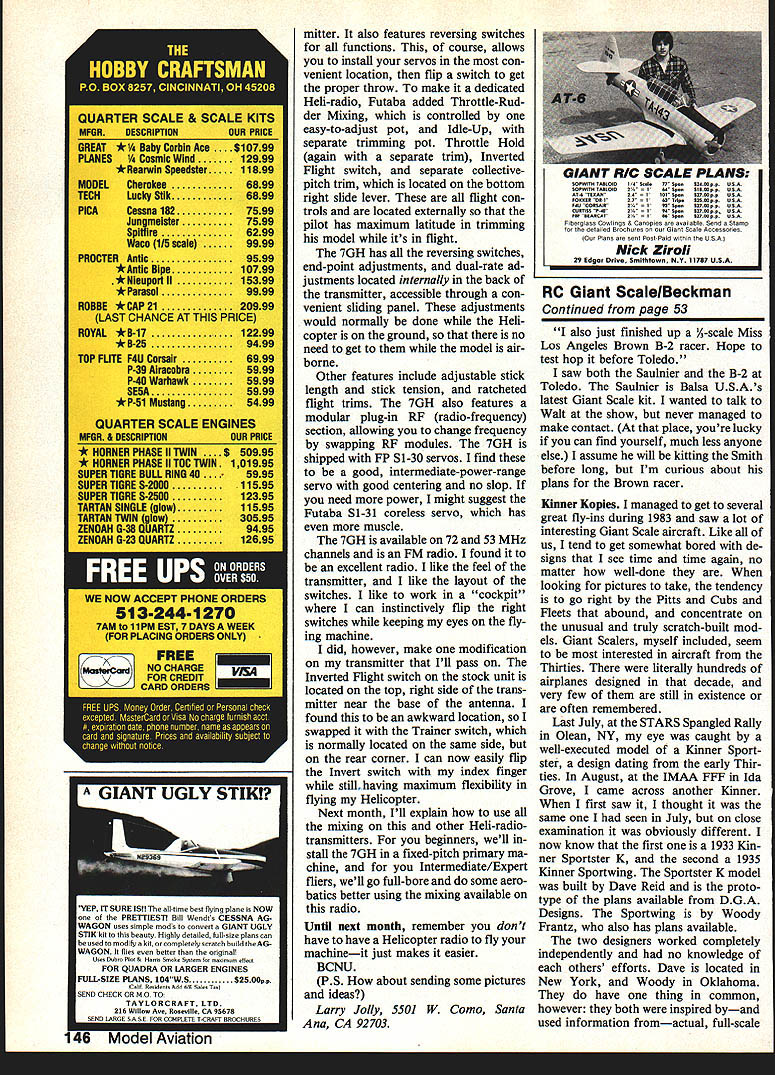
"Dear Bob: Enclosed pictures two latest efforts — WWI Morane Saulnier A-1, other is Smith Miniplane. Both A-scale. Specs below:
1917 Morane Saulnier A-1
- scale span: 103"
- weight: 25 lb
- power: 23 Cobra .18 / Zinger prop turns 7500 rpm
- chord: 19
- fuselage diameter: 12
- fuselage length: 68
Smith Miniplane
- scale power: 37 Cobra
- estimated weight: 28 lb
Saulnier flies just great, very aerobatic — loops, spins, rolls very nicely. Flew perfectly on test flight, no trims needed. Modeled after Cole Palen's original Old Rhinebeck Aerodrome New York model. Taped has simulated rib stitching, sure looks good, flies just great. Will be sending finished pictures of Smith soon."
I also just finished up a ½-scale Miss Los Angeles Brown B-2 racer. Hope to test hop it before Toledo.
I saw both the Saulnier and the B-2 at Toledo. The Saulnier is Balsa U.S.A.'s latest Giant Scale kit. I wanted to talk to Walt at the show, but never managed to make contact. (At that place, you're lucky if you can find yourself, much less anyone else.) I assume he will be kitting the Smith before long, but I'm curious about his plans for the Brown racer.
Kinner Kopies.
I managed to get several great fly-ins during 1983 and saw a lot of interesting Giant Scale aircraft. Like all of us, I tend to get somewhat bored with designs that I see time and time again, no matter how well-done they are. When looking for pictures to take, the tendency is to go by the Pritts and Cubs and Fleets that abound, and concentrate on the unusual and truly scratch-built models. Giant Scalers, myself included, seem to be most interested in aircraft from the Thirties. There were literally hundreds of airplanes designed in that decade, and very few of them are still in existence or are often remembered.
Last July, at the STARS Spangled Rally in Olean, NY, my eye was caught by a very well-executed model of a Kinner Sportster, a design dating from the early Thirties. In August, at the IMAA FFF in Ida Grove, I came across another Kinner. When I first saw it, I thought it was the same one I had seen in July, but on close examination it was obviously different. I now know that the first one is a 1933 Kinner Sportster K, and the second a 1935 Kinner Sportwing. The Sportster K was built by Dave Reid and is the prototype of the plane available from D.G.A. Designs. The Sportwing is by Woody Frantz, who also has plans available.
The two designers worked completely independently and had no knowledge of each other's efforts. Dave is located in New York, and Woody in Oklahoma. They do have one thing in common, however: they both were inspired by—and used information from—actual, full-scale aircraft. In Dave's case, he had access to two restored Sportsters Ks. Woody worked with the owner of the last remaining Sportwing. The two versions are very similar, with the Sportwing being a slightly cleaned up (aerodynamically) descendant of the Sportster. I couldn't resist reviewing the two plans together, so we can compare them.
Both models are 1/4-scale, so it's not surprising that their dimensions are quite similar. Fuselage length quoted by Dave is 72.5 in., Woody's is 72 in. Weight of both models is in the 17-to-20-lb. range. Dave used a Q-35 Quadra in his version, while Woody used a Cobra 2.3. The one spec that is significantly different is the wing span. Dave's Sportster has a span of 117 in., while Woody's Sportwing is only 102 in. They are probably both accurate, since it was not unusual in the Thirties for designers to increase an aircraft's top speed by increasing power and decreasing wing area. I would expect the models to perform as their full-scale counterparts did, with the Sportster a little slower, with a lower landing speed and more tendency to float. I have seen both models fly, and they both flew very well.
Construction of the two models is very similar. Fuselages are built-up frames of spruce or bass, with formers and stringers for final shape. Both designers recommend laminated construction of the sharply-curved fin and stabilizer outlines. Both plan sets employ a trick that I haven't run across before, even though it is quite logical once you think about it. Only one wing panel is drawn, but two copies of that drawing are included. The second copy, however, is made with the original turned over, so you get a mirror-image. It's a little disconcerting when you run across a plan sheet with all the lettering backwards, but it does give you identical right and left wing panels from which to work.
The real differences between the two models are in the wings and landing gear: I already mentioned the difference in span, but in addition there is a difference in dihedral arrangement. Dave's version has a flat center section, with the dihedral outboard of the landing gear. Woody's has straight wing panels with all the dihedral at the centerline. Since they were both working from existing, and slightly different, aircraft I figure they're both right. On both models, the wing panels separate just outboard of the landing gear.
The difference in the landing gear is dictated by the differences in the original aircraft. The 1935 Sportwing had streamlined fairings and wheel pants very similar to the Ryan STA. These, and the cowl on Woody's model, are made of fiberglass. They are available from T&D Fiberglass Specialties (see their ad in this magazine for the address).
Which one of these plans you will want depends on which model of the original aircraft you prefer. Both plans are quite adequate for the experienced builder. Woody's plans have a little more detail and might be a little easier for the less-experienced modeler, but neither version is meant for beginners. My personal choice would be the Sportwing, but that's just because I think it looks better.
1933 Kinner Sportster K plans, price $25, available from D.G.A. Designs, 135 East Main St., Phelps, NY 14532.
1935 Kinner Sportwing plans, price $30 plus $2.00 postage and handling, from Woody Frantz, 9126 E. 67th Ct., Tulsa, OK 74133.
Bob Beckman, 8248 Holly Grove Ct., Manassas, VA 22110.
Transcribed from original scans by AI. Minor OCR errors may remain.

