
Radio Control: Giant Scale
Bob Beckman
TAYLORCRAFT kit
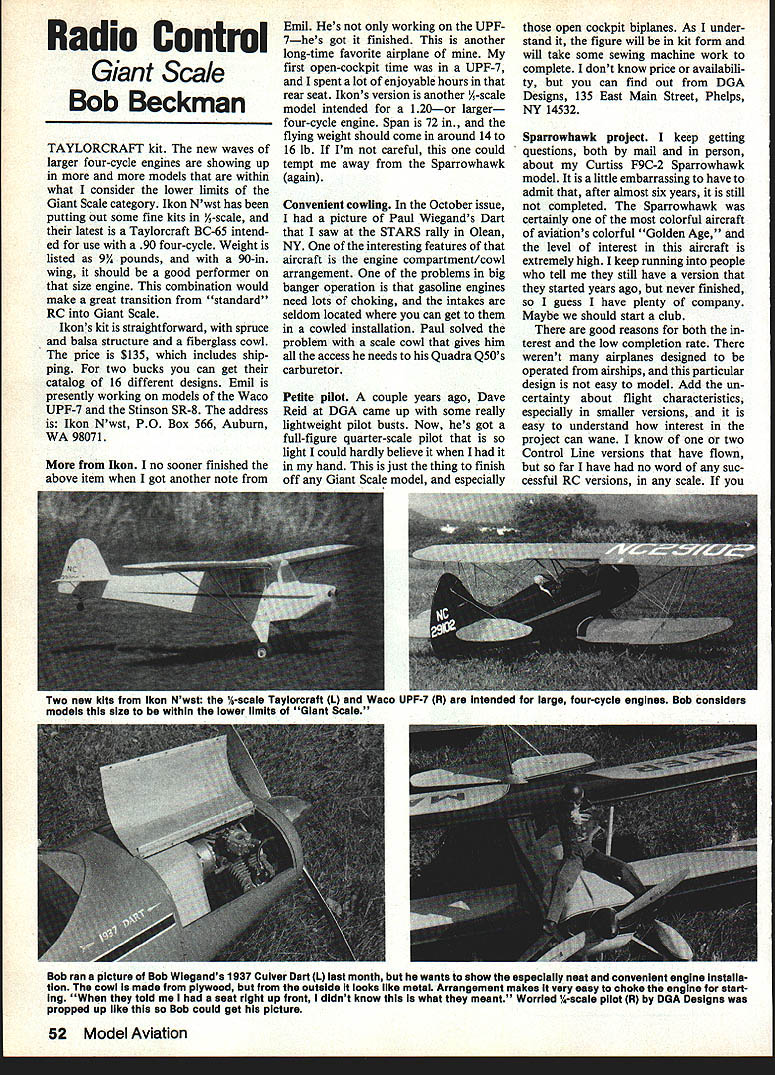
The new waves of larger four-cycle engines are showing up in more and more models that are within what I consider the lower limits of the Giant Scale category. Ikon N'west has been putting out some fine kits in 1/4-scale, and their latest is a Taylorcraft BC-65 intended for use with a .90 four-cycle. Weight is listed as 9 1/4 pounds, and with a 90-in. wing, it should be a good performer on that size engine. This combination would make a great transition from "standard" RC into Giant Scale.
Ikon's kit is straightforward, with spruce and balsa structure and a fiberglass cowl. The price is $135, which includes shipping. For two bucks you can get their catalog of 16 different designs. Emil is presently working on models of the Waco UPF-7 and the Stinson SR-8. The address is: Ikon N'west, P.O. Box 566, Auburn, WA 98071.
More from Ikon
I no sooner finished the above item when I got another note from Emil. He's not only working on the UPF-7—he's got it finished. This is another long-time favorite airplane of mine. My first open-cockpit time was in a UPF-7, and I spent a lot of enjoyable hours in that rear seat. Ikon's version is another 1/4-scale model intended for a .120—or larger—four-cycle engine. Span is 72 in., and the flying weight should come in around 14 to 16 lb. If I'm not careful, this one could tempt me away from the Sparrowhawk (again).
Convenient cowling
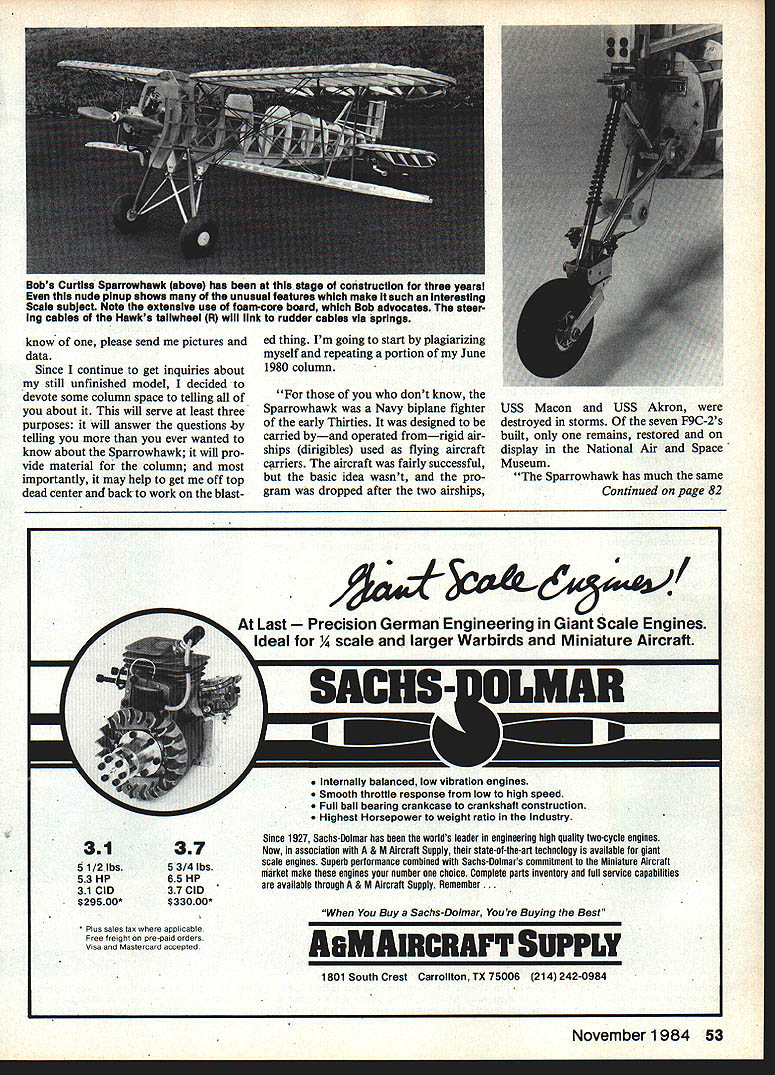
In the October issue, I had a picture of Paul Wiegand's Dart that I saw at the STARS rally in Olean, NY. One of the interesting features of that aircraft is the engine compartment/cowl arrangement. One of the problems in big-banger operation is that gasoline engines need lots of choking, and the intakes are seldom located where you can get to them in a cowled installation. Paul solved the problem with a scale cowl that gives him all the access he needs to his Quadra Q50 carburetor.
Petite pilot
A couple years ago, Dave Reid at DGA came up with some really lightweight pilot busts. Now, he's got a full-figure quarter-scale pilot that is so light I could hardly believe it when I had it in my hand. This is just the thing to finish off any Giant Scale model, and especially those open-cockpit biplanes. As I understand it, the figure will be in kit form and will take some sewing-machine work to complete. I don't know price or availability, but you can find out from DGA Designs, 135 East Main Street, Phelps, NY 14532.
Sparrowhawk project
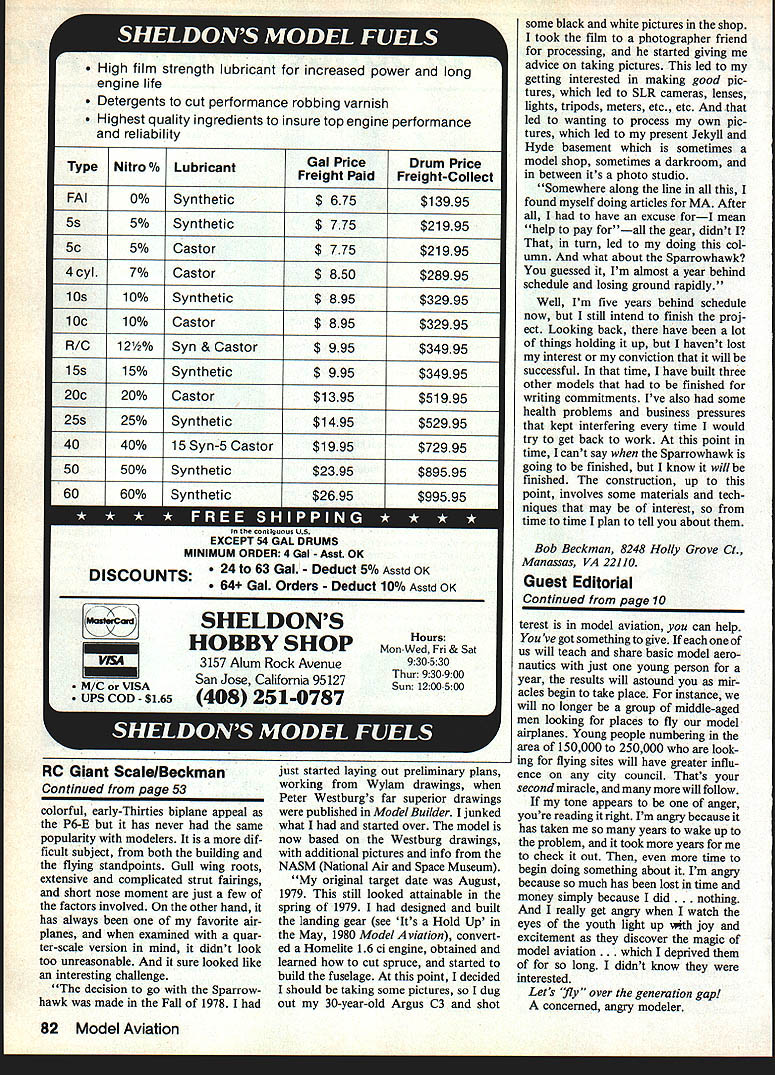
I keep getting questions, both by mail and in person, about my Curtiss F9C-2 Sparrowhawk model. It is a little embarrassing to have to admit that, after almost six years, it is still not completed. The Sparrowhawk was certainly one of the most colorful aircraft of aviation's colorful "Golden Age," and the level of interest in this aircraft is extremely high. I keep running into people who tell me they still have a version that they started years ago, but never finished, so I guess I have plenty of company. Maybe we should start a club.
There are good reasons for both the interest and the low completion rate. There weren't many airplanes designed to be carried and operated from airships, and this particular design is not easy to model. Add the uncertainty about flight characteristics, especially in smaller versions, and it is easy to understand how interest in the project can wane. I know of one or two control-line versions that have flown, but so far I have had no word of any successful RC versions, in any scale. If you know of one, please send me pictures and data.
Since I continue to get inquiries about my still-unfinished model, I decided to devote some column space to telling all of you about it. This will serve at least three purposes: it will answer the questions by telling you more than you ever wanted to know about the Sparrowhawk; it will provide material for the column; and most importantly, it may help to get me off top dead center and back to work on the blasted thing. I'm going to start by plagiarizing myself and repeating a portion of my June 1980 column.
For those of you who don't know, the Sparrowhawk was a Navy biplane fighter of the early Thirties. It was designed to be carried by—and operated from—rigid airships (dirigibles) used as flying aircraft carriers. The aircraft was fairly successful, but the basic idea wasn't, and the program was dropped after the two airships, USS Macon and USS Akron, were destroyed in storms. Of the seven F9C-2s built, only one remains, restored and on display in the National Air and Space Museum.
The Sparrowhawk has much the same colorful, early-Thirties biplane appeal as the P6-E, but it has never had the same popularity with modelers. It is a more difficult subject, from both the building and flying standpoints. Gull wing roots, extensive and complicated strut fairings, and short nose moment are just a few of the factors involved. On the other hand, it has always been one of my favorite airplanes, and when examined with a quarter-scale version in mind, it didn't look too unreasonable. And it sure looked like an interesting challenge.
The decision to go with the Sparrowhawk was made in the fall of 1978. I had just started laying out preliminary plans, working from Wylam drawings, when Peter Westburg's far superior drawings were published in Model Builder. I junked what I had started over. The model is now based on the Westburg drawings, with additional pictures and info from the NASM (National Air and Space Museum).
My original target date was August 1979. This still looked attainable in the spring of 1979. I had designed and built the landing gear (see "A Hold Up" in the May 1980 Model Aviation), converted a Homelite 1.6 ci engine, obtained and learned how to cut spruce, and started to build the fuselage. At this point, I decided I should be taking some pictures, so I dug out my 30-year-old Argus C3 and shot some black-and-white pictures in the shop. I took the film to a photographer friend for processing, and he started giving me advice on taking pictures. This led to my getting interested in making good pictures, which led to SLR cameras, lenses, lights, tripods, meters, etc., etc. And that led to wanting to process my own pictures, which led to my present Jekyll-and-Hyde basement which is sometimes a model shop, sometimes a darkroom, and in between it's a photo studio.
Somewhere along the line in all this, I found myself doing articles for MA. After all, I had to have an excuse for—I mean "help to pay for"—all the gear, didn't I? That, in turn, led to my doing this column. And what about the Sparrowhawk? You guessed it, I'm almost a year behind schedule and losing ground rapidly.
Well, I'm five years behind schedule now, but I still intend to finish the project. Looking back, there have been a lot of things holding it up, but I haven't lost my interest or my conviction that it will be successful. In that time, I have built three other models that had to be finished for writing commitments. I've also had some health problems and business pressures that kept interfering every time I would try to get back to work. At this point in time, I can't say when the Sparrowhawk is going to be finished, but I know it will be finished. The construction, up to this point, involves some materials and techniques that may be of interest, so from time to time I plan to tell you about them.
Contact
Bob Beckman 8248 Holly Grove Ct. Manassas, VA 22110
Transcribed from original scans by AI. Minor OCR errors may remain.

