
Radio Control: Giant Scale
Bob Beckman
Friendly reminder
I've said what follows before, and I see it from time to time in all the magazine columns. When you write to a columnist and expect an answer, please include a self-addressed, stamped envelope (SASE). A little thought should make the need for this obvious. The magazines don't pay postage for us, and, while it's nice to know that people out there are reading my stuff, I can't afford the cost of the postage to answer all the letters I get.
If you're sitting out there wondering why I haven't replied to your letter, it's probably because you didn't include the SASE. When I get an SASE, I try to get the reply off immediately. I don't always manage it the same day, and sometimes other things get in the way, but I respond as quickly as possible. If there is no SASE, but the question(s) being asked might be of interest to others as well as the sender, I usually save it (them) and try to give coverage in this column. If the information requested is not of general interest, I reluctantly have to set the letter aside.
Please don't let what I'm saying discourage you from writing! All columnists appreciate and depend upon input from the readers. It's just that we get these awful guilt feelings when we can't answer everyone's questions right away.
Foam core uses
In the category of general-interest questions have been several requests for information about foam core board and how to use it. My Sparrowhawk uses a lot of it, and in several plan reviews I've mentioned that it could be substituted for balsa wing ribs.
First, what is foam core board, and where do you get it? The general term refers to a material made of styrene foam sandwiched between two layers of paper, matboard, or plastic. It comes in various thicknesses from 1/16-inch up to one inch, or more. The material that I have most frequently used is 3/16-inch thick, but I recently found some 1/4-inch stock. All of mine is surfaced with smooth, white cardboard, but I have seen 3/16-inch stock surfaced with brown kraft paper. The plastic-faced versions are stronger, but are more expensive and harder to find. The type that I'm talking about is available at drafting and art-supply stores.
How do you use it? Well, like most materials, your imagination is the only limit to what you might be able to do. There are people who have made entire airplanes from the stuff, but I'm going to confine my remarks to very simple uses. The material cuts very easily with a sharp X-Acto knife and has absolutely no "grain." Although I haven't made any actual measurements, I feel that the weight compares favorably with firm sheet balsa. And it's a lot cheaper than balsa. Wing ribs and fuselage formers are perfect applications.
There are some things to watch out for, of course. Since the core is styrene foam, you have to be careful about adhesives and dope.
- Epoxy and aliphatic resins are OK.
- Do not use Hot Stuff or any cyanoacrylate—they dissolve styrofoam.
- Pacer Technology makes a product called Z-Foam Primer, claimed to eliminate the problem; I have yet to try it.
Ribs and formers in contact with doped fabric edges must be protected. Dope can be kept off the foam by using balsa cap strips or by sealing the edges with white glue.
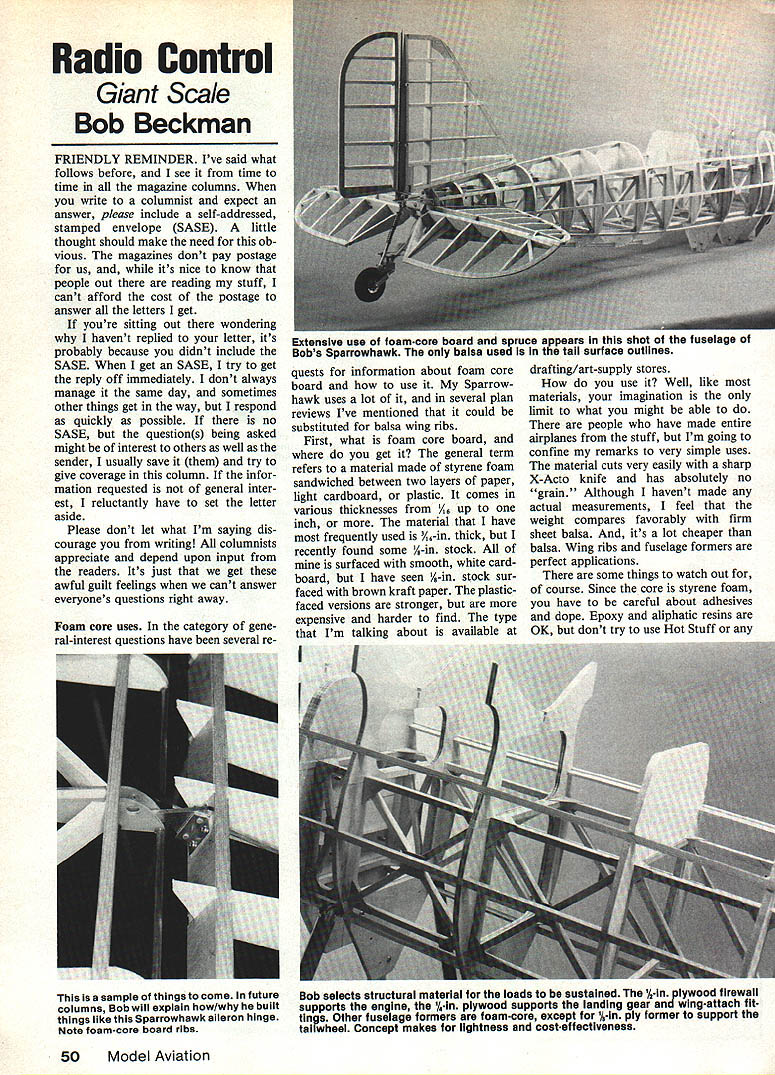
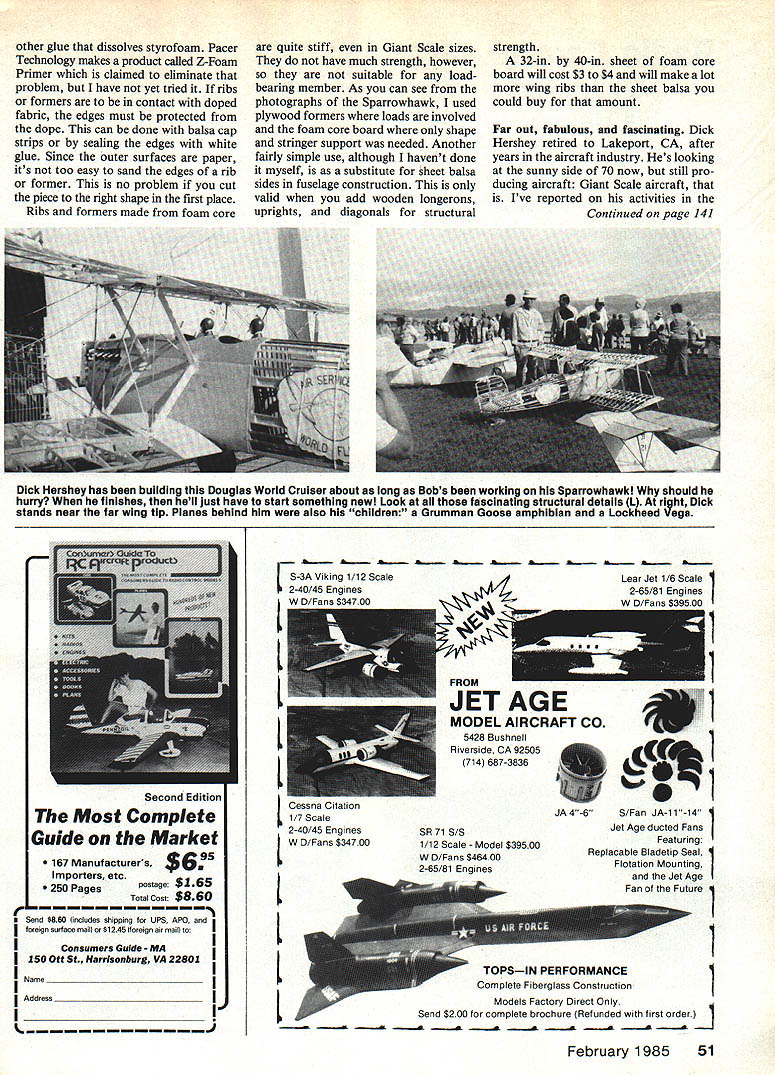
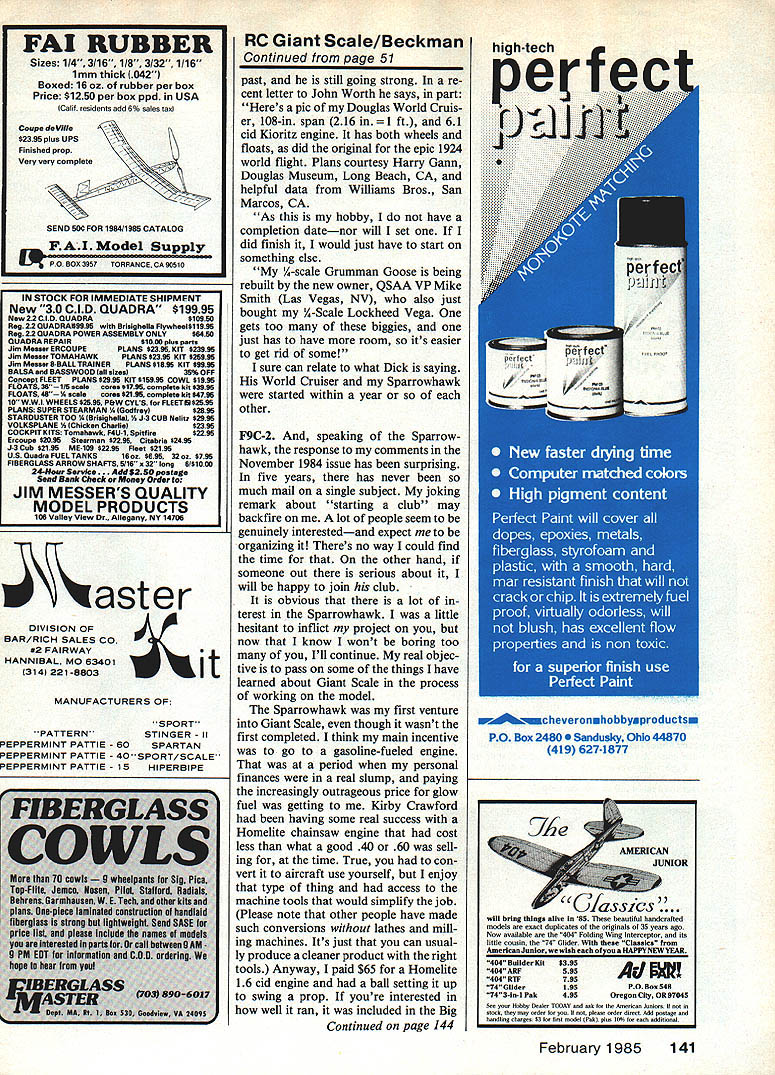
Since the outer surface is paper, it's too easy to sand away the edges. Ribs and formers are no problem if you cut the piece to the right shape in the first place. Ribs and formers made from foam core are quite stiff. In giant-scale sizes they do have strength; however, they are not suitable as load-bearing members. As you can see in the photographs, the Sparrowhawk used plywood formers where the loads involved demanded it, and foam-core board was used where shape and stringer support were needed.
Another fairly simple use, although I haven't done it myself, is to substitute sheet foam core for sides in fuselage construction. It would be wise to add wooden longerons, uprights, and diagonals for structural strength. A 32-in. by 40-in. sheet of foam core board will cost about $3 to $4 and will make a lot of wing ribs; the equivalent amount of sheet balsa would cost considerably more.
Far out, fabulous, and fascinating
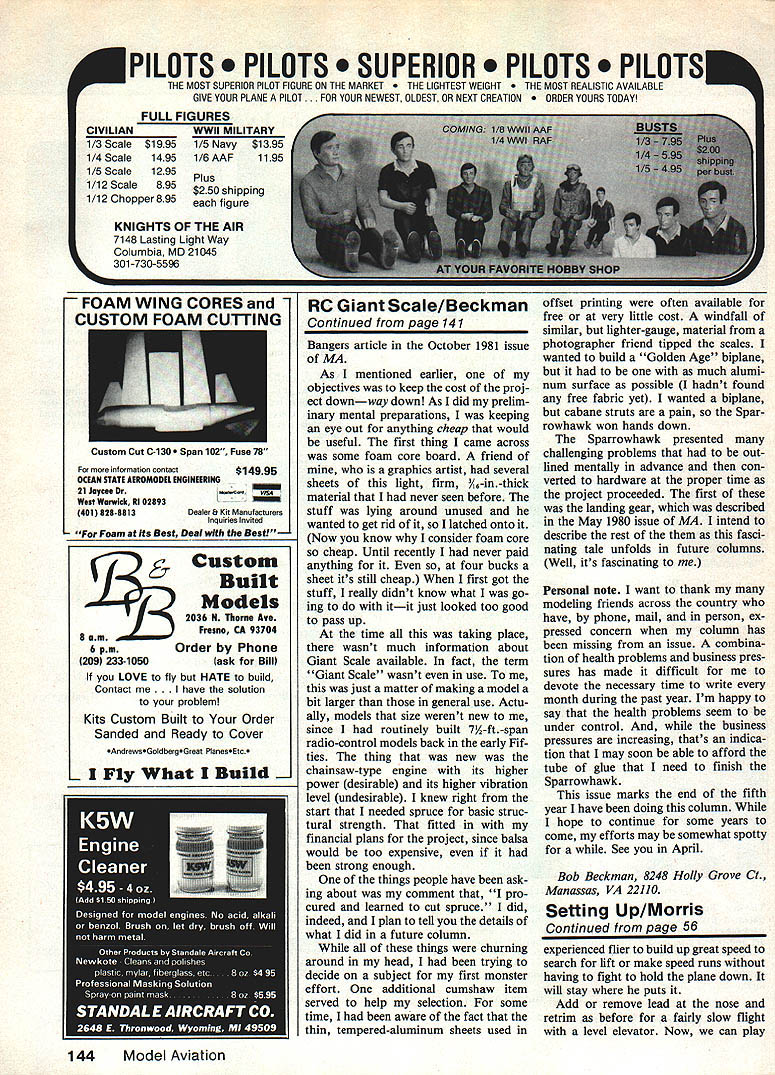
Dick Hershey retired to Lakeport, CA, after years in the aircraft industry. He's looking at the sunny side of 70 now, but still producing aircraft: Giant Scale aircraft. I've reported on his activities in the past, and he is still going strong. In a recent letter to John Worth he says, in part:
"Here's a pic of my Douglas World Cruiser, 108-in. span (about 2.74 m, 9 ft.), and 6.1 cid Kioritz engine. It has both wheels and floats, as did the original for the epic 1924 world flight. Plans courtesy Harry Gann, Douglas Museum, Long Beach, CA, and helpful data from Williams Bros., San Marcos, CA.
"As this is my hobby, I do not have a completion date—nor will I set one. If I did finish it, I would just have to start on something else.
"My 1/4-scale Grumman Goose is being rebuilt by the new owner, QSAA VP Mike Smith (Las Vegas, NV), who also just bought my 1/4-scale Lockheed Vega. One gets too many of these biggies, and one just has to have more room, so it's easier to get rid of some!"
I sure can relate to what Dick is saying. His World Cruiser and my Sparrowhawk were started within a year or so of each other.
F9C-2 (Sparrowhawk)
And, speaking of the Sparrowhawk, the response to my comments in the November 1984 issue has been surprising. In five years, there has never been so much mail on a single subject. My joking remark about "starting a club" may backfire on me. A lot of people seem to be genuinely interested—and expect me to be organizing it! There's no way I could find the time for that. On the other hand, if someone out there is serious about it, I will be happy to join his club.
It is obvious that there is a lot of interest in the Sparrowhawk. I was a little hesitant to inflict my project on you, but now that I know I won't be boring too many of you, I'll continue. My real objective is to pass on some of the things I have learned about Giant Scale in the process of working on the model.
The Sparrowhawk was my first venture into Giant Scale, even though it wasn't the first completed. I think my main incentive was to go to a gasoline-fueled engine. That was at a period when my personal finances were in a real slump, and paying the increasingly outrageous price for glow fuel was getting to me. Kirby Crawford had been having some real success with a Hemi-lite chainsaw engine that had cost less than what a .40 or .60 was selling for at the time. True, you had to convert it to aircraft use yourself, but I enjoy that type of thing and had access to the machine tools that would simplify the job. (Please note that other people have made such conversions without lathes and milling machines. It's just that you can usually produce a cleaner product with the right tools.) Anyway, I paid $65 for a Homelite 1.6 cid engine and had a ball setting it to swing a prop. If you're interested in how well it ran, it was included in the "Big Bangers" article in the October 1981 issue of MA.
As I mentioned earlier, one of my objectives was to keep the cost of the project down—way down! As I did my preliminary mental preparations, I was keeping an eye out for anything cheap that would be useful. The first thing I came across was some foam core board. A friend of mine, who is a graphics artist, had several sheets of this light, firm, 3/16-in.-thick material that I had never seen before. The stuff was lying around unused and he wanted to get rid of it, so I latched onto it. (Now you know why I consider foam core so cheap. Until recently I had never paid anything for it. Even so, at four bits per sheet it's still cheap.) When I first got the stuff, I really didn't know what I was going to do with it—"it just looked too good to pass up."
At the time all this was taking place, there wasn't much information about Giant Scale available. In fact, the term "Giant Scale" wasn't even in use. To me, this was just a matter of making a model a bit larger than those in general use. Actually, models that size weren't new to me, since I had routinely built 7-1/2-ft.-span radio-control models back in the early Fifties. The thing that was new was the chainsaw-type engine with its higher power (desirable) and its higher vibration level (undesirable). I knew right from the start that I needed spruce for basic structural strength. That fitted in with my financial plans for the project, since balsa would be too expensive, even if it had been strong enough.
One of the things people have been asking about was my comment that, "I procured and learned to cut spruce." I did, indeed, and I plan to tell you the details of what I did in a future column.
While all of these things were churning around in my head, I had been trying to decide on a subject for my first monster effort. One additional consideration served to help my selection. For some time, I had been aware of the fact that the thin, tempered-aluminum sheets used in offset printing were often available for free or at very little cost. A windfall of similar, but lighter-gauge, material from a photographer friend tipped the scales. I wanted to build a "Golden Age" biplane, but it had to be one with as much aluminum surface as possible (I hadn't found any free fabric yet). I wanted a biplane, but cabane struts are a pain, so the Sparrowhawk won hands down.
The Sparrowhawk presented many challenging problems that had to be outlined mentally in advance and then converted to hardware at the proper time as the project proceeded. The first of these was the landing gear, which was described in the May 1980 issue of MA. I intend to describe the rest of them as this fascinating tale unfolds in future columns. (Well, it's fascinating to me.)
Personal note
I want to thank my many modeling friends across the country who have, by phone, mail, and in person, expressed concern when my column has been missing from an issue. A combination of health problems and business pressures has made it difficult for me to devote the necessary time to write every month during the past year. I'm happy to say that the health problems seem to be under control, and while the business pressures are increasing, that's an indication that I may soon be able to afford the time to glue that I need to finish the Sparrowhawk.
This issue marks the end of the fifth year I have been doing this column. While I hope to continue for some years to come, my efforts may be somewhat spotty for a while. See you in April.
Bob Beckman 8248 Holly Grove Ct. Manassas, VA 22110.
Transcribed from original scans by AI. Minor OCR errors may remain.

