
Radio Control: Giant Scale
Bob Beckman GUEST COLUMNIST
This month I am going to turn most of my space over to John Hunton. Several years ago, before Giant Scale really became popular and well known, John was working with engines for RPVs. Before most of us had ever run across the idea of using chainsaw engines in our models, John was, on a daily basis, solving the problems involved. As a result, he is well qualified to tell us . . .
How to Rig Pumping Carburetors for Flight
by John Hunton
Industrial-type engines now popular for the larger model aircraft are equipped with carburetors that are not designed to operate in the dynamic environment of flight. These notes explain what problems those carburetors experience and how to solve them.
Problem No. 1: Intake blow-off. Most engines of interest are reed-valve type. (Note: John is not quite correct in that statement. Just as many, and maybe more, of our big bangers are piston-ported — the Quadras are prime examples. However, the conditions John is describing can exist with both types of engine.)
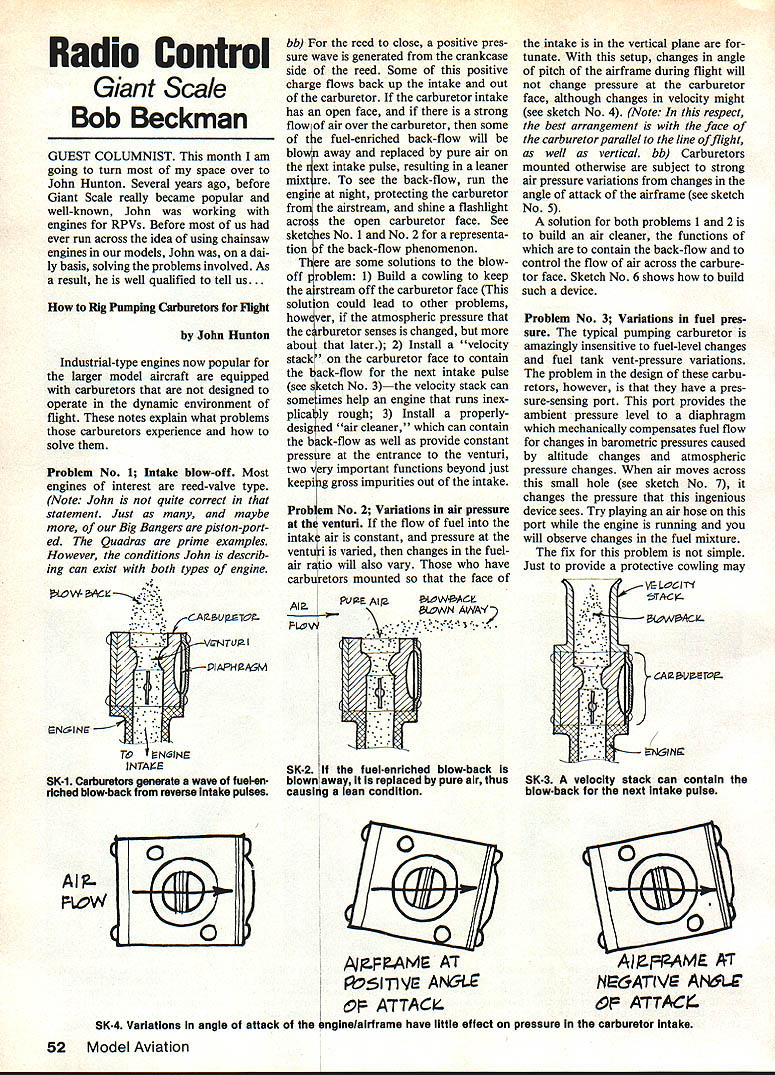
For the reed to close, a positive pressure wave is generated from the crankcase side of the reed. Some of this positive charge flows back up the intake and out of the carburetor. If the carburetor intake has an open face, and if there is a strong flow of air over the carburetor, then some of the fuel-enriched back-flow will be blown away and replaced by pure air on the next intake pulse, resulting in a leaner mixture. To see the back-flow, run the engine at night, protecting the carburetor from the airstream, and shine a flashlight across the open carburetor face. See sketches No. 1 and No. 2 for a representation of the back-flow phenomenon.
There are some solutions to the blow-off problem:
- Build a cowling to keep the airstream off the carburetor face. (This solution could lead to other problems, however, if the atmospheric pressure that the carburetor senses is changed — more about that later.)
- Install a velocity stack on the carburetor face to contain the back-flow for the next intake pulse — the velocity stack can sometimes help an engine that runs inexplicably rough.
- Install a properly designed air cleaner, which can contain the back-flow as well as provide constant pressure at the entrance to the venturi — two very important functions beyond just keeping gross impurities out of the intake.
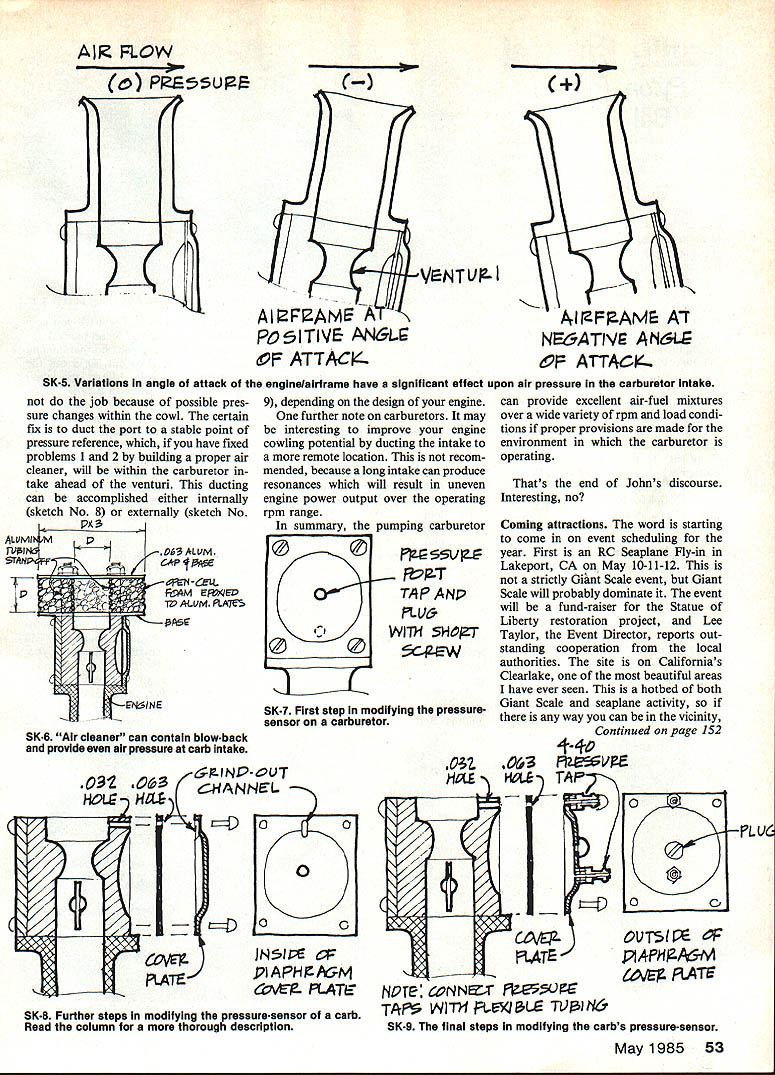
Problem No. 2: Variations in air pressure at the venturi. If the flow of fuel into the intake air is constant, and pressure at the venturi is varied, then changes in the fuel-air ratio will also occur. Those who have carburetors mounted so that the face of the intake is in the vertical plane are fortunate. With this setup, changes in angle of pitch of the airframe during flight will not change pressure at the carburetor face, although changes in velocity might (see sketch No. 4). (Note: In this respect, the best arrangement is with the face of the carburetor parallel to the line of flight, as well as vertical.) Carburetors mounted otherwise are subject to strong air pressure variations from changes in the angle of attack of the airframe (see sketch No. 5).
A solution for both problems 1 and 2 is to build an air cleaner. Its functions are to contain the back-flow and to control the flow of air across the carburetor face. Sketch No. 6 shows how to build such a device.
Problem No. 3: Variations in fuel pressure. The typical pumping carburetor is amazingly insensitive to fuel-level and fuel tank vent-pressure variations. The problem in the design of these carburetors, however, is that they have a pressure-sensing port. This port provides the ambient pressure level to a diaphragm which mechanically compensates fuel flow for changes in barometric pressure caused by altitude changes and atmospheric pressure changes. When air moves across this small hole (see sketch No. 7), it changes the pressure that this ingenious device senses. Try playing an air hose on this port while the engine is running and you will observe changes in the fuel mixture.
The fix for this problem is not simple. Just providing a protective cowling may not do the job because of possible pressure changes within the cowl. The certain fix is to duct the port to a stable point of pressure reference, which, if you have fixed problems 1 and 2 by building a proper air cleaner, will be within the carburetor intake ahead of the venturi. This ducting can be accomplished either internally (sketch No. 8) or externally (sketch No. 3) depending on the design of your engine.
One further note on carburetors: it may be tempting to improve your engine cowling by ducting the intake to a more remote location. This is not recommended, because a long intake can produce resonances which will result in uneven engine power output over the operating rpm range.
In summary, the pumping carburetor can provide excellent air-fuel mixtures over a wide variety of rpm and load conditions if proper provisions are made for the environment in which the carburetor is operating.
That's the end of John's discourse. Interesting, no?
Sketch captions
- SK-1. Carburetors generate a wave of fuel-enriched blow-back from reverse intake pulses.
- SK-2. If the fuel-enriched blow-back is blown away, it is replaced by pure air, thus causing a lean condition.
- SK-3. A velocity stack can contain the blow-back for the next intake pulse.
- SK-4. Variations in angle of attack of the engine/airframe have little effect on pressure in the carburetor intake.
- SK-5. Variations in angle of attack of the engine/airframe have a significant effect upon air pressure in the carburetor intake.
- SK-6. An air cleaner can contain blow-back and provide even air pressure at the carburetor intake.
- SK-7. First step in modifying the pressure-sensor on a carburetor.
- SK-8. Further steps in modifying the pressure-sensor of a carburetor. Read the column for a more thorough description.
- SK-9. The final steps in modifying the carburetor's pressure-sensor.
Coming attractions Don't miss this one. For information contact Lee Taylor, 216 Willow Ave., Roseville, CA 95678; his phone number is (916) 783-4190.
- RC Seaplane Fly-in, Lakeport — May 10–12. This is not a strictly Giant Scale event, but Giant Scale will probably dominate it. The event will be a fund-raiser for the Statue of Liberty restoration project, and Lee Taylor, the event director, reports outstanding cooperation from the local authorities. The site is on California's Clear Lake, one of the most beautiful areas I have ever seen. This is a hotbed of both Giant Scale and seaplane activity, so if there is any way you can be in the vicinity, try to attend.
- STARS Scale Rally, Olean, NY — July 6–7. One of my all-time favorite events. This is another event not limited to Giant Scale, but you don't see much else there. The flying site and the hospitality are fantastic.
- IMAA Fun-Fly Festival (IMAA bash), Mobile, AL — July 18–21. This is the fifth year for the event; note the change from August to July. Like the Nats, the FFF rotates locations each year, which gives IMAA members around the country a chance to participate. From what I'm hearing, this will be another great one. More information from Don Godfrey, 91 Blackstone Ave., Binghamton, NY 13903; telephone (607) 724-0115.
Bob Beckman 8248 Holly Grove Ct. Manassas, VA 22110
Transcribed from original scans by AI. Minor OCR errors may remain.

