
Radio Control: Giant Scale
Bob Beckman
Sparrowhawk wings
Not all of the letters I've received in response to my Sparrowhawk articles have been complimentary. I'm happy to report that the roses far outnumber the brickbats, though most people are more likely to write when they're unhappy, so I figure I'm way ahead of the game.
Even the brickbats are, for the most part, friendly in intent. One letter took exception to some statements I made about choosing the Sparrowhawk as a subject. I had noted that few modelers have taken the F9C-2 as a subject, even though it was a contemporary of—and just as colorful as—the P6-E. I went on to say, "It is a more difficult subject, from both the building and flying standpoint. Gull wing roots, extensive and complicated strut fairings, and short nose moment are just a few of the factors involved." I also commented on "uncertain flight characteristics," to which my correspondent objected.
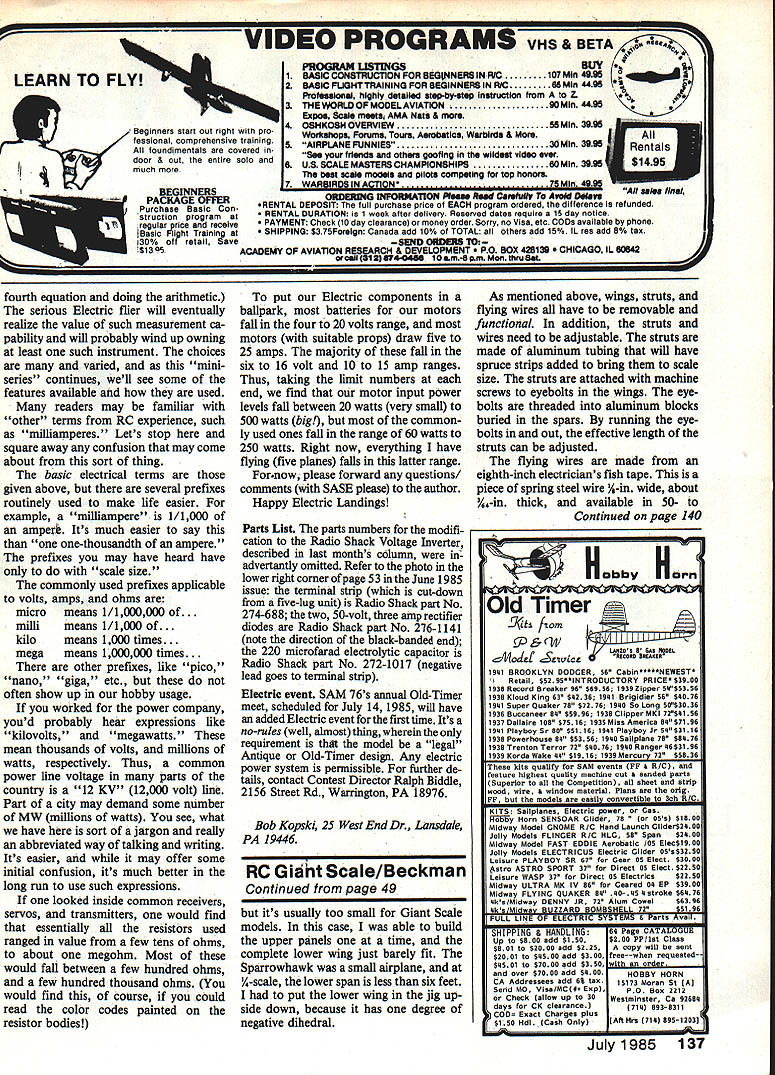
His comments help illustrate what I went through in selecting the Sparrowhawk and designing its wing construction. He reminded me that he had built rubber-powered Sparrowhawks in the Thirties and dismissed the modern modeler's worry about flight characteristics. He downplayed the difficulty of strut fairings, and argued that gull center-sections are advantageous because the upper wing can be built in one piece and attached without cabane struts. Finally, he suggested that, not being a Giant Scale builder, he perhaps didn't appreciate the problems of building airplanes that must come apart to fit in a car.
Why quarter-scale is different
There is a real difference between a small, lightweight rubber-powered model and a 20-pound, 1/4-scale model, even when both are based on the same aircraft. They can be equally challenging and rewarding, but the problems are different.
Fillets and strut fairings illustrate this contrast clearly:
- On a small model, some fillets can be omitted or reduced to simple silhouettes without being noticeable. The small model generally doesn't break apart intentionally, so fillets can be fixed in place and the process is relatively simple, though tedious.
- On a quarter-scale model, the fillets must be present for the finished product to look right. At this size, all fillets are noticeable and most must be removable because the wings and struts have to come off for transportation or repair. Fillets also cover attachment points for the struts and, in some cases, the landing gear.
There are 20 strut fairings on the Sparrowhawk, no two identical. The fillets must be lightweight—nobody wants a 20-pound airplane with five pounds of fillets—yet durable and replaceable. I decided to vacuum-form them from sheet styrene. That requires carving more than 20 plugs (some fillets are two-piece), but it makes replacement of damaged ones easy.
Gull wing and wing attachment
I agree with my critic about the advantages of the gull center-section; that was one reason I picked the Sparrowhawk. I love biplanes but hate cabane struts. Even so, I never considered making the upper wing a single piece, though at 1/4-scale it's only a bit over six feet in span. From the start I planned two panels attached to the fuselage gull section at the scale hinge points.
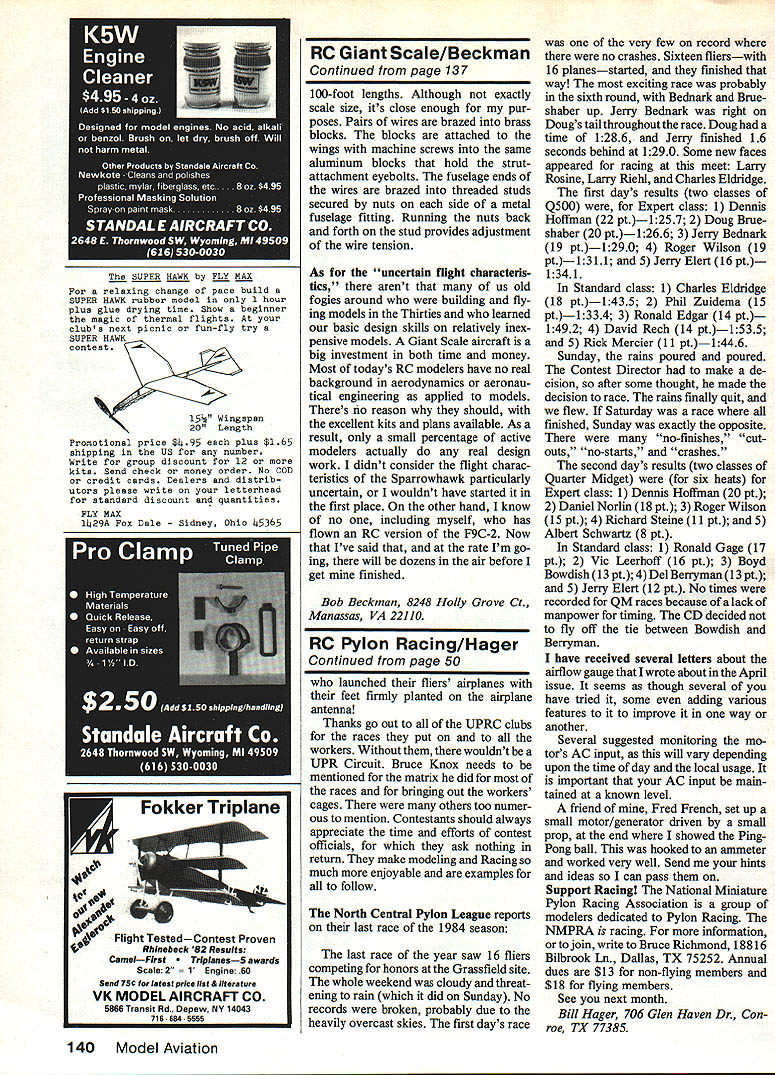
My solution to the attachment problem is shown in one of the photos: a spring-loaded pin (like an overgrown watchband pin) holds each wing panel to the fuselage. Of course the struts and flying wires are functional—this is not an ornithopter.
The lower wing is one piece, even though the original had two panels attached in the same manner as the upper wing. My thinking was that I would need access to the radio gear anyway, so I mounted the lower wing like a conventional low-wing R/C model. As it turned out, I needed access through removable skin panels on the upper center section anyway, so I could have made the lower wing in two panels, but I was too far along to change it.
Wing construction and materials
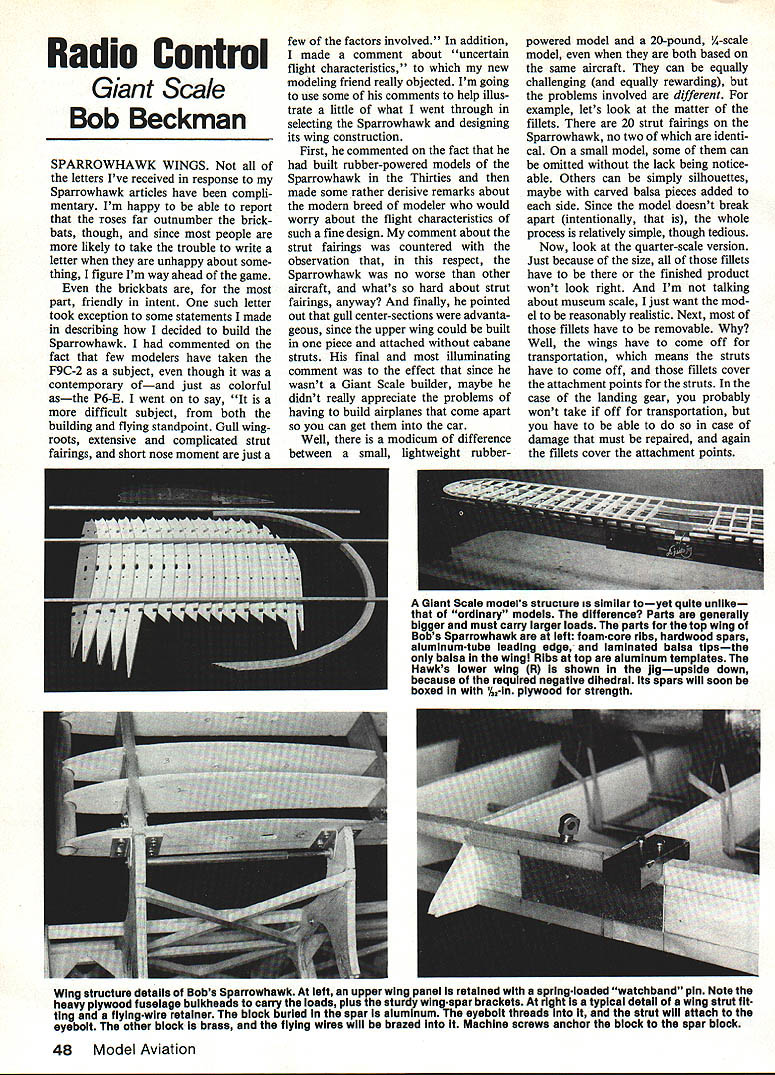
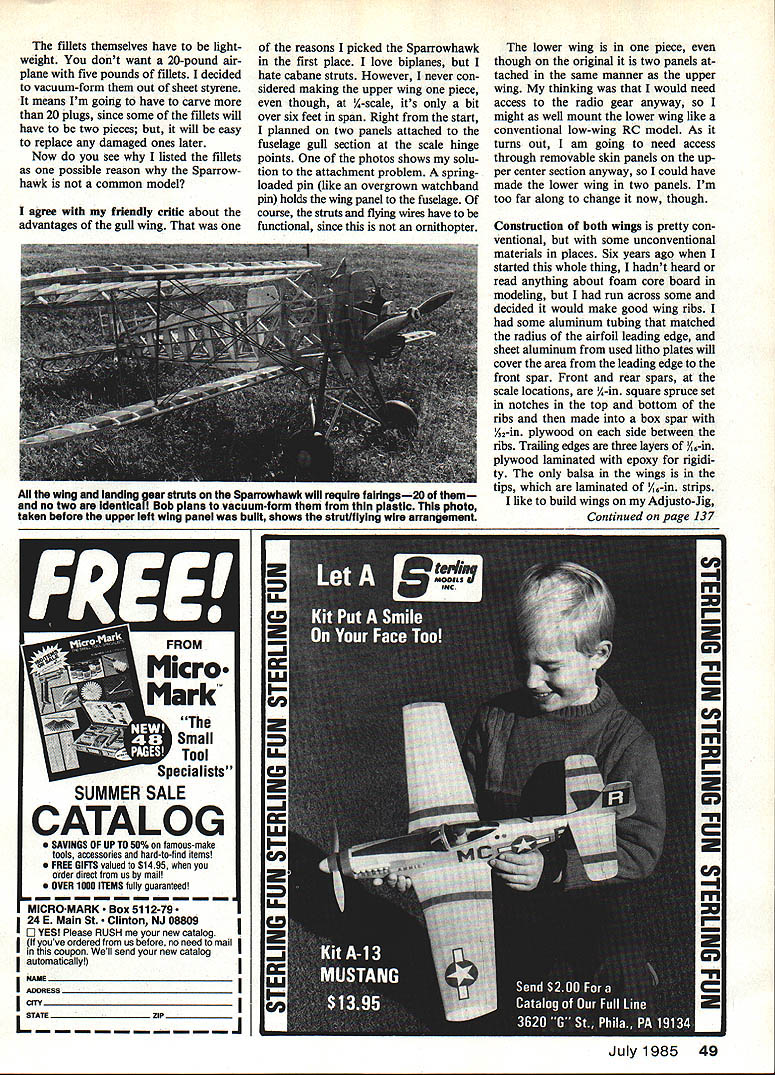
Construction of both wings is pretty conventional, but with some unconventional materials used in places. Six years ago, when I started this project, I hadn't heard much about foam-core board in modeling, but I found some and used it for wing ribs.
Key structural details:
- Ribs: foam-core board (cut from aluminum templates for accuracy).
- Leading edge: aluminum tubing matching the radius of the airfoil leading edge.
- Front and rear spars: 1/4-in. square spruce, set in notches in the top and bottom of the ribs at the scale locations; spars are made into a box spar with 1/8-in. plywood on each side between the ribs.
- Trailing edge: three layers of 1/8-in. plywood laminated with epoxy for rigidity.
- Tips: laminated balsa made from 1/16-in. strips; otherwise little balsa in the wings.
- Skinning around the leading edge: sheet aluminum from used lube plates covers the area from the leading edge to the front spar in places.
I like to build wings on my Adjusto-Jig, though it's usually too small for Giant Scale models. In this case I was able to build the upper panels one at a time and the complete lower wing just barely fit. The Sparrowhawk is a small airplane, and at 1/4-scale the lower span is less than six feet. I had to put the lower wing in the jig upside down because it has one degree of negative dihedral. After assembly, the spars were boxed with 1/8-in. plywood for strength.
Bracing and flying wires
The flying wires are brazed in pairs into brass blocks. The blocks are attached to the wings with machine screws into the same aluminum fittings that hold the strut-attachment eyebolts. The fuselage ends of the wires are brazed into threaded studs secured by nuts on each side of a metal fuselage fitting. Running the nuts back and forth on the stud provides adjustment of the wire tension.
Flight characteristics and final thoughts
As for the "uncertain flight characteristics," there aren't many of us left who were building and flying models in the Thirties and learned basic design skills on inexpensive models. A Giant Scale aircraft is a big investment in both time and money. Most of today's RC modelers have no formal background in aerodynamics or aeronautical engineering as applied to models—and there's no reason they should, given the excellent kits and plans available. As a result, only a small percentage of active modelers actually do any real design work.
I didn't consider the flight characteristics of the Sparrowhawk particularly uncertain; otherwise I wouldn't have started it. On the other hand, I know of no one, including myself, who has flown an R/C version of the F9C-2. Now that I've said that, and at the rate I'm going, there will probably be dozens in the air before I get mine finished.
Bob Beckman 8248 Holly Grove Ct. Manassas, VA 22110
Transcribed from original scans by AI. Minor OCR errors may remain.

