
Radio Control: Giant Scale
Bob Beckman
Guest Columnists
So far this year, business pressures have made it impossible for me to get to any fly-ins. Unfortunately, it doesn't look like that is going to change any time soon, so I've asked some other people to provide some input on what is going on out there. This month, Joan and Dale Alyea of Pueblo, CO are bailing me out. This is a husband-and-wife team who have been active modelers for many years. They got into Giant Scale early, and Dale has been their District's IMAA rep since the first IMAA election. I was particularly interested in this report, since I am originally from Denver, and all of my early modeling was done at mile-high altitudes.
High-Altitude Flying
by Joan and Dale Alyea
"High-altitude flying!" — words strong enough to create a good case of nerves in RC fliers who operate reasonably close to sea level. Flying Giant Scale aircraft at higher altitudes does go on—successfully—and plenty of it in the Rocky Mountain States.
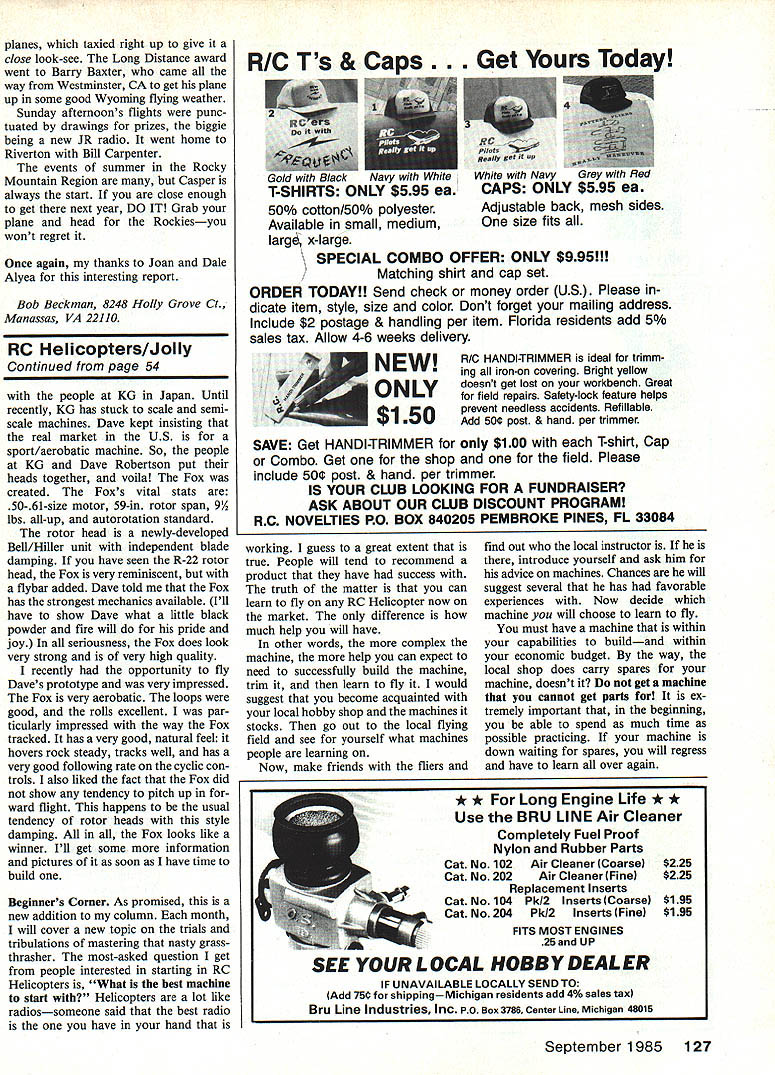
We admit that there are a few secrets to flying Giant Scale aircraft at altitudes from 5,000 to 9,000 feet above sea level. We build for lightness as well as strength, and we use engines that are a bit heftier in power than what the plans call for. For example, we are flying our Balsa U.S.A. Fly Baby biplane with a Sachs-Dolmar 3.1 instead of the Quadra 35 that would be a good choice at lower altitudes. The plane doesn't go a whole lot faster, but we have more power to pull through maneuvers, as well as greater stability at our high altitudes. We learned this lesson in our younger days with .60-size Pattern jobs, and we have never let ourselves forget it.
The 400- to 600-foot runways at most of the flying sites in the Rocky Mountain states assure safe flying, too. It does get hot in these parts during our summer flying months, and (having learned our density-altitude lessons well) we know our planes are going to eat up a lot more runway on takeoffs and landings as the temperature goes up.
There has been no shortage of high-altitude competitions and fun-flies this summer, and a large percentage of the aircraft we see at these events are Giant Scale. The Memorial Day weekend started us off on the 1985 flying season with much enthusiasm. It has become a "must" on everybody's flying calendar. Judging from the number of people and planes we saw, we aren't sure that there were a whole lot of Giant Scale fliers who stayed home that weekend.
Casper Fly-In (Memorial Day Event)
Now, Casper's field is high altitude, just 50 feet short of a real Wyoming mile. There is a 560-foot by 50-foot paved runway, plus a diagonal runway, and a third runway already graded out which will be paved and ready next year. Casper's city fathers are definitely good friends to RC. The city provided the site and a large chunk of the improvements, and local businesses donate a lot of the wherewithal for getting trophies and merchandise prizes. This is one city where there is no problem in getting the local newspaper and television people to come out and see what's going on, and they come up with some excellent publicity for model aviation. The Casper Aeromodelers have the best of all possible worlds on this count!
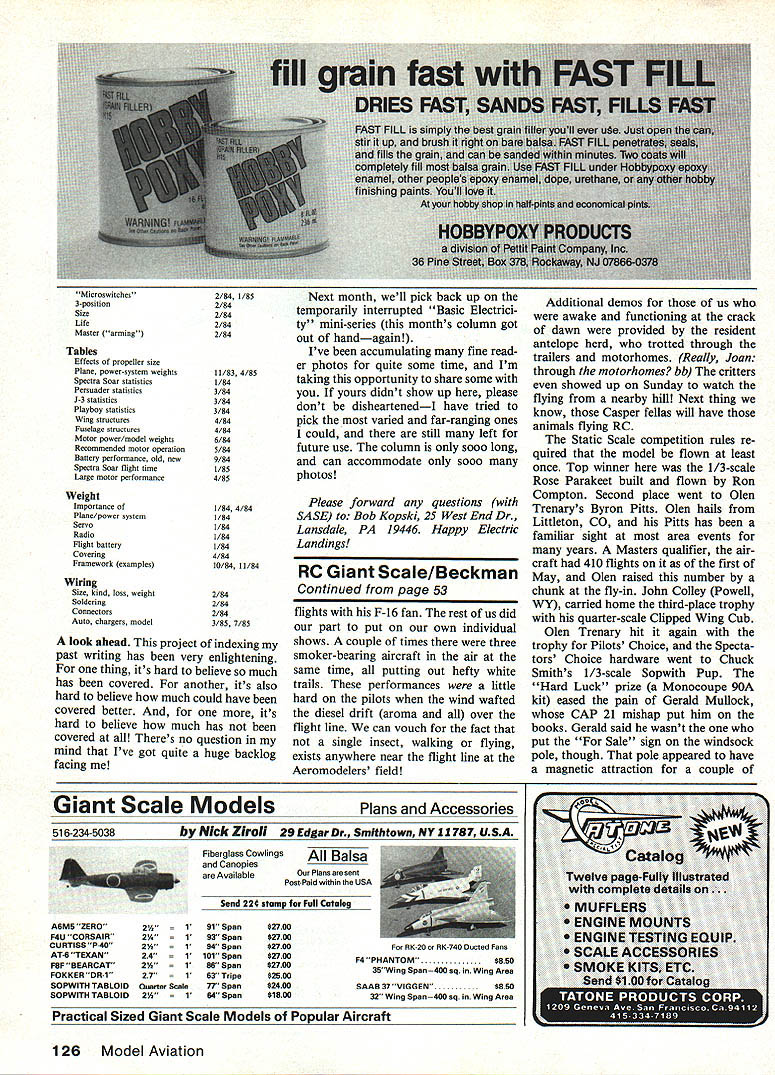
Springtime in the Rockies can sometimes be an iffy situation when it comes to good flying weekends, but there was no "iffy" about that weekend. Winds dropped fairly early in the morning, and we had pretty close to ideal weather in which to take our big birds up. During the weekend, 174 flights were logged by 54 entrants, who put somewhere in the neighborhood of 90 planes on the line. Among the fliers were members of the Colorado IMAA Show Team and two AMA Air Show Teams: the Denver Air Show Team (known as DAS Team), and the High Country Barnstormers from Colorado Springs.
Powerplants and Demonstrations
The power requirements of flight at a mile above sea level were met by, among others:
- Sachs-Dolmars (both 3.1 and 3.7)
- Kings
- Tartan Twins
These big mills were able to haul the aircraft easily through everything from loops to Lomcevaks with nary a second of hesitation.
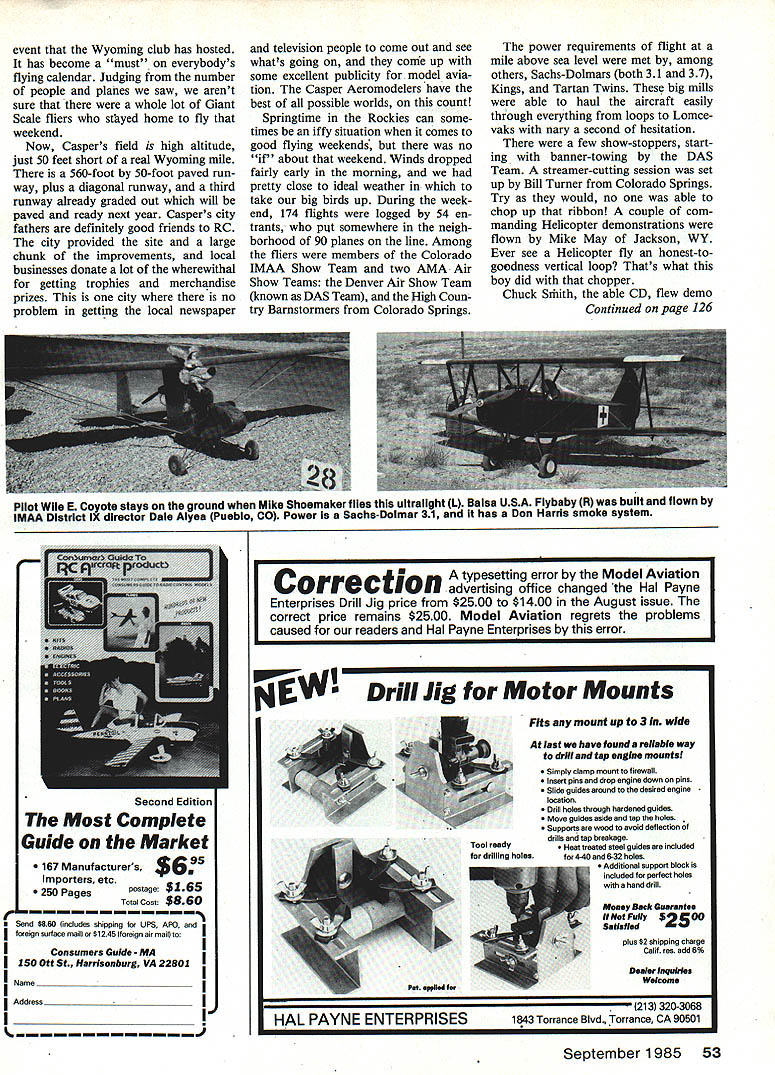
There were a few show-stoppers, starting with banner-towing by the DAS Team. A streamer-cutting session was set up by Bill Turner from Colorado Springs. Try as they would, no one was able to chop up that ribbon! A couple of commanding helicopter demonstrations were flown by Mike May of Jackson, WY. Ever see a helicopter fly an honest-to-goodness vertical loop? That's what he did with that chopper.
Chuck Smith, the able CD, flew demo flights with his F-16 fan. The rest of us did our part to put on our own individual shows. A couple of times there were three smoke-bearing aircraft in the air at the same time, all putting out hefty white trails. These performances were a little hard on the pilots when the wind wafted the diesel drift (aroma and oil) over the flight line. We can vouch for the fact that not a single insect, walking or flying, exists anywhere near the flight line at the Aeromodelers' field!
Additional demos for those of us who were awake and functioning at the crack of dawn were provided by the resident antelope herd, who trotted through the trailers and motorhomes. (Really, Joan: through the motorhomes?) But the critters even showed up on Sunday to watch the flying from a nearby hill!
Static Scale Competition and Awards
The Static Scale competition rules required that the model be flown at least once. Winners included:
- Top winner: Ron Compton, 1/3-scale Rose Parakeet (built and flown by Ron)
- Second place: Olen Trenary, Byron Pitts (Olen hails from Littleton, CO; his Pitts had 410 flights as of May 1 and he added many more during the fly-in)
- Third place: John Colley (Powell, WY), quarter-scale Clipped Wing Cub
Other awards:
- Pilots' Choice: Olen Trenary
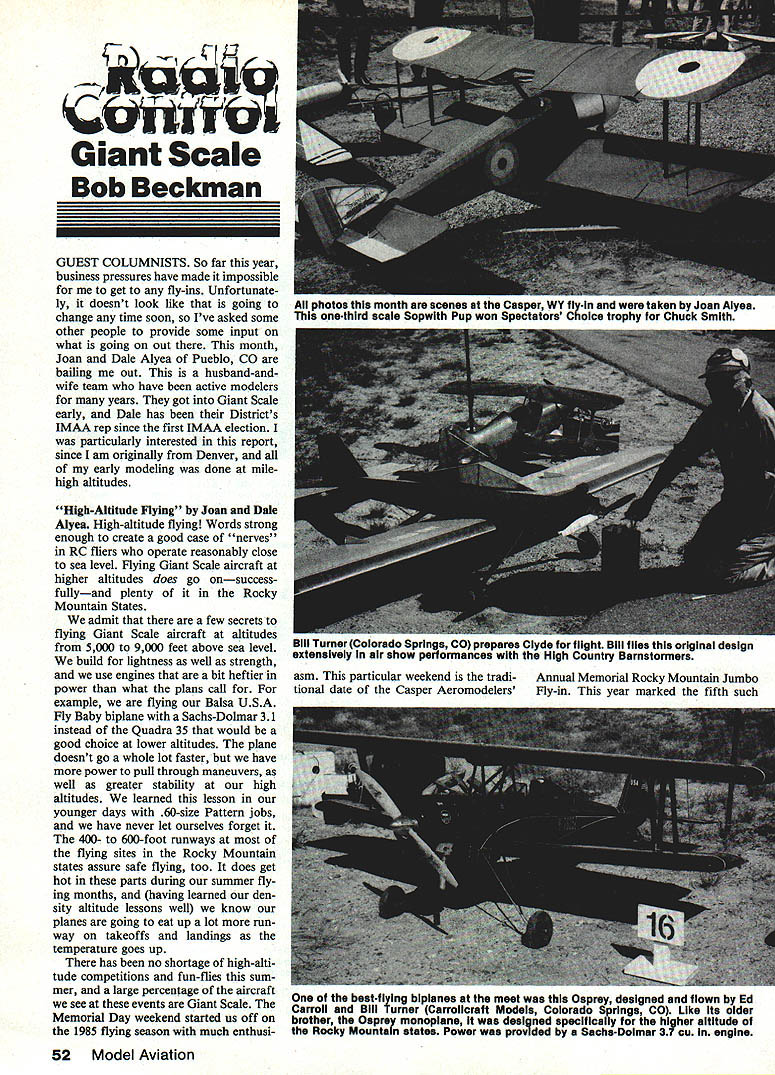
- Spectators' Choice: Chuck Smith's 1/3-scale Sopwith Pup
- "Hard Luck" prize (a Monocoupe 90A kit): Gerald Mullock, whose CAP 21 mishap put him on the books. Gerald said he wasn't the one who put the "For Sale" sign on the windsock pole, though. That pole appeared to have a magnetic attraction for a couple of planes, which taxied right up to give it a close look-see.
- Long Distance award: Barry Baxter, who came all the way from Westminster, CA
Sunday afternoon's flights were punctuated by drawings for prizes, the biggie being a new JR radio. It went home to Riverton with Bill Carpenter.
The events of summer in the Rocky Mountain Region are many, but Casper is always the start. If you are close enough to get there next year, DO IT! Grab your plane and head for the Rockies—you won't regret it.
Once again, my thanks to Joan and Dale Alyea for this interesting report.
Bob Beckman 8248 Holly Grove Ct., Manassas, VA 22110
Transcribed from original scans by AI. Minor OCR errors may remain.

