
GIANT SCALE
Bob Beckman
Mail Call
I've been getting a lot of mail, and I'm going to catch up with some of it this month. If you're still waiting on an answer and don't see it here, hang in there. I will respond.
One of the first to write was Johnny Burnett of Portland, OR. We've had a couple of exchanges now; here's part of his second letter:
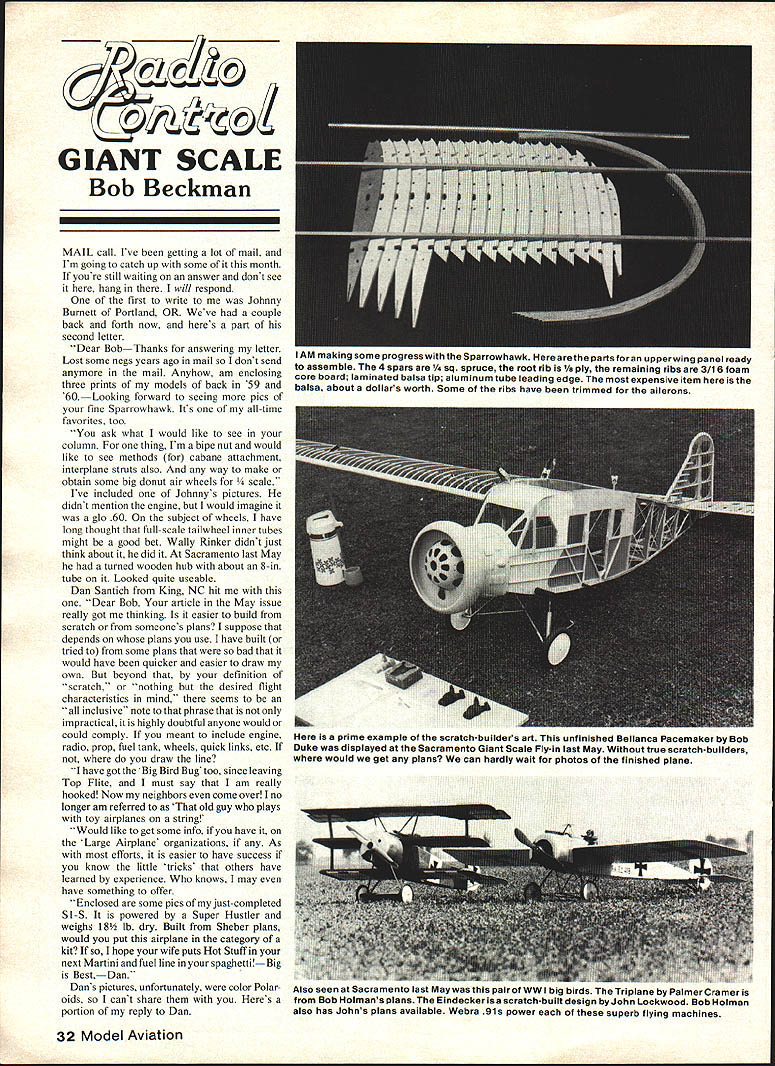
"Dear Bob—Thanks for answering my letter. Lost some negs years ago in the mail so I don't send anymore in the mail. Anyhow, am enclosing three prints of my models back in '59 and '60—Looking forward to seeing more pics of your fine Sparrowhawk. It's one of my all-time favorites, too.
You ask what I would like to see in your column. For one thing, I'm a bipe nut and would like to see methods for cabane attachment and interplane struts also. And any way to make or obtain some big donut air wheels 1/4-scale. I've included one of Johnny's pictures. He didn't mention the engine, but I would imagine it was a .60 glow. On the subject of wheels, I have long thought that full-scale tailwheel inner tubes might be a good bet. Wally Rinker didn't just think about it; at Sacramento last May he had a turned wooden hub with about an 8‑in. tube on it. Looked quite usable."
Dan Santich from King, NC wrote:
"Dear Bob. Your article in the May issue really got me thinking. Is it easier to build from scratch or from someone's plans? I suppose that depends on whose plans you use. I have built (or tried to) from some plans that were so bad that it would have been quicker and easier to draw my own. But beyond that, by your definition of 'scratch' or 'nothing but the desired flight characteristics in mind,' there seems to be an 'all-inclusive' note to that phrase that is not only impractical, it is highly doubtful anyone would or could comply. If you meant to include engine, radio, prop, fuel tank, wheels, quick links, etc., draw the line—you draw the line."
"To finish, add I must say that I am really hooked! Now my neighbors even come over! I no longer am referred to as 'that old guy who plays with toy airplanes on a string.'
Would like to get some info, if you have it, on the 'Large Airplane' organizations, if any. As with most efforts, it is easier to have success if you know the little 'tricks' others have learned by experience. Who knows, I may even have something to offer.
Enclosed are some pics of my just-completed SI‑S. It is powered by a Super Hustler and weighs 18½ lb. dry. Built from Sheber plans, I would put this airplane in the kit category. If so, I hope your wife puts Hot Stuff in your next Martini and fuel line in your spaghetti! — Big is Best... Dan."
Dan's pictures were color Polaroids, so I couldn't share them. Here is a portion of my reply to Dan:
Dear Dan—Thanks for the letter. It's nice to know someone out listening. From your comments it's obvious I didn't quite express myself completely. What I'm saying is: an average plane built from a kit requires a certain set of skills; an average plane built from plans requires some additional skills to develop the plans the plane can be built from and requires skills to maintain step-by-step. Plan-built, scratch-built, kit-built — these are not the same. No way can a plane built from Sheber plans be in the same category as a kit-built plane. I don't think I implied anything like that; I think you're pulling my leg about 'scratch.' However, I know modelers do everything, including designing and building engine fittings from scratch. Oh, come to think of it, builders didn't metal-cut down trees, so I guess they weren't really scratch-built.
All kidding aside, I think the term 'scratch-built' can reasonably allow the use of pre-existing components; it depends what you mean by scratch-building. For example, it is reasonable to include a commercially available engine in a scratch design airplane. Assembling a GHQ engine kit didn't give a scratch-built engine; in fact, seldom did anyone give that kind of engine. I don't mean to imply a scratch-built plane is automatically better. Like anything else, it depends how well it does. I've done a lot of scratch-building over the years, both original designs and scale successful ones; certainly in the majority I at least learned something.
Dan's query about big-bird organizations is a common one. Of those I know:
- Quarter Scale Association of America (QSAA) — the older and better known. They restrict their activities to one-quarter-size scale replicas of existing man-carrying aircraft, and their constitution requires that all officers of the association reside in the Las Vegas, NV area.
- Address: c/o Pat Bunker, 6532 Bourbon Way, Las Vegas, NV 89107
- Miniature Aircraft Society (MAS) — dedicated to the advancement and enjoyment of all kinds of big birds. They have a president (Don Godfrey of Super Stearman fame) and an 11-member board of representatives with members from throughout the U.S. and Canada, and one member from France.
- Address: c/o Godfrey & Son Music, 254 Washington St., Binghamton, NY 13901
Send $10.00 to either or both, and they'll make you a card-carrying member.
Thistledown Flyers again. Last month I told you about the Aug. 2–3 Monster Airplane Rally in Napoleon, OH. It turns out the date that one is taking place about the time you read this is just a warm-up session. On the three-day Labor Day weekend they are going to do it all again, only more so. This will be a Miniature Aircraft Society regional fly-in and should be a doozy. The Thistledown Flyers should know how to run a giant-scale fly-in. After all, they have one every weekend. This 40-member club fields 75 big birds all by itself.
For more info contact:
- Corky Heitman, c/o Thistledown Flyers, PO Box 334, Napoleon, OH 43545
- Phone: (419) 264-5441
Bob Beckman 8248 Holly Grove Ct. Manassas, VA 22110
Transcribed from original scans by AI. Minor OCR errors may remain.

