
Radio Control: Giant Scale
Bob Beckman
Encore — Joan and Dale Alyea
Giant Scale fliers are mobile people. We think nothing of hauling off several hundred miles on a weekend to get to a good fun-fly or contest. Our aircraft even go with us on vacations! Even a couple of hundred miles in this part of the country can result in a flier looking to put his aircraft in the air at an altitude much different than what he is used to. If the altitude difference is great, he must know what conditions to be prepared for and how to make adjustments.
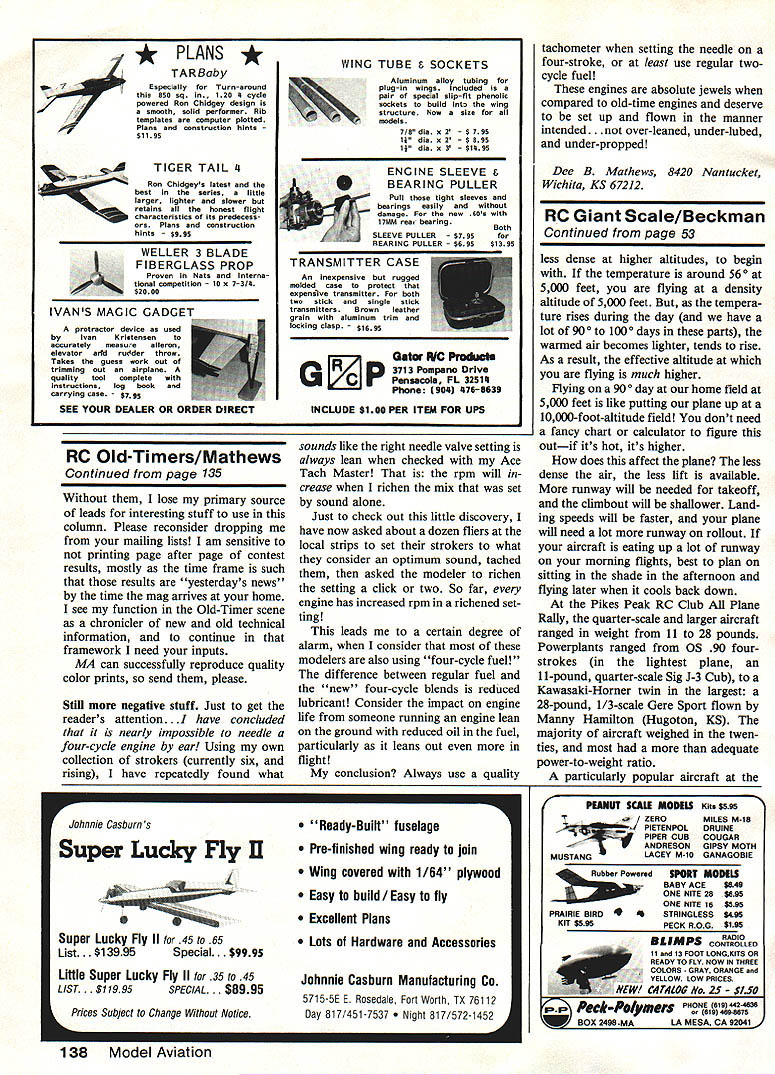
As a case in point, the field used by the Pikes Peak R/C Club of Colorado Springs, Colorado, is at an elevation of 7,200 feet above sea level. We took our Fly Baby biplane to the annual All Plane Rally held in June, and we noticed some differences in flight handling—even though we are used to flying at this field and our home field is around 5,000 feet above sea level. The plane didn't have as much "soup" as it does at home and went through maneuvers a tad slower. But because we use a Sachs-Dolmar .31 cu. in. engine in this plane, we still had plenty of power. Other fliers, coming from the lower elevations of Kansas and Texas, found a few more differences posed by the greater altitude of this field. One doesn't have to travel to the Rocky Mountain region to deal with increased altitude; flying at a site having an altitude difference of 1,000 feet anywhere in the country can give you the experience.
Plan on expecting longer takeoff and landing runs. The higher the altitude, the less dense the air is, and you will need the extra space. Bring aircraft with lighter wing loading and plenty of power. If your plane is marginal on power at home, don't put it in the air at higher altitudes! (You may not have the chance—it may not have enough get-up-and-go to get off the ground.)
Some adjustments to the aircraft and power plant will probably be necessary. You may find it necessary to richen the fuel mixture; since there is less oxygen in the air, you probably will be listening to a very lean engine running at the setting you normally use. Make your first flight a trim-out flight: avoid adding weight to the aircraft for this flight (leave the smoke tank empty), and don't start burning up the sky until you find out what the plane is capable of doing at altitude. If it doesn't go straight up on its tail as it usually does, forget about doing some of your pet maneuvers. Power adjustments and other changes can then properly be made before your next flight.
You may want to try a different size or pitch on the prop. Ask around and find out what the hometown boys have found to work best on similar aircraft. On a hot day, you may find that the cowling has to be left off the plane for the engine to perform in a satisfactory manner in the air.
Don't expect afternoon flights to be the same as the flights you make in the morning. Higher afternoon temperatures are going to have a definite effect on aircraft performance (so will increased humidity, although the Rocky Mountain area is generally fairly dry). Handling the heat involves knowing a little about density altitude. It's a vital factor that even full-size aircraft pilots coming from lower altitudes occasionally forget about, to their consternation, and it has just as much effect on a Giant Scale aircraft.
Density Altitude
Density altitude works this way: air is less dense at higher altitudes, to begin with. If the temperature is around 56° at 5,000 feet, you are flying at a density altitude of 5,000 feet. But as the temperature rises during the day (and we have a lot of 90° to 100° days in these parts), the warmed air becomes lighter and tends to rise. As a result, the effective altitude at which you are flying is much higher.
Flying on a 90° day at our home field at 5,000 feet is like putting our plane up at a 10,000-foot-altitude field! You don't need a fancy chart or calculator to figure this out—if it's hot, it's higher.
How does this affect the plane? The less dense the air, the less lift is available. More runway will be needed for takeoff, and the climbout will be shallower. Landing speeds will be faster, and your plane will need a lot more runway on rollout. If your aircraft is cutting up a lot of runway on your normal morning flights, it's best to plan on sitting in the shade in the afternoon and flying later when it cools back down.
Tips for High-Altitude Flying
- Expect longer takeoff and landing runs; plan extra runway distance.
- Use aircraft with lighter wing loading and ample power.
- Make the first flight a light trim-out flight (leave the smoke tank empty).
- Consider richening the fuel mixture to compensate for reduced oxygen.
- Try different props (size or pitch) based on local recommendations.
- Avoid flying the heaviest maneuvers on the first flights; adjust power and trim first.
- Prefer flying in cooler hours if afternoon temperatures are high.
Pikes Peak All Plane Rally
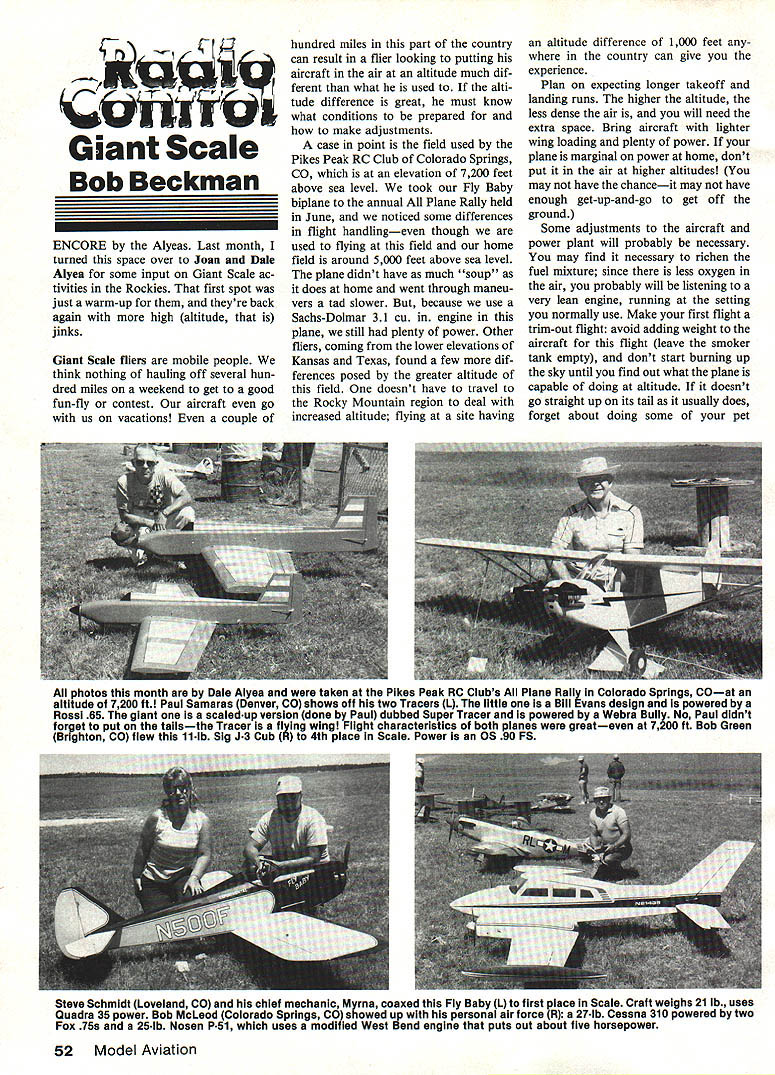
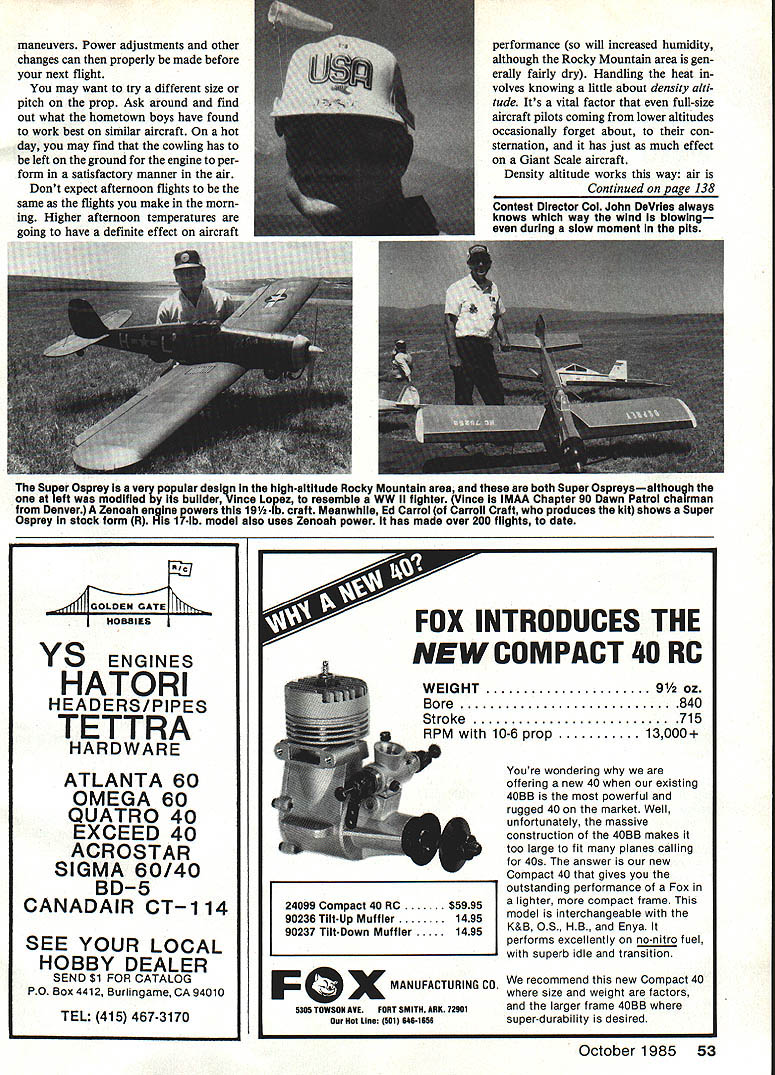
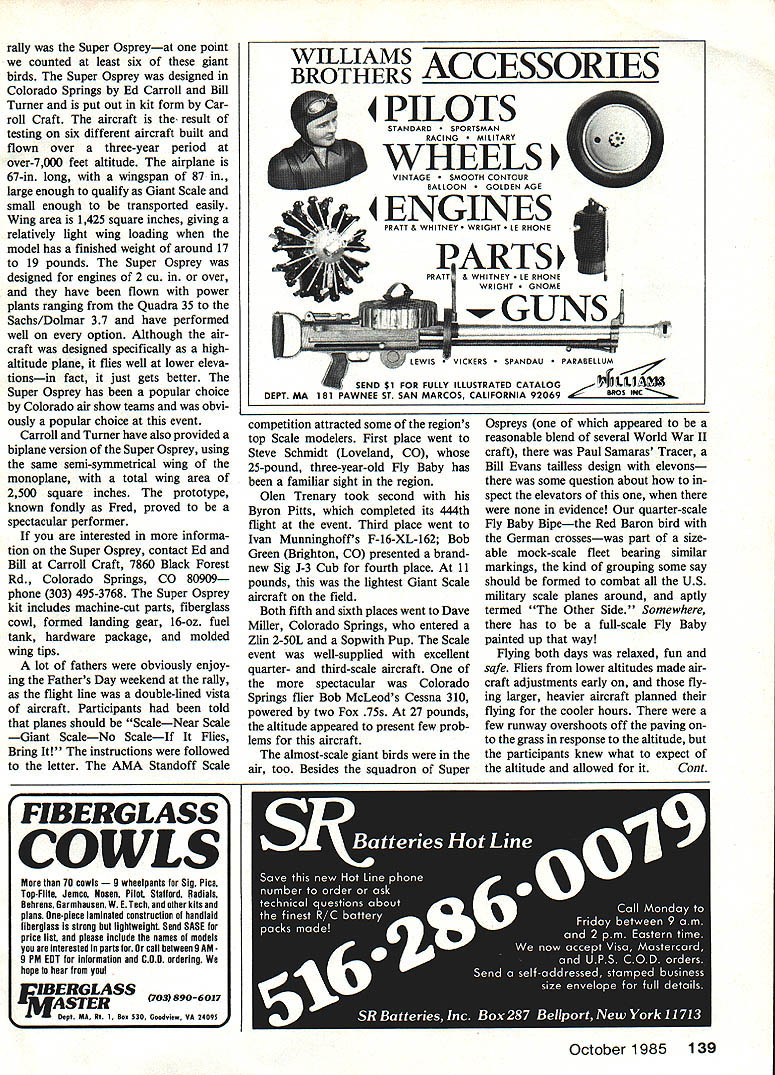
At the Pikes Peak R/C Club All Plane Rally, the quarter-scale and larger aircraft ranged in weight from 11 to 28 pounds. Powerplants ranged from OS .90 four-strokes (in the lightest plane, an 11-pound, quarter-scale Sig J-3 Cub) to a Kawasaki-Horner twin in the largest: a 28-pound, 1/3-scale Cessna 310 flown by Manny Hamilton (Hugoton, KS). The majority of aircraft weighed in the twenties, and most had more than adequate power-to-weight ratios.
A particularly popular aircraft at the rally was the Super Osprey—at one point we counted at least six of these giant birds. The Super Osprey was designed in Colorado Springs by Ed Carroll and Bill Turner and is produced in kit form by Carroll Craft. The aircraft is the result of testing on six different airframes built and flown over a three-year period at over 7,000 feet altitude. The airplane is 67 in. long, with a wingspan of 87 in., large enough to qualify as Giant Scale and small enough to be transported easily. Wing area is 1,425 square inches, giving a relatively light wing loading when the model has a finished weight of around 17 to 19 pounds. The Super Osprey was designed for engines of 2 cu. in. or over, and they have been flown with power plants ranging from the Quadra 35 to the Sachs/Dolmar 3.7 and have performed well on every occasion. Although the aircraft was designed specifically as a high-altitude plane, it flies well at lower elevations—in fact, it just gets better. The Super Osprey has been a popular choice by Colorado air show teams and was obviously a popular choice at this event.
Carroll and Turner have also provided a biplane version of the Super Osprey, using the same semi-symmetrical wing of the monoplane, with a total wing area of 2,500 square inches. The prototype, known fondly as Fred, proved to be a spectacular performer.
If you are interested in more information on the Super Osprey, contact Ed Carroll and Bill Turner at Carroll Craft, 7860 Black Forest Rd., Colorado Springs, CO 80909 — phone (303) 495-3768.
The Super Osprey kit includes:
- Machine-cut parts
- Fiberglass cowl
- Formed landing gear
- 16-oz. fuel tank
- Hardware package
- Molded wing tips
Scale Competition and Notable Aircraft
A lot of fathers were obviously enjoying the Father's Day weekend at the rally, as the flight line was a double-lined vista of aircraft. Participants had been told that planes should be "Scale—Near Scale—Giant Scale—No Scale—If It Flies, Bring It!" The instructions were followed to the letter. The AMA Standard Scale competition attracted some of the region's top scale modelers.
Winners:
- Steve Schmidt (Loveland, CO) — First place, 25-pound Fly Baby (three years on the line, a familiar sight in the region).
- Olen Ternary — Second place, Byron Pitts (completed its 44th flight at the event).
- Ivan Munninghoff — Third place, F-16-XL-162.
- Bob Green (Brighton, CO) — Fourth place, new Sig J-3 Cub (11 pounds; the lightest Giant Scale aircraft on the field).
5–6. Dave Miller (Colorado Springs) — Fifth and sixth places, Zlin Z-50A and Sopwith Pup.
The Scale event was well supplied with excellent quarter- and third-scale aircraft. One of the more spectacular was Colorado Springs flier Bob McLeod's Cessna 310, powered by two Fox .75s. At 27 pounds, the altitude appeared to present few problems for this aircraft.
The almost-scale giant birds were in the air, too. Besides the squadron of Super Ospreys (one of which appeared to be a reasonable blend of several World War II craft), there was Paul Samaras' Tracer, a Bill Evans tailless design with elevons—there was some question about how to inspect the elevators of this one when there were none in evidence! Our quarter-scale Fly Baby—the Red Baron bird with the German crosses—was part of a sizable mock-scale fleet bearing similar markings, the kind of grouping some say should be formed to balance all the U.S. military scale planes around, aptly termed "The Other Side."
Flying both days was relaxed, fun, and safe. Fliers from lower altitudes made aircraft adjustments early on, and those flying larger, heavier aircraft planned their flying for the cooler hours. There were a few runway overshoots off the paving onto the grass in response to the altitude, but the participants knew what to expect and allowed for it.
The hangar flying was as much fun as the real flying. With Scale experts like Col. John DeVries (also the Contest Director) and Lt. Col. Bill Dunn (CD for the Scale event) holding forth, you are bound to have some good discussions and learn something in the process.
Closing Notes
The Pikes Peak All Plane Rally is an annual event; they have no problem attracting people to fly at a field of 7,200 feet elevation. There are similar events, and regular Sunday flying, at Rocky Mountain-region R/C fields of 5,000+ feet. It's no problem if one remembers the rules of high-altitude flying. What happens when we take our giant planes to lower altitudes? We lean them in a little more, they fly just as great—and we never forget about density altitude!
Once again, my thanks to Joan and Dale Alyea for their fascinating account of life at high density altitude.
Something sounds backwards to me in their description of mixture settings, but there is no doubt about the effects Dale and Joan are talking about. A lot of full-scale pilots have learned the density-altitude lesson the hard way.
Two months from now, I expect to have a report on the STARS Scale Rally right from none other than the horse's (fill in the blank) himself, George Privitera.
Bob Beckman 8248 Holly Grove Ct. Manassas, VA 22110
Transcribed from original scans by AI. Minor OCR errors may remain.

