
Radio Control: Giant Scale
Bob Beckman
Exceptional Edwards Engine
Over the Labor Day weekend, Evelyn and I visited one of our favorite flying sites, the Merwin Ranch near Sacramento, CA. I saw a fabulous engine there that I want to tell you about.
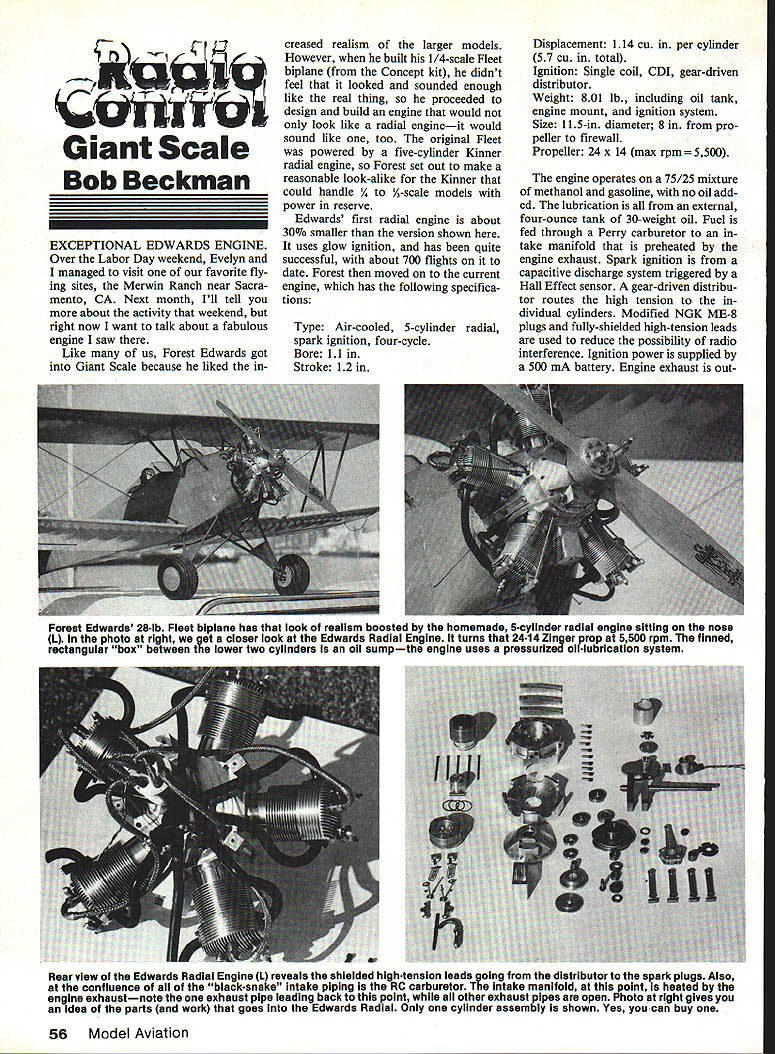
Like many of us, Forest Edwards got into Giant Scale because he liked the increased realism of the larger models. When he built his 1/4-scale Fleet biplane (from the Concept kit), he didn't feel it looked and sounded enough like the real thing, so he designed and built an engine that would not only look like a radial engine — it would sound like one, too. The original Fleet was powered by a five-cylinder Kinner radial engine, so Forest set out to make a reasonable look-alike for the Kinner that could handle 1/4- to 1/3-scale models with power in reserve.
Edwards' first radial engine is about 30% smaller than the version shown here. It uses glow ignition and has been quite successful, with about 700 flights on it to date. Forest then moved on to the current engine, which has the following specifications:
- Type: Air-cooled, 5-cylinder radial, spark ignition, four-cycle
- Bore: 1.1 in.
- Stroke: 1.2 in.
- Displacement: 1.14 cu. in. per cylinder (5.7 cu. in. total)
- Ignition: Single coil, CDI, gear-driven distributor
- Weight: 8.01 lb., including oil tank, engine mount, and ignition system
- Size: 11.5-in. diameter; 8 in. from propeller to firewall
- Propeller: 24 x 14 (max rpm = 5,500)
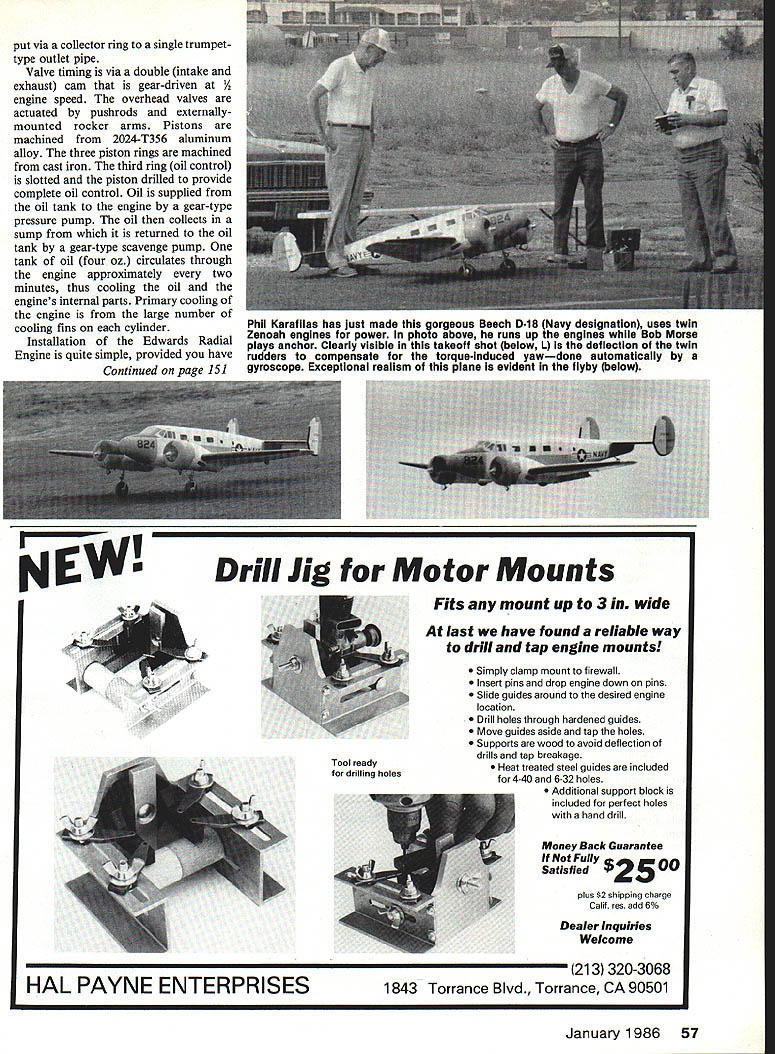
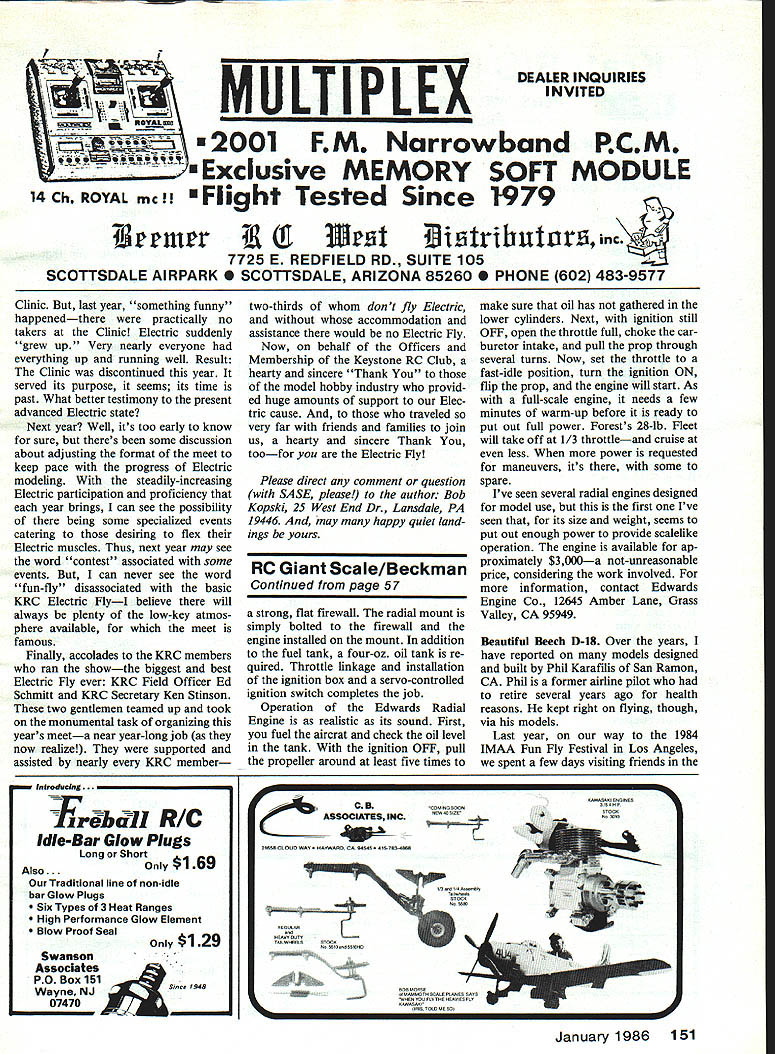
The engine operates on a 75/25 mixture of methanol and gasoline, with no oil added to the fuel. Lubrication is supplied from an external four-ounce tank of 30-weight oil. Fuel is fed through a Perry carburetor to an intake manifold that is preheated by the engine exhaust. Spark ignition is from a capacitive discharge system triggered by a Hall Effect sensor. A gear-driven distributor routes the high tension to the individual cylinders. Modified NGK ME-8 plugs and fully shielded high-tension leads are used to reduce the possibility of radio interference. Ignition power is supplied by a 500 mA battery. Engine exhaust is routed via a collector ring to a single trumpet-type outlet pipe.
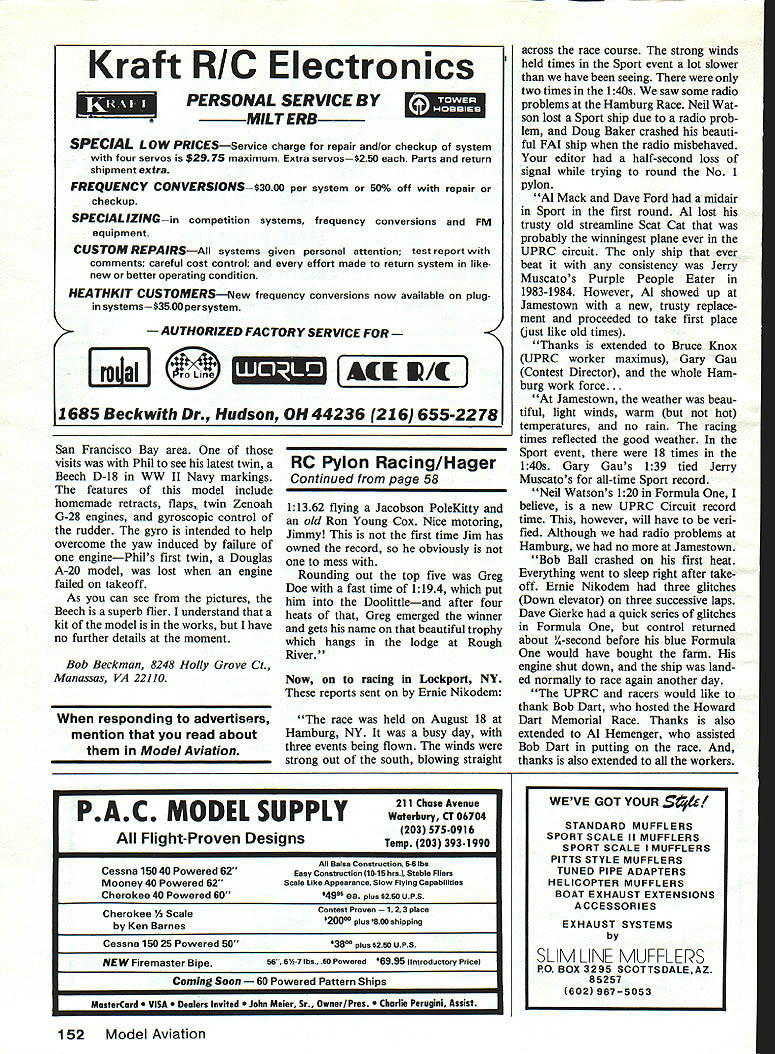
Valve timing is via a double cam (intake and exhaust) that is gear-driven at 1/2 engine speed. The overhead valves are actuated by pushrods and externally mounted rocker arms. Pistons are machined from 2024-T356 aluminum alloy. The three piston rings are machined from cast iron. The third ring (oil control) is slotted and the piston drilled to provide complete oil control.
Oil is supplied from the oil tank to the engine by a gear-type pressure pump. The oil then collects in a sump from which it is returned to the oil tank by a gear-type scavenge pump. One tank of oil (four oz.) circulates through the engine approximately every two minutes, thus cooling the oil and the engine's internal parts. Primary cooling of the engine is from the large number of cooling fins on each cylinder.
Installation of the Edwards radial engine is straightforward, provided you have a strong, flat firewall. The radial mount bolts to the firewall and the engine installs on the mount. In addition to the fuel tank, a four-ounce oil tank is required. Throttle linkage, installation of the ignition box, and a servo-controlled ignition switch complete the job.
Operation of the Edwards radial engine is as realistic as its sound. Typical start and run procedure:
- Fuel the aircraft and check the oil level in the tank.
- With the ignition OFF, pull the propeller around at least five times to make sure oil has not gathered in the lower cylinders.
- With ignition still OFF, open the throttle full, choke the carburetor intake, and pull the prop through several turns.
- Set the throttle to a fast-idle position, turn the ignition ON, flip the prop, and the engine will start.
- Allow a few minutes of warm-up before cutting to full power.
Forest's 28-lb Fleet will take off at 1/3 throttle—and cruise at even less. When more power is requested for maneuvers, it's there, with some to spare.
I've seen several radial engines designed for model use, but this is the first one I've seen that, for its size and weight, seems to put out enough power to provide scale-like operation. The engine is available for approximately $3,000 — a reasonable price, considering the work involved. For more information, contact Edwards Engine Co., 12645 Amber Lane, Grass Valley, CA 95949.
Beautiful Beech D-18
Over the years I have reported on many models designed and built by Phil Karafilis of San Ramon, California. Phil is a former airline pilot who had to retire several years ago for health reasons. He kept right on flying, though, via his models.
Last year, on our way to the 1984 IMAC Fun Fly Festival in Los Angeles, we spent a few days visiting friends in the San Francisco Bay area. One of those visits was with Phil to see his latest twin, a Beech D-18 in WWII Navy markings. The features of this model include homemade retracts, flaps, twin Zenoah G-28 engines, and gyroscopic control of the rudder. The gyro is intended to help overcome the yaw induced by failure of one engine — Phil's first twin, a Douglas A-20 model, was lost when an engine failed on takeoff.
As you can see from the pictures, the Beech is a superb flier. I understand that a kit of the model is in the works, but I have no further details at the moment.
Bob Beckman 8248 Holly Grove Ct., Manassas, VA 22110
When responding to advertisers, mention that you read about them in Model Aviation.
Transcribed from original scans by AI. Minor OCR errors may remain.

