
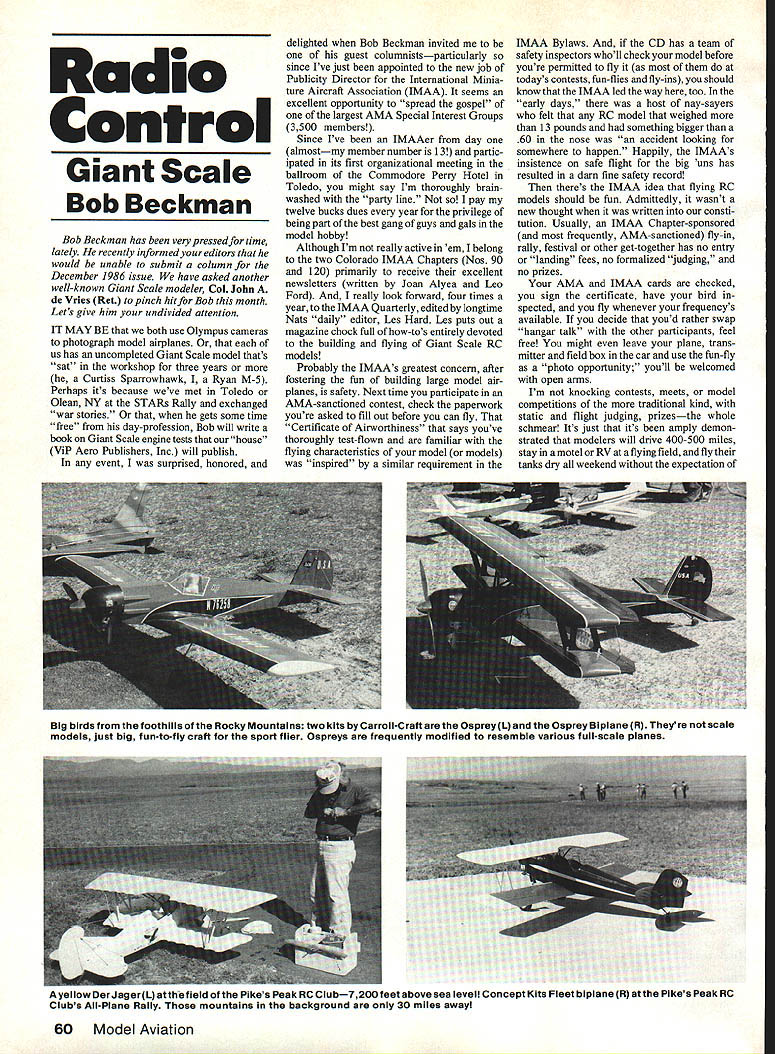
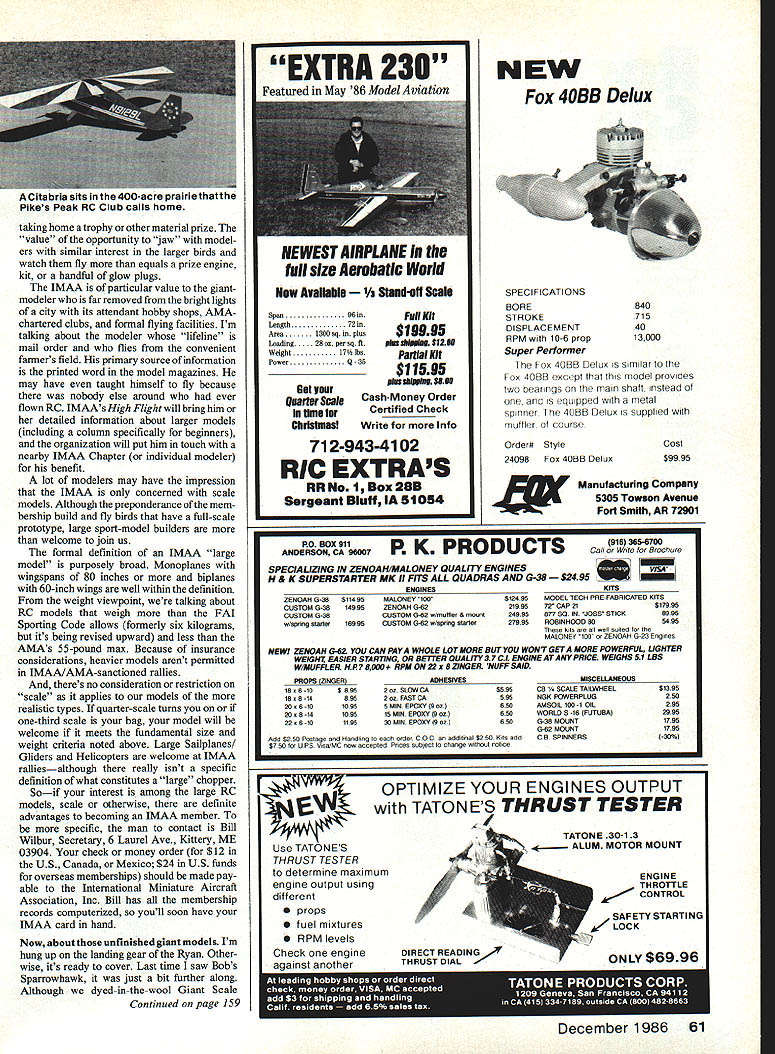
Radio Control: Giant Scale
By Col. John A. de Vries (Ret.), guest columnist for Bob Beckman
Introduction
Bob Beckman has been very pressed for time lately and informed our editors that he could not submit a column for the December 1986 issue. We asked another well-known Giant Scale modeler, Col. John A. de Vries (Ret.), to pinch-hit for Bob this month.
It may be that we both use Olympus cameras to photograph model airplanes, or that each of us has an uncompleted Giant Scale model that's sat in the workshop for three years or more (he, a Curtiss Sparrowhawk; I, a Ryan M-5). Perhaps it's because we've met in Toledo and Olean, NY at the STARS Rally and exchanged "war stories." Or because, when he gets some time free from his day profession, Bob will write a book on Giant Scale engine tests that our house (VIP Aero Publishers, Inc.) will publish.
I was surprised, honored, and delighted when Bob Beckman invited me to be one of his guest columnists—particularly since I've just been appointed Publicity Director for the International Miniature Aircraft Association (IMAA). It seems an excellent opportunity to spread the gospel of one of the largest AMA Special Interest Groups (about 3,500 members).
My IMAA involvement
I've been an IMAAer from almost day one (my member number is 13) and participated in its first organizational meeting in the ballroom of the Commodore Perry Hotel in Toledo. I'm thoroughly committed to the group, and I pay my twelve-dollar dues every year for the privilege of being part of the best gang of guys and gals in the model hobby.
Although I'm not deeply active in chapter affairs, I belong to the two Colorado IMAA chapters (Nos. 90 and 120) primarily to receive their excellent newsletters (written by Joan Alyea and Leo Ford). I also look forward to the IMAA Quarterly, edited by longtime Nats "daily" editor Les Hard. Les produces a magazine full of how-to articles devoted entirely to the building and flying of Giant Scale RC models.
Safety
Probably IMAA's greatest concern, after fostering the fun of building large model airplanes, is safety. Next time you participate in an AMA-sanctioned contest, check the paperwork you're asked to fill out before you can fly. That "Certificate of Airworthiness" says you've thoroughly test-flown and are familiar with the flying characteristics of your model and was inspired by a similar requirement in IMAA bylaws.
If the contest director has a team of safety inspectors who'll check your model before you're permitted to fly it (as most do at today's contests, fun-flies, and fly-ins), know that IMAA led the way here. In the early days there were many nay-sayers who felt that any RC model weighing more than 13 pounds and carrying something bigger than a .60 engine in the nose was "an accident looking for somewhere to happen." Happily, IMAA's insistence on safe flight for the big ones has resulted in an excellent safety record.
Fun-fly philosophy
IMAA believes flying RC models should be fun. Usually, an IMAA chapter-sponsored (and most frequently AMA-sanctioned) fly-in, rally, festival, or get-together has no entry or landing fees, no formalized judging, and no prizes.
The routine is simple: your AMA and IMAA cards are checked, you sign the Certificate of Airworthiness, have your bird inspected, and you sign the frequency-availability board. If you'd rather swap hangar talk with other participants, feel free. You might even leave your plane, transmitter, and field box in the car and use the fun-fly as a photo opportunity—you'll be welcomed with open arms.
I'm not knocking contests with static and flight judging and prizes. It's just that modelers will drive 400–500 miles, stay in a motel or RV at a flying field, and fly their tanks dry all weekend without expecting a prize. Many builders aren't particularly interested in competition; I kind of wonder who'll let his "hangar queen" into the air first.
What qualifies as a "large model" and who is welcome
A lot of modelers may think IMAA concerns only scale models. Although many members build and fly full-scale prototypes, large sport-model builders are also welcome.
The formal definition of an IMAA "large model" is purposely broad:
- Monoplanes with spans of 80 inches or more.
- Biplanes with 60-inch wings.
- From the weight viewpoint, RC models that weigh more than the FAI Sporting Code allows (formerly six kilograms) but less than the AMA's 55-pound maximum.
Because of insurance considerations, heavier models aren't permitted in IMAA/AMA-sanctioned rallies. There is no restriction on scale as it applies to realistic-type models: quarter-scale, one-third scale, etc., are all welcome if they meet the size and weight criteria above. Large sailplanes/gliders and helicopters are welcome at IMAA rallies, although there isn't a specific definition of what constitutes a "large" chopper.
How to join
If your interest is in the larger RC models, scale or otherwise, there are definite advantages to becoming an IMAA member. Contact:
- Bill Wilbur, Secretary
- 6 Laurel Ave., Kittery, ME 03904
Dues:
- $12 (U.S., Canada, Mexico)
- $22 (overseas, in U.S. funds)
Make checks or money orders payable to the International Miniature Aircraft Association, Inc. Bill has membership records computerized, so you'll soon receive your IMAA card.
Closing notes
Now, about those unfinished giant models: I'm hung up on the landing gear of the Ryan M-5; otherwise, it's ready to cover. Last time I saw Bob's Sparrowhawk it was a bit further along.
Once again, many thanks for Col. John A. de Vries' efforts this month. Bob Beckman intends to be back next month, so continue to send corrections and comments to him at the address below.
Bob Beckman 8248 Holly Grove Ct. Manassas, VA 22110
Transcribed from original scans by AI. Minor OCR errors may remain.

