
Radio Control: Giant Scale
Bob Beckman
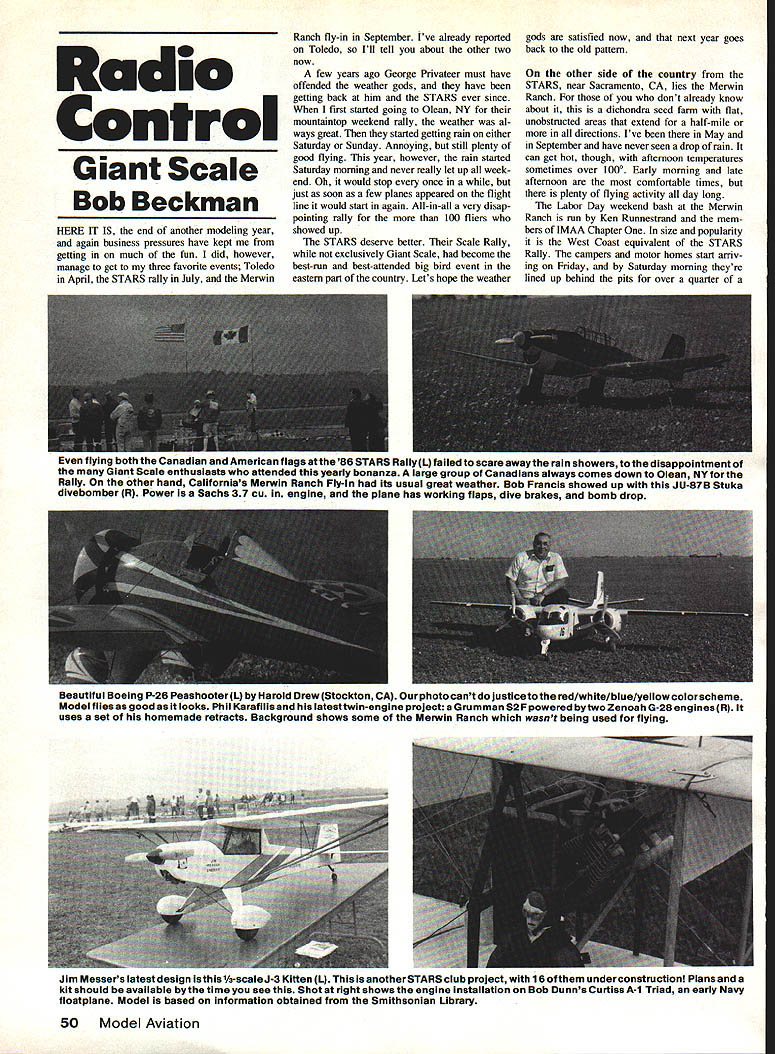
Here it is, the end of another modeling year, and again business pressures have kept me from getting in on much of the fun. I did, however, manage to get to my three favorite events: Toledo in April, the STARS rally in July, and the Merwin Ranch fly-in in September. I've already reported on Toledo, so I'll tell you about the other two now.
A few years ago George Privateer must have offended the weather gods, and they have been getting back at him and the STARS ever since. When I first started going to Olean, NY for their mountaintop weekend rally, the weather was always great. Then they started getting rain on either Saturday or Sunday. Annoying, but still plenty of good flying. This year, however, the rain started Saturday morning and never really let up all weekend. Oh, it would stop every once in a while; just as soon as a few planes appeared on the flight line it would start in again. All in all a very disappointing rally for the more than 100 fliers who showed up.
The STARS deserve better. Their Scale Rally, while not exclusively Giant Scale, had become the best-run and best-attended big-bird event in the eastern part of the country. Let's hope the weather gods are satisfied now, and that next year goes back to the old pattern.
On the other side of the country from the STARS, near Sacramento, CA, lies the Merwin Ranch. For those of you who don't already know about it, this is a dichondra seed farm with flat, unobstructed areas that extend for a half-mile or more in all directions. I've been there in May and in September and have never seen a drop of rain. It can get hot, though, with afternoon temperatures sometimes over 100°. Early morning and late afternoon are the most comfortable times, but there is plenty of flying activity all day long.
The Labor Day weekend bash at the Merwin Ranch is run by Ken Runnestrand and the members of IMAA Chapter One. In size and popularity it is the West Coast equivalent of the STARS Rally. The campers and motor homes start arriving on Friday, and by Saturday morning they're lined up behind the pits for over a quarter of a mile.
Just as at Olean, I have a lot of friends I see once a year at Merwin's place. Bob Siegelkoff, owner of CB Associates, always has something interesting to fly every year. Cardboard aircraft have a long history with the guys in California; there's a lot of buying and selling of models, and in fact sometimes it's hard to find out who originally built anything. In this case Bob picked up a model at a trade-show swap shop in Chicago. I first saw the model at the IMAA Fun-Fly Festival in Louisville in 1981. Dave Gray of Du-Bro was the original owner. The aircraft is modeled after the Eastbourne monoplane, about 1910 vintage, and is a twin. Despite its rather weather-beaten, ungainly look the model was a slow, graceful, stable flier.
Bob rigged a releasable hook and used a streamer made of yellow surveyor's tape about 400 feet long. In a tight turn the model could almost swallow its own tail. At times during lull flying Bob would take off the streamer and pretty soon would have half a dozen planes up trying to cut it — they actually did cut it once, though it hit several times. Flight controls on the model were rudder and elevator; Bob flies elevator on the left stick, rudder on the right stick. Usually aileron makes sense, but directional control by rudder led to the final demise of the cardboard contraption.
Late Saturday afternoon Bob got ready for another flight. There was a bit of wind, it was light, and with the loading the model lifted off and the wind grabbed it very quickly. Just after takeoff it banked gently right; with wind under the left wing the turn kept tightening. I stood waiting for Bob to straighten things out. Instead the turn continued to tighten up until the model inevitably met the ground. As I picked up the pieces Bob explained that for some reason he hadn't gotten any response from the rudder control.
He said that just after takeoff, as the plane started to bank to the right, he gave left rudder, but he could see that the rudder on the plane didn't respond. It finally dawned on him that he had been using the left stick (the usual Mode I rudder location) instead of the right stick, usually aileron, but in this case rudder. I think that by the STARS' Crash Point system, this performance would rate maximum points.
Swan Song
I have been writing this column for almost seven years now; but, reluctantly, I have to make this my final contribution. For the last couple of years a combination of health problems and business pressures has made it impossible for me to do the job right. I have enjoyed doing the column, and I appreciate the support I've received from all of you. I've made a lot of new friends as a result, and I hope to see all of you from time to time.
Jack de Vries will be taking over, starting next month. Since Jack lives in Colorado, he should bring a fresh view of Giant Scale to the column. And since he gets around quite a bit, he can cover activities throughout the country.
I wonder if this will let me find the time to finish the Sparrowhawk?
Bob Beckman 8248 Holly Grove Ct. Manassas, VA 22110.
Transcribed from original scans by AI. Minor OCR errors may remain.

