
Radio Control: Giant Scale
John A. de Vries
Colonel, USAF, Ret.
Little did I realize that writing a guest column for Bob Beckman would result in gainful employment for me on the Model Aviation team! However, Bob's business has been growing by leaps and bounds, and it left him with little modeling time—to say nothing about the hours it takes to bolt together a monthly column. Needless to say, I'm more than happy to take over Bob's "big bird" column. Not only because it gives me a monthly chance to "talk" with you, but because it means that Bob's company is burgeoning.
A bit of personal background might be appropriate at this point. I've been building model airplanes since 1936—from rubber, through gas Free Flight, U-Control, and finally into RC (in the escapement days). My AMA license number is 1427, my IMAA number is a "real" 13, and I'm a member of the Aviation/Space Writers Association.
I've had 15 RC designs (mostly scale) published in the model magazines and over 200 other articles printed in model and other publications. I've had two books published (on German Taubes and the Alexander Eaglerock), and at present I'm associated with Dick Phillips in ViP Aero Publishers, Inc.
Those of you who followed my column in RCM will probably remember that I spent 30 years in the Air Force and flew 116 different types and marks of aircraft from J-3 Cubs through B-50s, with the emphasis on fighters (P-40s, P-51s). I "retired" in 1972.
Enough of this background stuff—let's talk large, radio-controlled miniature aircraft. Although the emphasis in this column will be on scale biggies, we won't forget those of us who just like to build and fly larger-than-normal models. In fact, that's what I'd like to start out with this month.
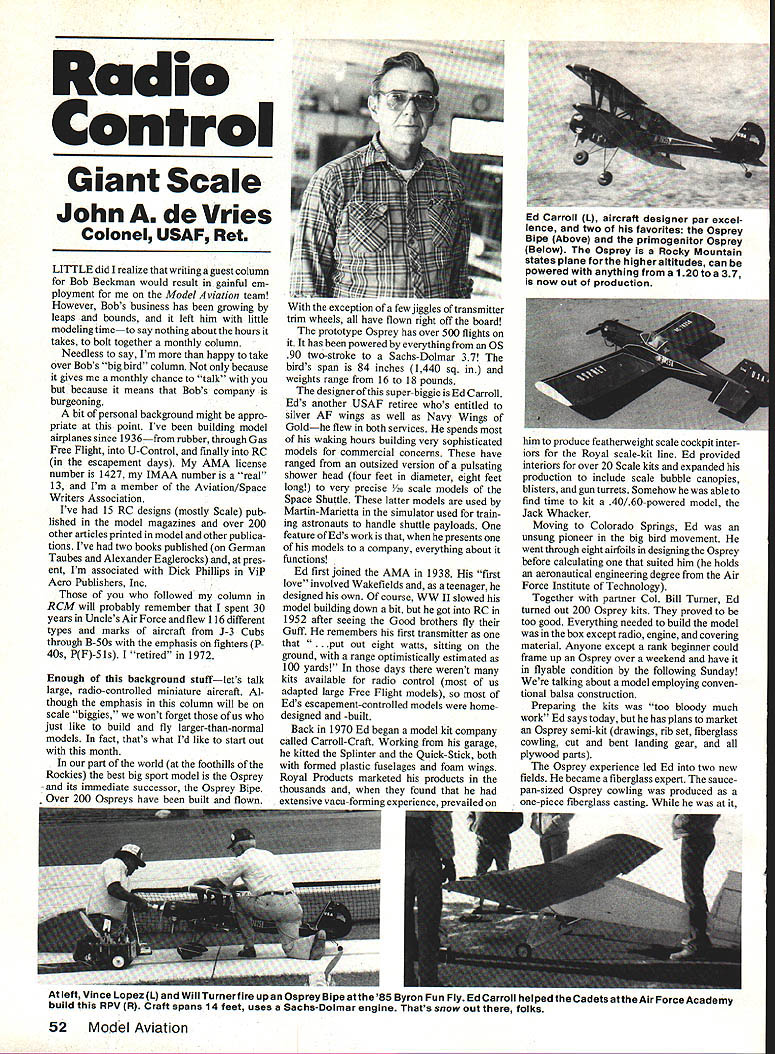
In our part of the world (at the foothills of the Rockies) the best big sport model is the Osprey and its immediate successor, the Osprey Bipe. Over 200 Ospreys have been built and flown. With the exception of a few jiggles of transmitter trim wheels, all have flown right off the board!
The prototype Osprey has over 500 flights on it. It has been powered by everything from an OS 90 two-stroke to a Sachs-Dolmar .37. The bird's span is 84 inches (1,440 sq. in.) and weights range from 16 to 18 pounds.
The designer of this super-biggie is Ed Carroll. Ed's another USAF retiree who's entitled to silver AF wings as well as Navy Wings of Gold—he flew in both services. He spends most of his waking hours building very sophisticated models for commercial concerns. These have ranged from an outsized version of a pulsating shower head (four feet in diameter, eight feet long) to very precise 1/20 scale models of the Space Shuttle. These latter models are used by Martin-Marietta in the simulator as training aids for astronauts to handle shuttle payloads. One feature of Ed's work is that, when he presents one of his models to a company, everything about it functions!
Ed first joined the AMA in 1938. His "first love" involved Wakefields and, as a teenager, he designed his own. Of course, WWII slowed his model building down a bit, but he got into RC in 1952 after seeing the Good brothers fly Guff. He remembers his first transmitter as one that "put out eight watts, sitting on the ground, range optimistically estimated at 100 yards!" In those days there weren't many kits available for radio control (most of us adapted large Free Flight models), so most of Ed's escapement-controlled models were home-designed and -built.
Back in 1970 Ed began a model kit company called Carroll-Craft. Working from his garage, he kitted the Splinter and the Quick-Stick, both with formed plastic fuselages and foam wings. Royal Products marketed his products in the thousands and, when they found that he had extensive vacu-forming experience, prevailed on him to produce featherweight scale cockpit interiors for the Royal scale-kit line. Ed provided interiors for over 20 scale kits and expanded his production to include scale bubble canopies, blisters, and gun turrets. Somehow he also found time to kit a .40/.60-powered model, the Jack Whacker.
Moving to Colorado Springs, Ed was an unsung pioneer in the big bird movement. He went through eight airfoils in designing the Osprey before calculating one that suited him (he holds an aeronautical engineering degree from the Air Force Institute of Technology).
Together with partner Col. Bill Turner, Ed turned out 200 Osprey kits. They proved to be too good. Everything needed to build the model was in the box except radio, engine and covering material. Anyone except the rank beginner could frame up an Osprey over a weekend and have it in flyable condition the following Sunday! We're talking about a model employing conventional balsa construction.
"Preparing the kits was 'too bloody much work,'" Ed says today, but he has plans to market an Osprey semi-kit (drawings, rib set, fiberglass cowling, cut and bent landing gear, and all plywood parts).
The Osprey experience led Ed into two new fields. He became a fiberglass expert. The saucepan-sized Osprey cowling was produced as a one-piece fiberglass casting. He bent some cabane wires and produced the Osprey Bipe.
Although he didn't kit the Bipe he was generous with the drawings, and soon a host of kit-built Ospreys sported two wings. The big surprise was that the biplane version flew as well as the low-winger, albeit requiring substantially larger engines (beginning with the three-cubic-inch Quadra .50) to handle the extra drag.
Chronologically speaking, Carroll's Lazy Boy followed the Bipe into the air. A high-wing monoplane with an 84-inch span, the Lazy Boy flew easily on a .90 four-cycle engine. It's one of those models which is so stable that, once trimmed, it will let you lay the transmitter on the ground while you go for a Coke! Satisfied with its performance, Ed has added flaps and a drooping leading edge. Would you believe 20 mph takeoffs under full control?
A member of the IMAA, Ed belongs to both Colorado chapters. But it was only recently that he's been bitten by the scale big bird "bug." Although he's talked about a big Fokker D.VIII (adapted from a British kit), he's hard at work on a largeish SE-5A. It'll have 1,800 square inches in its 60-inch-span wings and be motivated by a 1.2 four-cycle or ignition engine.
In his "spare" time, Ed's been working with the cadets at the Air Force Academy on their RPV (Remotely Piloted Vehicle—drone) program. He consults with them on design matters and, when it comes time to fly their out-sized birds (14-foot wingspans!), he takes his turn on the transmitter sticks. In appreciation the Class of '86 presented him with a saber engraved with the words, "To Ed Carroll—who finally made it fly."
Notes and announcements:
- Royal Products of Denver, CO will introduce a Y-scale Boeing P-26 Peashooter kit in the near future. For .90s and up, it has a span of 67 inches and an estimated flight weight of 9½ pounds. It's very close to scale, and the kit features a spun aluminum cowl and plastic moldings for the radial engine, headrest, and wheel spats.
- Good friend Bill Hannam (P.O. Box A, Escondido, CA 92025) has published his newest epic, Peanuts & Pistachios ($3.95 plus postage). Much of the bi- and triplane-building community has been buying his books for the sole intention of enlarging his scale three-views to giant RC sizes! Bill is so happy with this prospect that he's decided to concentrate on books that are primarily collections of three-views—and let his readers enlarge them to anything from Peanuts to full-size airplanes. You should see the drawings of the 1926 Farman Sport (La Carte Postale) in the book. It'll knock your socks off!
See you next month.
John de Vries 4610 Moffatt Ln., Colorado Springs, CO 80915.
Transcribed from original scans by AI. Minor OCR errors may remain.

