
Radio Control: Giant Scale
Bob Beckman
The STARS Scale Rally (Olean, NY)
Have you ever had a perfect weekend? I just got home from one that was almost perfect: fabulous weather, good food, great hospitality, an outstanding flying site, and bevies of beautiful big birds. I'm talking about the STARS Scale Rally in Olean, NY, on July 12–13.
- Fabulous weather
- Good food
- Great hospitality
- Outstanding flying site
- Bevy of beautiful big birds
The STARS club and their models
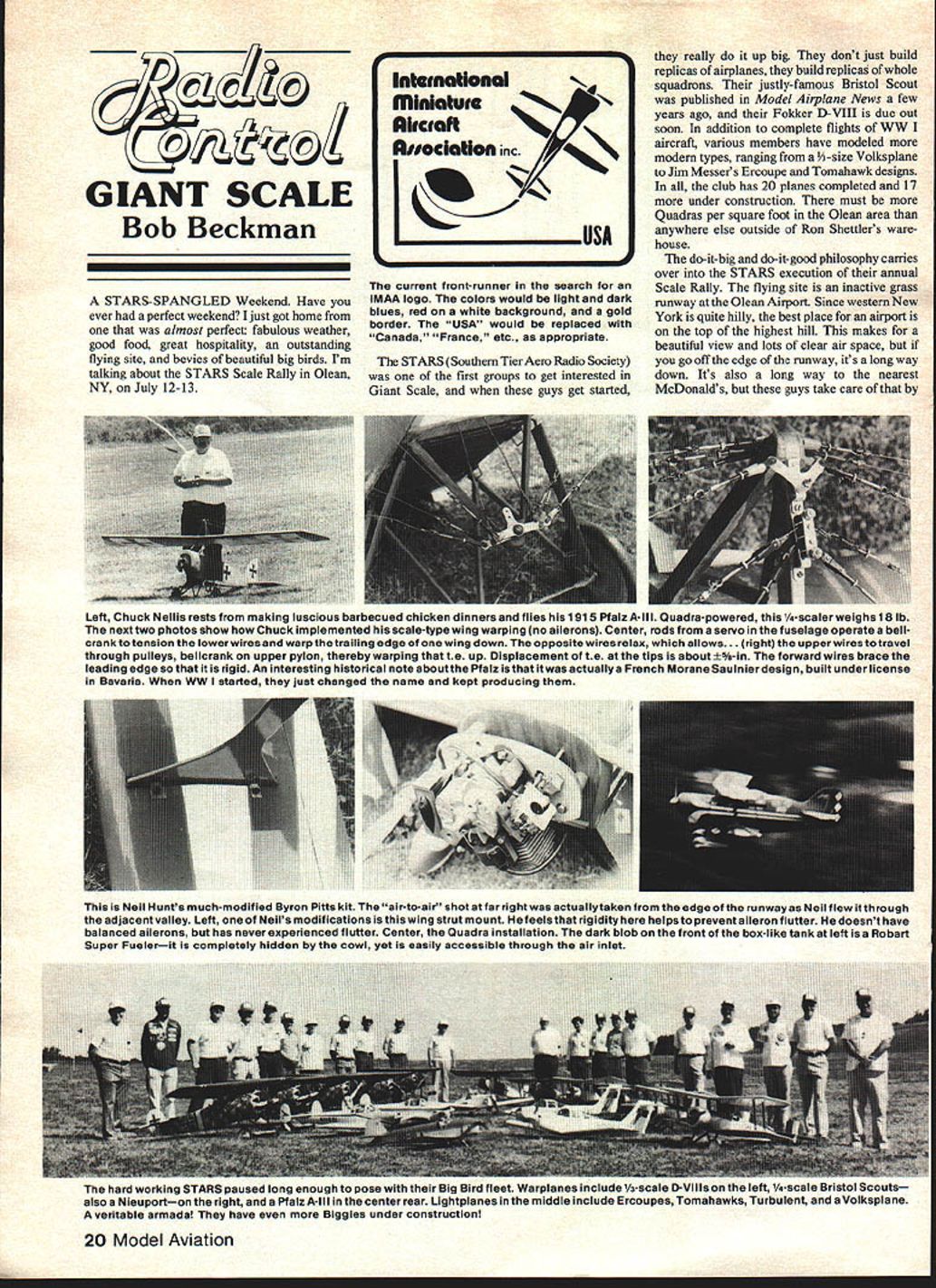
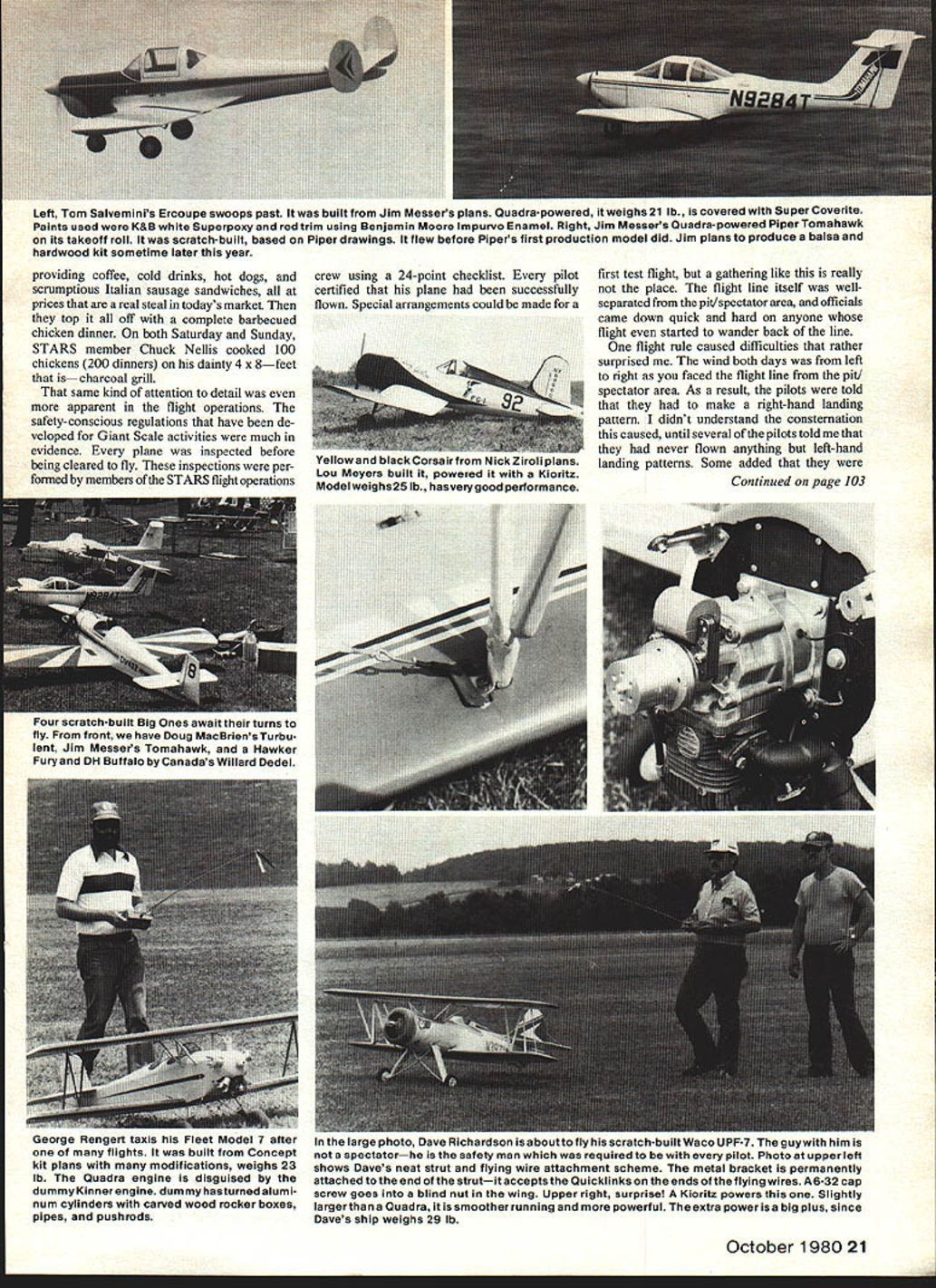
The STARS (Southern Tier Aero Radio Society) was one of the first groups to get interested in Giant Scale, and when these guys get started, they really do it up big. They don't just build replicas of airplanes, they build replicas of whole squadrons. Their justly famous Bristol Scout was published in Model Airplane News a few years ago, and their Fokker D-VIII is due out soon. In addition to complete flights of WW I aircraft, various members have modeled more modern types, ranging from 1/4-size Volksplane to Jim Messer's Ercoupe and Tomahawk designs. In all, the club has 20 planes completed and 17 more under construction. There must be more Quadras per square foot in the Olean area than anywhere else outside of Ron Shettler's warehouse.
The flying site and hospitality
The flying site is an inactive grass runway at the Olean Airport. Since western New York is quite hilly, the best place for an airport is on the top of the highest hill. This makes for a beautiful view and lots of clear airspace, but if you go off the edge of the runway, it's a long way down. It's also a long way to the nearest McDonald's, but these guys take care of that by topping off a complete barbecued chicken dinner both Saturday and Sunday. STARS member Chuck Nellis cooked 100 chickens—200 dinners—on a dainty 4 × 8-foot charcoal grill.
Flight operations and safety
The same kind of attention to detail is apparent in flight operations. Safety-conscious regulations have developed as Giant Scale activities have grown. Planes are inspected before being cleared to fly; inspections are performed by members of the STARS flight operations crew using a 24-point checklist; a pilot is certified before his plane is allowed to fly. Special arrangements can be made for a first test flight at a gathering like this, but the flight line itself is well separated from the pit/spectator area. Officials came down quick and hard on anyone whose flight started to wander back toward the line.
The flight rule caused difficulties—rather surprising since the wind both days was left-to-right, facing the flight line from the pit/spectator area. As a result, pilots were told that they had to make a right-hand landing pattern. I didn't understand the consternation this caused until several of the pilots told me that they had never flown anything but left-hand landing patterns. Some added that they were used to flying completely around their position on the ground and had difficulty staying on one side of a line. A pilot shouldn't consider himself really qualified to perform before spectators if he can't handle something as relatively simple as variations in landing patterns.
Flying highlights
Aside from the landing-pattern qualms, the flying was, on average, the best I've seen at a fly-in like this. While there were some prangs, they were few and far between. One of the highlights was Dave Landvater's flying of his 80-in.-span scratch-built Pitts. This 20-lb., Quadra-powered plane is an outstanding performer. Dave uses a 21 × 12 prop of his own design, and gets more out of his engine/prop/plane combination than I would have believed possible.
And then there was Dave's (yes, the same Dave) sunset performance with his 13-year-old, .60-powered, 1/4-scale Porterfield. As the rest of us sat around a fire and talked, he quietly flew high enough to catch reflections from an already-invisible sun, and circled there until he ran out of fuel. Then he brought the venerable Porterfield down in a whistling series of consecutive loops to a deadstick landing at his feet.
Aircraft, engines, and trends
From the technical standpoint, I didn't see much that was really new in the 75 or so planes present. Number-wise, the Quadra still dominates in the engine category, but the four Kioritz-powered planes that flew were impressive. Scratch-built and plan-built models far outnumbered kit types, a reversal of the trend for the last two years. Only two Pitts were seen: Landvater's scratch-built and Neil Hunt's much-modified Byron kit. There were many Super Stearmans, based on Godfrey's plans, but most of the builders I talked to modified the construction, especially aft of the cockpit, to lighten the tail.
Another trend, noted earlier this year in Sacramento and apparently true on the East Coast as well, is the lack of interest in gear drives. The only one at Olean was Rudi Mayer's six-year-old 1/5-scale Tiger Moth. Rudi is one of the large Canadian group that came down from the Kitchener–Waterloo area. His homemade gear drive with an HP .40 swings a 16 × 6 prop, and flies the six-foot-span model with authority.
Controls and a warning
In controls, there seems to be a drift away from the practice of doubling-up on aileron servos. There were several planes with one-piece wings and a single servo driving both, or all four, ailerons. The servos used were usually the 15H or 20H type, and seemed to be adequate for most flight situations. However, there may be a warning in one of the few crashes that occurred. The aircraft had just gone through a series of rather violent maneuvers that had obviously been practiced many times. A short time later, in what was meant to be a gentle turn, the model rolled over and went straight in. On examination it was found that the square output drive on the servo had rotated within the socket on the output arm. Don't underestimate the stresses with which we are dealing.
International Miniature Aircraft Association (IMAA)
On Sunday, I had a chance to talk with Don Godfrey about the progress of the organization that was launched at Toledo last April. For one thing, a permanent name has been selected, and the Miniature Aircraft Society is now the International Miniature Aircraft Association. It truly is international, with directors from Canada and France, as well as from throughout the U.S. A constitution and bylaws have been prepared, and incorporation is pending. Selection of a logo is about complete, and membership cards and a newsletter should be out by the time you read this. A lot has been done in the three months since the Toledo meeting.
The current front-runner in the search for an IMAA logo features light and dark blues, red on a white background, and a gold border. The "USA" would be replaced with "Canada," "France," etc., as appropriate.
For more information, contact: Don Godfrey, c/o Godfrey & Son Music, 254 Washington St., Binghamton, NY 13901.
Wrap-up
As a lead-in to this report, I said that I had had an "almost perfect weekend." The only thing that kept it from total perfection was the fact that I didn't have anything to fly. I'm looking forward to a perfect STARS-spangled weekend next year.
Fourth annual fly-in
The QSAA Fly-in is set for a fourth go-round. Dates are October 9–12; location is Las Vegas, NV. If this year's bash continues the pattern set by the first three, it's one you don't want to miss. For details write to: Ed Morgan, 2310 Cimarron Rd., Las Vegas, NV 89117, or call him at (702) 878-1306 after 10 a.m., Las Vegas time.
Bob Beckman 8248 Holly Grove Court Manassas, VA 22110
Transcribed from original scans by AI. Minor OCR errors may remain.

