
Radio Control: Giant Scale
John A. de Vries Colonel, USAF, Ret.
Peanuts and Giants
There are two groups of modelers who lead the field in producing the unusual when it comes to designing and flying scale models—the "Peanuts" and the "Giants." At opposite ends of the model-size spectrum, they're both likely to come up with the obscure, complex, or seldom-seen scale subjects. Probably the reason for this miniature and outsized diversity is that neither the Peanut field nor the Giant RC field is readily available as kits.
To build either Peanuts or Giant Scale models you must build from scratch using a host of readily available construction drawings. As we all realize, this takes a greater degree of building skill than simply "shaking the kit box."
We're not talking years of model-building experience here. A couple or three successful kit-built designs and the average R/C’er is ready for Giant RC Scale.
Choosing Your First Scale Subject
Assuming this degree of skill, the first step into Giant Scale is choosing your first scale subject. Having done a smidgen of research on this subject, I can say that there are over 300 different Giant Scale drawings that have been or are currently offered by a host of model designers! There is a veritable smorgasbord of plans from which to choose.
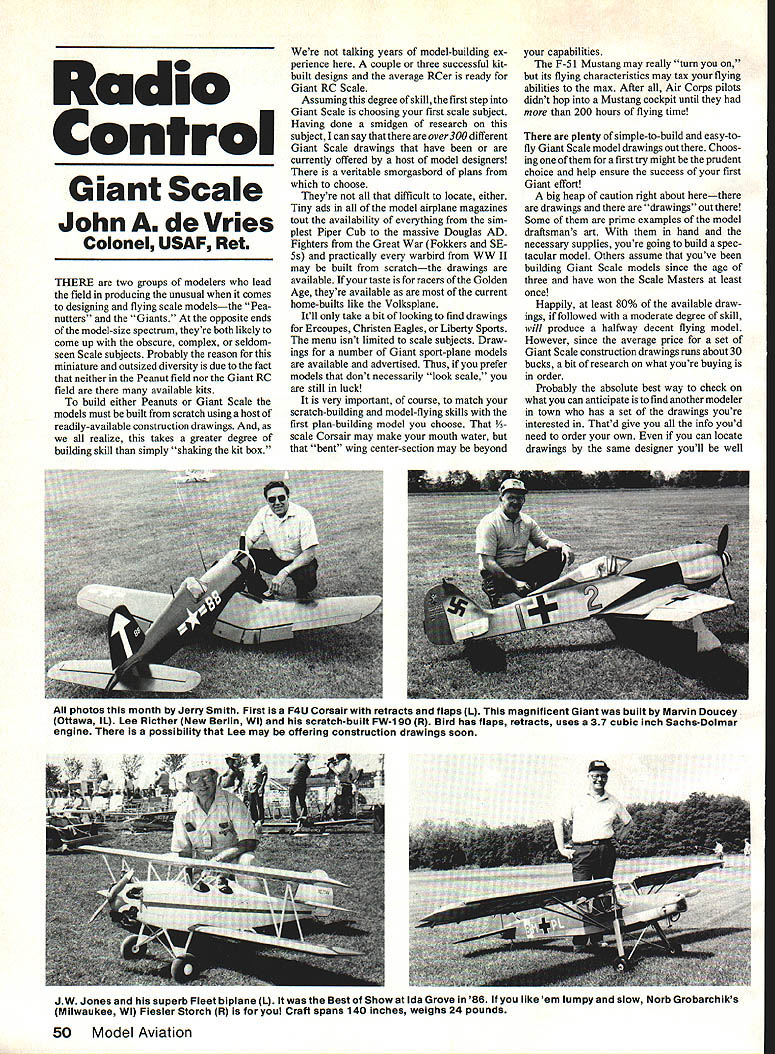
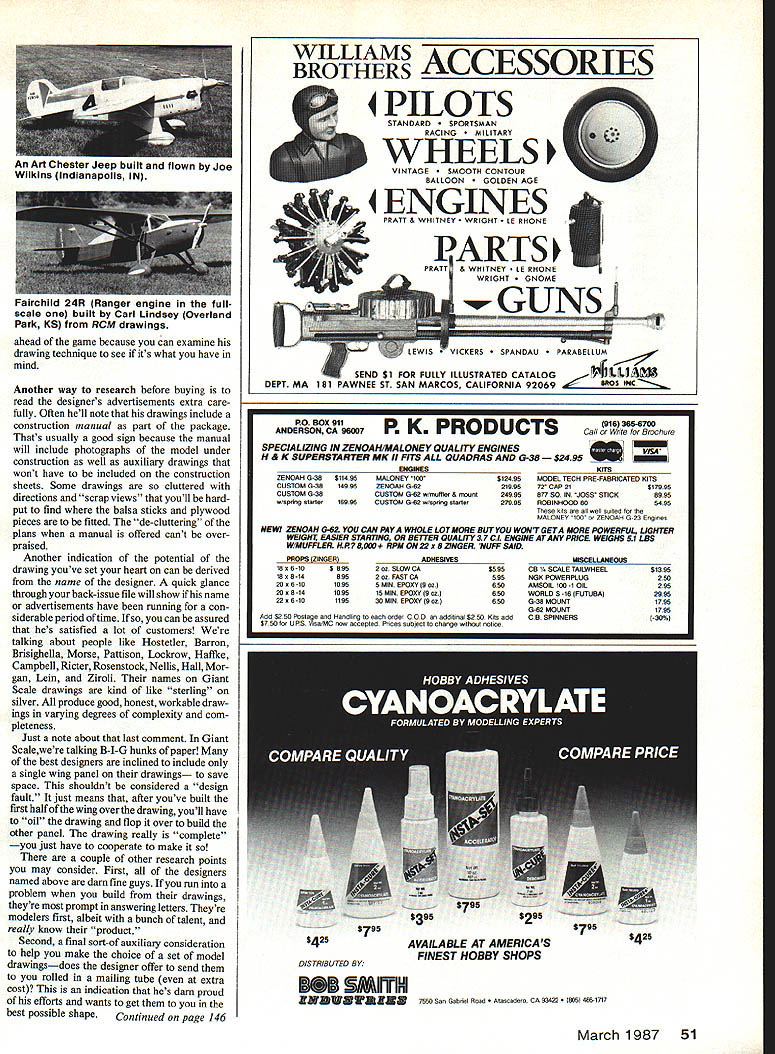
They're not all that difficult to locate, either. Tiny ads in the model-airplane magazines tout the availability of everything from the simplest Piper Cub to the massive Douglas AD, fighters from the Great War (Fokkers and SE-5s), and practically every warbird from WWII—these may be built from scratch; the drawings are available. If your taste is for racers of the Golden Age, they're available, as are most of the current home-builts like the Volksplane. It may take a bit of looking to find drawings for Ercoupes, Christen Eagles, or Liberty Sports. The menu isn't limited to scale subjects. Drawings for a number of Giant sport-plane models are available and advertised. Thus, if you prefer models that don't necessarily "look scale," you're still in luck!
It is very important, of course, to match your scratch-building and model-flying skills with the first plan-built model you choose. That "scale" Corsair may make your mouth water, but that bent wing center-section may be beyond your capabilities. The F-51 Mustang may really "turn you on," but its flying characteristics may tax your flying abilities to the max. After all, Air Corps pilots didn't hop into a Mustang cockpit until they had more than 200 hours of flying time!
There are plenty of simple-to-build and easy-to-fly Giant Scale model drawings out there. Choosing one of them for a first try might be the prudent choice and help ensure the success of your first Giant effort!
Finding and Evaluating Drawings
A big heap of caution right about here—there are drawings and there are "drawings" out there! Some of them are prime examples of the model draftsman's art. With them in hand and the necessary supplies, you're going to build a spectacular Giant Scale model in short order. Others assume that you've been building Giant Scale models since age three and have won the Scale Masters at least once! Happily, at least 80% of the available drawings, if followed with a moderate degree of skill, will produce a decent flying model. However, since the average price for a set of Giant Scale construction drawings runs about $30, a bit of research on what you're buying is in order.
Probably the absolute best way to check what you can anticipate is to find another modeler in town who has a set of the drawings you're interested in. That will give you all the information you need to decide. Even if you can only locate drawings by the same designer, you'll be well aware of your capabilities.
Another way to research before buying is to read designers' advertisements extra carefully. Often they'll note the drawings include a construction manual as part of the package. That's usually a good sign because the manual will include photographs of the model under construction, whereas auxiliary drawings won't include construction sheets. Some drawings are cluttered, with directions and scrap views—you'll have a hard time finding which balsa sticks and plywood pieces are fitted. A decluttered plans manual can't be overpraised.
Another indication of the potential quality of a drawing can be derived from the name of the designer. A quick glance through the back-issue file will show names of designers who have been advertising for a considerable period of time—you can be assured they've satisfied a lot of customers. Designers to look for include:
- Hostetler
- Barron
- Brisighella
- Morse
- Pattison
- Lockrow
- Haffke
- Campbell
- Ricter
- Rosenstock
- Nellis
- Hall
- Morgan
- Lein
- Ziroli
Scale drawings are kind of like "sterling" on silver. All produce good, honest, workable drawings in varying degrees of complexity and completeness.
Just a note about that last comment. In Giant Scale, we're talking B-I-G hunks of paper! Many of the best designers are inclined to include only one wing panel on their drawings—to save space. This shouldn't be considered a design fault. It just means that, after you've built the first half of the wing over the drawing, you'll have to flip the drawing over to build the other panel. The drawing really is complete—you just have to cooperate to make it so!
Additional Research Points
There are a couple of other research points you may consider. First, all of the designers named above are darn fine guys. If you run into a problem when you build from their drawings, they're most prompt in answering letters. They're modelers first, albeit with a bunch of talent, and really do know their product.
Second, a final sort-of-auxiliary consideration to help you make the choice of a set of model drawings—does the designer offer to send them to you rolled in a mailing tube (even at extra cost)? This is an indication that he's proud of his efforts and wants to get them to you in the best possible shape.
Closing
With a bit of checking I think you'll find what you're looking for among the mail-order Giant Scale drawings. Give it a try—you'll like scratch building.
My sincere thanks to Jerry Smith, photographer par excellence, for the photos accompanying this month's column. I've been slowed up a bit by surgery, and Jerry came through for me like the U.S. Marines!
John A. de Vries 4610 Mogall Ln., Colorado Springs, CO 80915.
Transcribed from original scans by AI. Minor OCR errors may remain.

