
Radio Control: Giant Scale
John A. de Vries Colonel, USAF, Ret.
Wood, size and tools
One of the first things a modeler learns about Giant Scale models is that the pieces are big, too. That shouldn't be a surprise to someone used to building smaller models. Wood sizes become substantially larger: stringers on a .60-size model that might be 1/8‑in. square balsa suddenly become 3/8‑ or 1/4‑in. square or bigger. The nice, soft balsa is often replaced by much harder spruce, redwood or basswood.
Another early realization is that the ever‑handy X‑Acto knife isn't able to cut Giant Scale‑sized woods properly. The budding Giant Scaler soon visits the local hobby shop to purchase a razor saw, and probably a small aluminum or wooden miter box. These tools help make square cuts across the harder woods that Giant Scale models demand for both strength and lightness.
Joints, glues and the sanding problem
Although the razor saw works well, the modeler who uses high‑speed cyanoacrylate (CyA) glues will soon find that the accuracy of saw cuts can leave something to be desired. CyA glues demand very precise fits between parts.
A common reaction is to "touch up" fits with a sanding stick or sandpaper. After a couple of swipes, the nice square (if slightly fuzzy) cut produced by the razor saw can be skewed out of square. Hand‑sanding is an imprecise process and can destroy a tight fit.
You effectively have two alternatives:
- Use gap‑filling CyA glues or epoxy to bridge the gaps. This sometimes works for small imperfections, but large gaps are risky — glue fillets don't transfer flight stresses the same way tight wood joints do, and a weak structure can result.
- Invest in a powered disk sander to produce good, tight wood joints and precise parts. This is the recommended solution.
The powered disk sander — recommended
A powered disk sander doesn't have to be large or expensive. A simple electric disk with an adjustable table that permits square sanding is ideal. For the price of a couple of Giant Scale servos you can acquire a tool that will last for years and enable you to prepare absolutely perfect joints.
Typical features and uses:
- Many small disk sanders include a plastic right‑angle guide for dead‑on square sanding.
- Slightly more expensive models include templates or adjustable tables for angle sanding (useful for fuselage crosspieces and diagonal braces).
- The sander is compact enough to sit at the back of the workbench without taking much room.
- Technique: mark the part in pencil, cut slightly oversize with the razor saw, then sand to precise size on the disk sander. This produces parts that lock together and bond with thin CyA glues.
- Additional uses: squaring and fitting trailing edges, wing ribs, thicker plywood tasks, trimming firewalls, creating dihedral braces, and multi‑plane sanding by tilting the guide table.
In short, the little machine becomes indispensable quickly — you'll wonder how you managed without it.
Scale resources and publications
For modelers devoted to true scale work, a few publications and resources are worth noting:
- WWI Aero (Leo Opdycke, 15 Crescent Rd., Poughkeepsie, NY 12601) — published for 25 years, five times a year. It covers aircraft and period details from the Wright brothers through 1919 and is a reliable source of scale information (cockpits, instruments, colors, markings, etc.).
- Skyways, The Journal of the Airplane, 1920–1940 — a new quarterly begun by Leo Opdycke with editor Kenn Rust (author of books published by Paul Matt's Historical Aviation Album). Like WWI Aero, Skyways publishes reader‑written articles and documents the between‑wars era. Support is by membership (a $20/year contribution is suggested).
If your interest is in the silk‑scarf‑and‑goggles era, consider contacting Leo Opdycke and/or Kenn Rust to become a member.
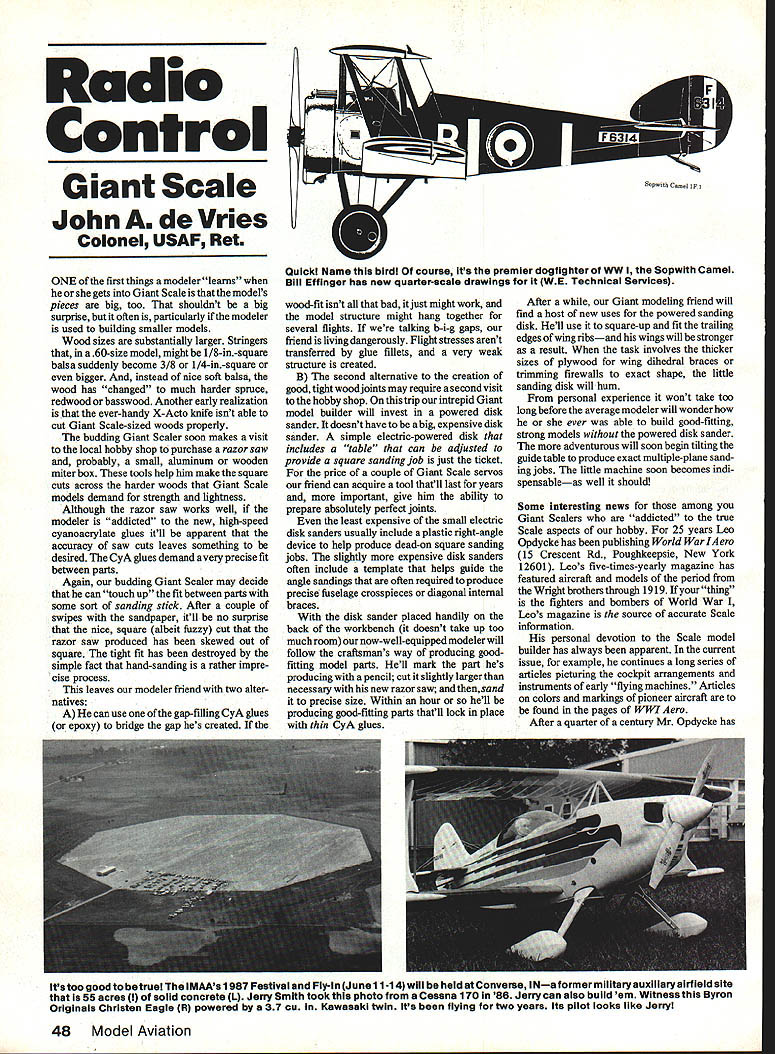
New plans: Sopwith Camel (quarter scale)
W.E. Technical Services (Bill Effinger, P.O. Box 76884, Atlanta, GA 30328) is offering quarter‑scale drawings for the Sopwith Camel. Details announced include:
- Designed for Quadra power
- 84 in. span
- About 11 lb ready to fly
- Approximately 2,150 sq. in. wing area
- RAF 16 scale airfoil
- Cantilever wings that do not rely on scale rigging for structural integrity
- Plans document Captain Roy Brown's aircraft
- Price: $24.95
- Bill Effinger offers a $1 brochure listing available models and drawings (the $1 applies toward a purchase)
Effinger's plans are professionally done and produce good, flyable models that are true to scale.
IMAA Flying Festival (1987)
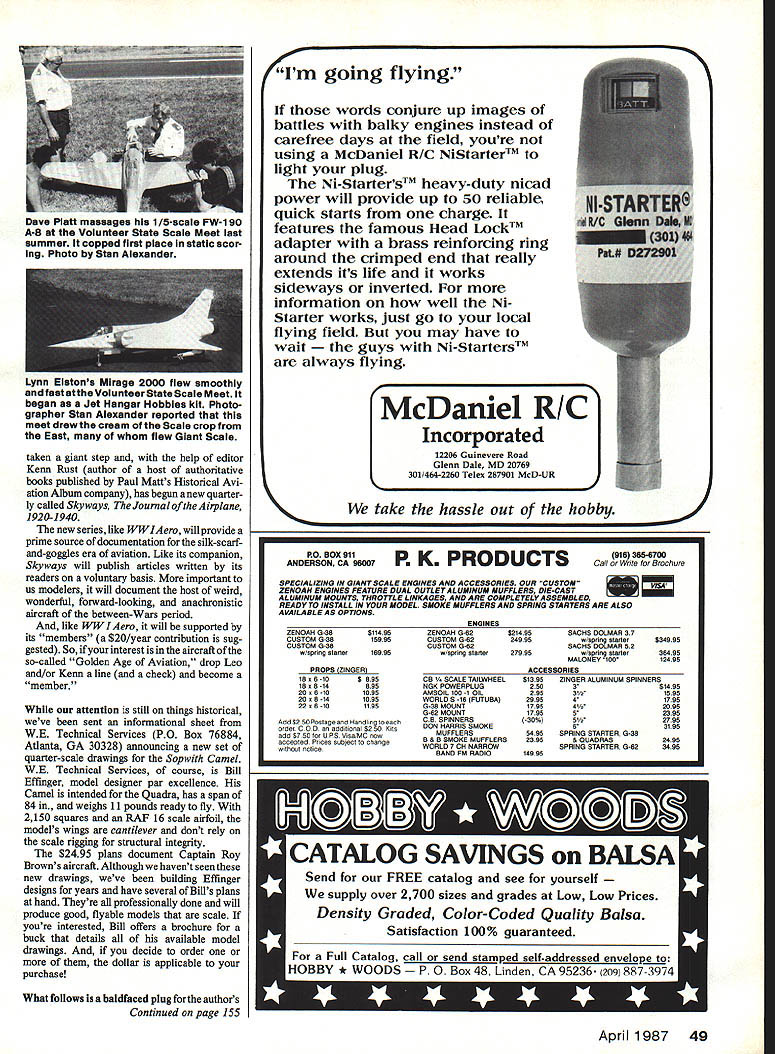
Plans are going forward for the IMAA's 1987 Flying Festival. Key points:
- Dates: June 11–14 (scheduled earlier in the season to avoid heat and humidity)
- Location: Converse, IN — a former military auxiliary airfield with about 55 acres of paved surface
More specifics and particulars were to be provided in subsequent announcements.
From the Firewall Forward — The Quadra Bible
Dario Brisighella ("Mr. Quadra") is the author of From The Firewall Forward: The Quadra Bible, a comprehensive guide to the care, operation and maintenance of Quadra series engines and similar converted small industrial engines. The book is highly detailed and useful if you operate Quadra or converted chain‑saw/leaf‑blower engines in your Giant.
Ordering:
- Illustrated copy with color cover: $12.95 plus $1.50 postage and handling
- Available from the author (U.S. Quadra, 1032 E. Manitou, Oak Creek, WI 53154), RCM, Zenith Aviation Books, or model dealers who carry Ace R/C or Royal Products
- Dario may be persuaded to provide autographed copies
Closing
Keep 'em flying B‑I‑G!
John A. de Vries 4610 Moffatt Ln. Colorado Springs, CO 80915
Transcribed from original scans by AI. Minor OCR errors may remain.

