
Radio Control: Giant Scale
John A. de Vries
Colonel, USAF, Ret.
Looking Back
In the January 1938 issue of Model Airplane News, Jay's Hobby Shop in Los Angeles advertised a Megow Art Chester's Jeep kit in 4-in. = 1-ft. scale (!) for $12.50, postpaid. Of course, it was a gas-powered Free Flight model—but it was one-third the size of the prototype racer.
Cleveland advertisements in even earlier model magazines touted Stinson gull-wing kits with 82-in. spans "suitable for the Brown Jr. gas engine." The Peerless Model Airplane Company, for $5.50 (plus 50 cents for postage), promised a 72-in. Taylor Cub kit.
Digging into the magazines of the Thirties, practically every issue had photographs of what we now call Giant Scale. Rubber-powered Monocoupes and Boeing F4B-4s with spans from seven to nine feet were common (there were kits for them, and the Miniature Aircraft Company sold 82-in. Lockheed Vegas "to be powered by rubber or 1/2-horsepower gas engines"—$18.00). The "silent fliers" didn't stand short in the good old days. Fourteen-foot sailplanes were relatively common, and the April 1938 Model Airplane News featured a 10-ft.-span, 100%-scale Primary Glider.
My magazine collection begins in 1932, and paging through the volumes reveals that even then modelers were doing what we are today—designing and building Giant Scale. The only essential differences between then and now involve power and radio control. The pioneering "giant" builders were limited to rubber and had to build light. Two-and-a-half to three pounds was the norm for eight-foot scale models that had twisted rubber bands for power. Other scale modelers were delighted with achieving 200-ft. flights; the "giant builders" were sailing out to 900 feet—or so they claimed.
Then as now, the big'uns had superior aerodynamic performance. It's really puzzling why the majority of modelers stuck with the 12-in. to 24-in. scale models when the larger birds flew much better. It probably was a matter of cost!
The first contest I ever won (with a Denny Condor rubber-powered Duration model) had a prize of five whole dollars, which I promptly spent for nine Cleveland "Dwarf" Thompson kits — trophy racer kits! And I still had half a buck left over for glue and dope! The same money would have purchased only five 1/4-size of the real planes! G.H.Q. Monocoupe or Stinson kits!
Why all this ancient history? There are a couple of reasons. First, to indicate that the building of large-sized scale models has a long and varied tradition. As long as there have been model airplanes, modelers have been building them in "giant" sizes. From the days when wingtips were made of bamboo strips bent around hot light bulbs and you had to make your own glue by dissolving celluloid in acetone, B-I-G Bleriots, Wrights, and Taubes have proliferated.
The second reason for the history lesson is to bring to your attention that there are a host of Giant Scale designs already flight-proven that can be adapted to today's structural demands—and can be adapted to radio control!
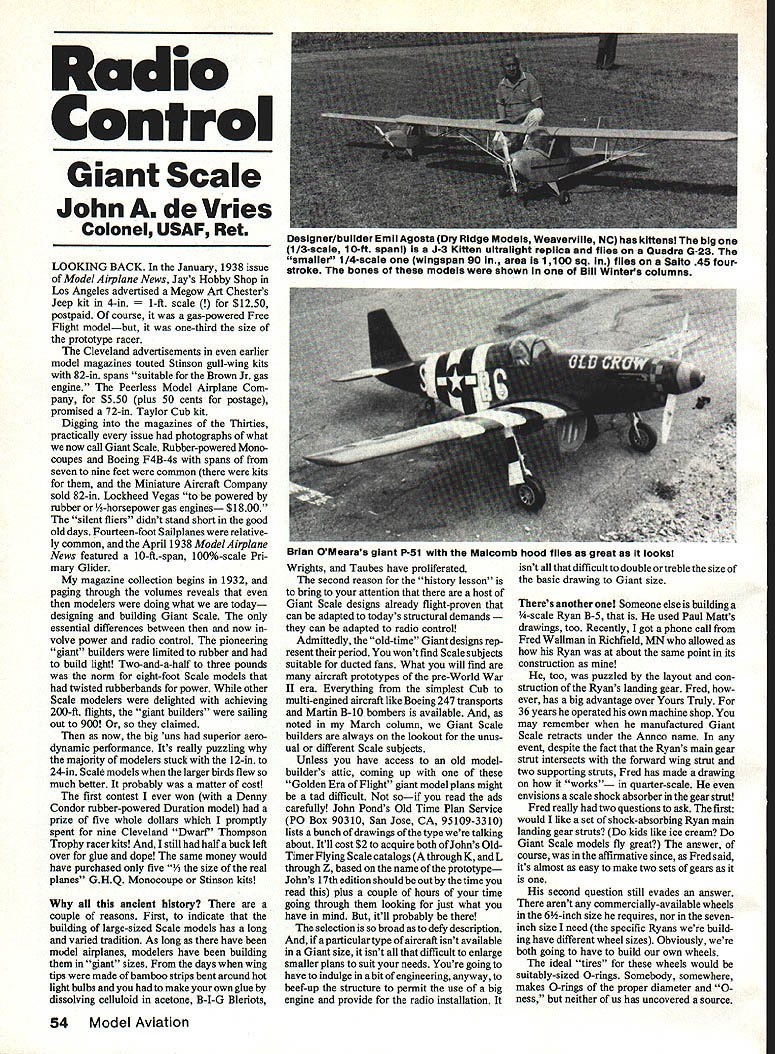
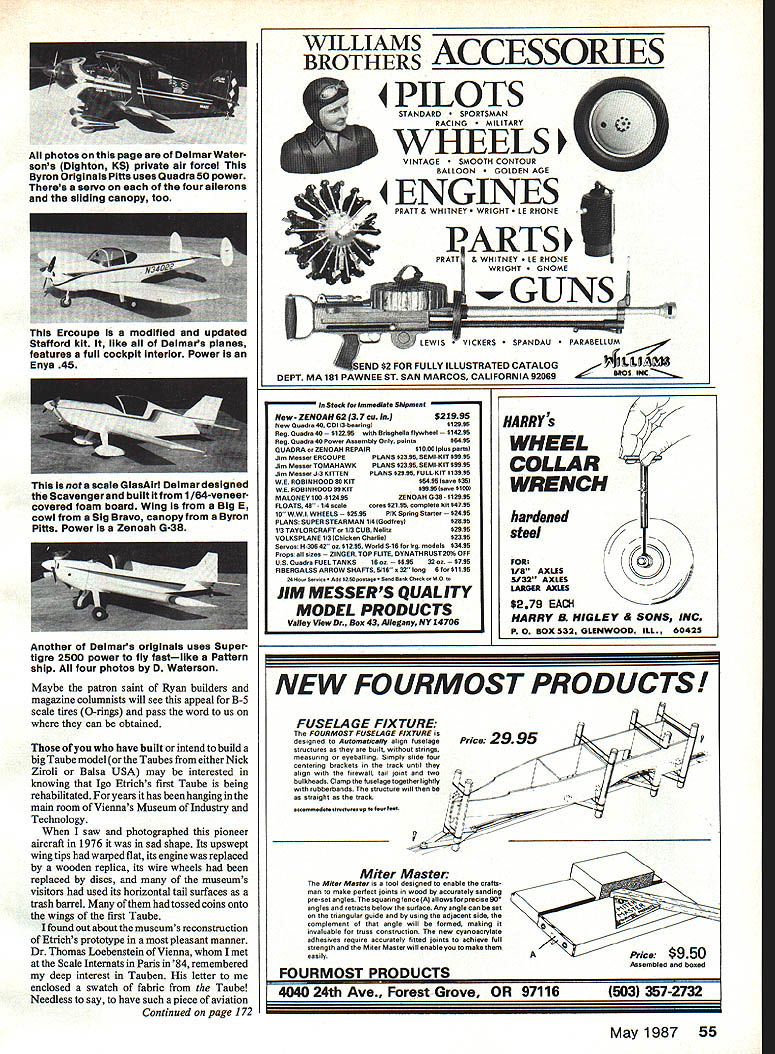
Admittedly, the old-time Giant designs represent their period. You won't find scale subjects suitable for ducted fans. What you will find are many aircraft prototypes of the pre-World War II era. Everything from the simplest Cub to multi-engined aircraft like Boeing 247 transports and Martin B-10 bombers is available. And, as noted in my March column, the giant scale builders are always on the lookout for unusual or different scale subjects.
Plans and Sources
Unless you have access to an old model builder's attic, coming up with Golden Era giant model plans might be a tad difficult. If you read ads carefully, John Pond's Old Timer Plan Service, P.O. Box 90310, San Jose, CA 95109-3310 lists a bunch of drawings of the type we're talking about. It will cost $2 to acquire both John's Old Timer Flying Scale catalogs (A through K and L through Z, based on the name of the prototype). John's 17th edition should be out by the time you read this. The selection is broad and defies description. If a particular type aircraft isn't available, Giant size isn't difficult—enlarge smaller plans to suit needs. You're going to have to indulge a bit of engineering anyway to beef up the structure to permit the use of a big engine and provide for the radio installation. It isn't difficult to double or treble the size of the basic drawing to make it Giant size.
Ryan B-5 and Landing Gear
There's another one! Someone else is building a 1/4-scale Ryan B-5, that is. He used Paul Matt's drawings, too. Recently I got a phone call from Fred Waliman of Richfield, MN, who mentioned that his Ryan was at about the same point in its construction as mine.
He, too, was puzzled by the layout and construction of the Ryan's landing gear. Fred, however, has a big advantage over yours truly. For 36 years he operated his own machine shop. You may remember he manufactured Giant Scale retracts under the Annco name. In any event, despite the fact that the Ryan's main gear strut intersects the forward wing strut, Fred has made a drawing that works in quarter-scale and envisions a scale shock-absorbing gear strut.
Fred really had two questions to ask. The first was: would I like a set of shock-absorbing Ryan main landing gear? (Do kids like ice cream?) The answer, of course, was yes; it's almost as easy to make two sets of gear as it is one.
His second question still evades an answer. There aren't any commercially available wheels in the 6-1/2-inch size he requires, nor in the 5-inch size I need. Since the two Ryans we're building have different wheel sizes, obviously we're both going to have to build our own wheels. The ideal "tires" for these wheels would be suitably sized O-rings. Somebody, somewhere, makes O-rings of the proper diameter and cross-section, but neither of us has uncovered a source.
Maybe the patron saint of Ryan builders and magazine columnists will see this appeal for B-5 scale tires (O-rings) and pass the word to us on where they can be obtained.
Taube Restoration
Those of you who have built or intend to build a big Taube model (or the Taubes from either Nick Ziroli or Balsa USA) may be interested in knowing that Igo Etrich's first Taube is being rehabilitated. For years it has been hanging in the main room of Vienna's Museum of Industry and Technology.
When I saw and photographed this pioneer aircraft in 1976 it was in sad shape. Its upswept wingtips had warped flat, its engine was replaced by a wooden replica, its wire wheels had been replaced by discs, and many of the museum's visitors had used its horizontal tail surfaces as a trash barrel. Many of them had tossed coins onto the wings of the first Taube.
I found out about the museum's reconstruction of Etrich's prototype in a most pleasant manner. Dr. Thomas Loebenstein of Vienna, whom I met at the Scale Internationals in Paris '84, remembered my deep interest in Taube. His letter to me enclosed a swatch of fabric from the Taube! Needless to say, to have such a piece of aviation history is the next best thing to winning a sweepstakes!
Events
Don't forget the big IMAA Festival in Converse, IN — June 11-14. See you at the Rally of Giants!
John A. de Vries 4610 Moffat Ln. Colorado Springs, CO 80915
Transcribed from original scans by AI. Minor OCR errors may remain.

