
Radio Control: Giant Scale
John A. de Vries Colonel, USAF, Ret.
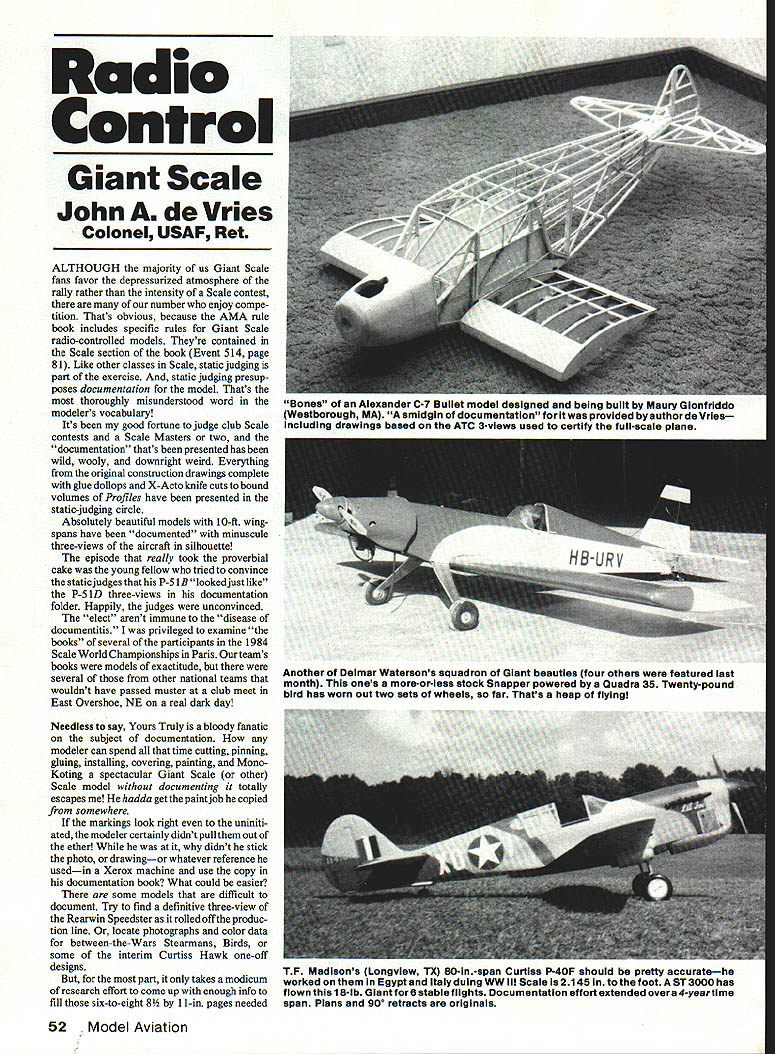
ALTHOUGH the majority of us Giant Scale fans favor the relaxed atmosphere of a rally rather than the intensity of a Scale contest, many of us enjoy competition. The AMA rule book even includes specific rules for Giant Scale radio-controlled models (Scale section, Event 514, page 81). Like other Scale classes, static judging is part of the exercise — and static judging presupposes documentation. “Documentation” is one of the most misunderstood words in the modeler’s vocabulary.
The problem with documentation
Judges at club Scale contests and larger events have seen documentation that ranges from original construction drawings (complete with glue dollops and X‑Acto knife cuts) to bound volumes of profiles, to minuscule three‑views or mere silhouettes. Beautiful models have lost points because their documentation was generic, incomplete, or inaccurate — for example, trying to show a P‑51B as a P‑51D by using the wrong three‑views. Good documentation should demonstrate that the model accurately represents a specific prototype.
Sources for documentation
- Local libraries — often the best starting point. Many have back issues of Jane’s, World’s Aircraft, Aircraft Yearbooks, and aviation magazines (Popular Aviation, Sport Aviation, Aero Digest, etc.).
- Aviation magazines — contemporary issues often contain photos, color data, and details useful for modeling.
- Coin‑operated Xerox machines at libraries — useful for capturing pages for your documentation binder.
- Documentation/photo services — for specific airframes, consider commercial services that supply comprehensive color photos and three‑views.
Recommended photo services
- Scale Plans and Photo Service (Lyle Pepino)
3209 Madison Ave., Greensboro, NC 27403 — Offers stacks of color photos, three‑views, and some Giant Scale construction drawings.
- Scale Model Research (Bob Bianka)
2334 Ticonderoga Way, Costa Mesa, CA 92626 — Provides color photos and reference material for individual aircraft.
A combination of library research, Xeroxed references, and color photos of the specific airframe is often all that’s needed to assemble a prize‑winning documentation booklet.
Preparing the documentation booklet
- Avoid looseleaf notebooks — repeated handling enlarges the holes and the pages look shabby.
- Use a report folder (manila type) with metal fasteners for a semi‑permanent binding.
- Insert each page in clear plastic page protectors to keep them clean on the flight line and in the static circle.
- Mount photos smaller than full‑page on the black inserts that come with the plastic protectors so they won’t fall out.
Order and contents of the booklet
The booklet should be logically arranged to make the judges’ job easy.
- Cover
- Identify the model, builder, and owner.
- A manufacturer logotype (trademark) of the prototype is appropriate.
- First page
- A full‑size three‑view and your name.
- Include on the first page:
- Model’s name
- Full‑scale manufacturer’s name and nationality
- Date of the prototype’s first flight
- Production dates of the prototype
- If facts are obscure, cite your sources (books, magazines, articles)
- If using a plastic kit
- Show the kit box and the kit scale on the first pages.
- Include the three‑view and then photos of the kit and the completed model.
- Photographs and color data
- Include clear color and black‑and‑white photographs of the aircraft and of the prototype’s markings.
- Provide annotations noting exact positions of markings and paint schemes.
- Commercial parts and equipment (not strictly “documentation” but useful)
- List major commercial components used in the model and their sources, for example:
- Engine make and model
- Propeller
- Radio gear
- Retracts
- Tires/wheels
- Other major components
- References
- Cite the sources of your reference material (books, magazines, photo services, archives).
Final notes
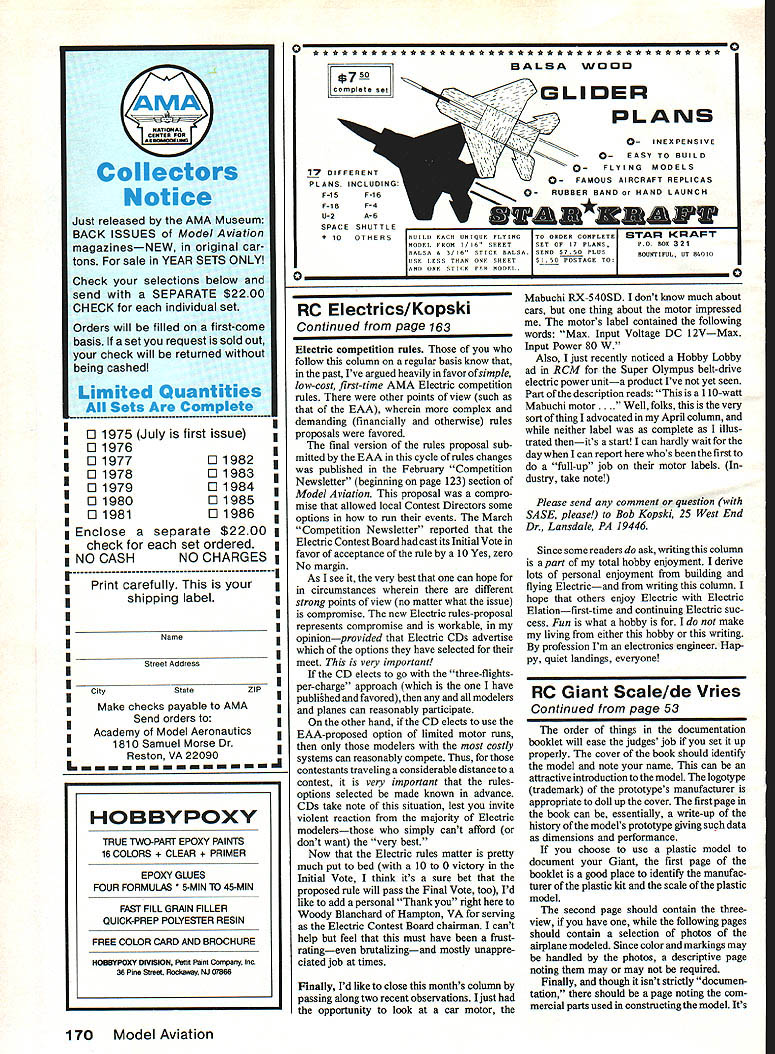
Some prototypes are hard to document (rare types, one‑offs, or between‑the‑wars designs), but a modest amount of research effort usually yields enough information to fill the typical six‑ to eight‑page (8½ × 11 in.) documentation booklet. Good documentation not only helps judges see the accuracy of your model, it can add points to your static score.
Transcribed from original scans by AI. Minor OCR errors may remain.

