
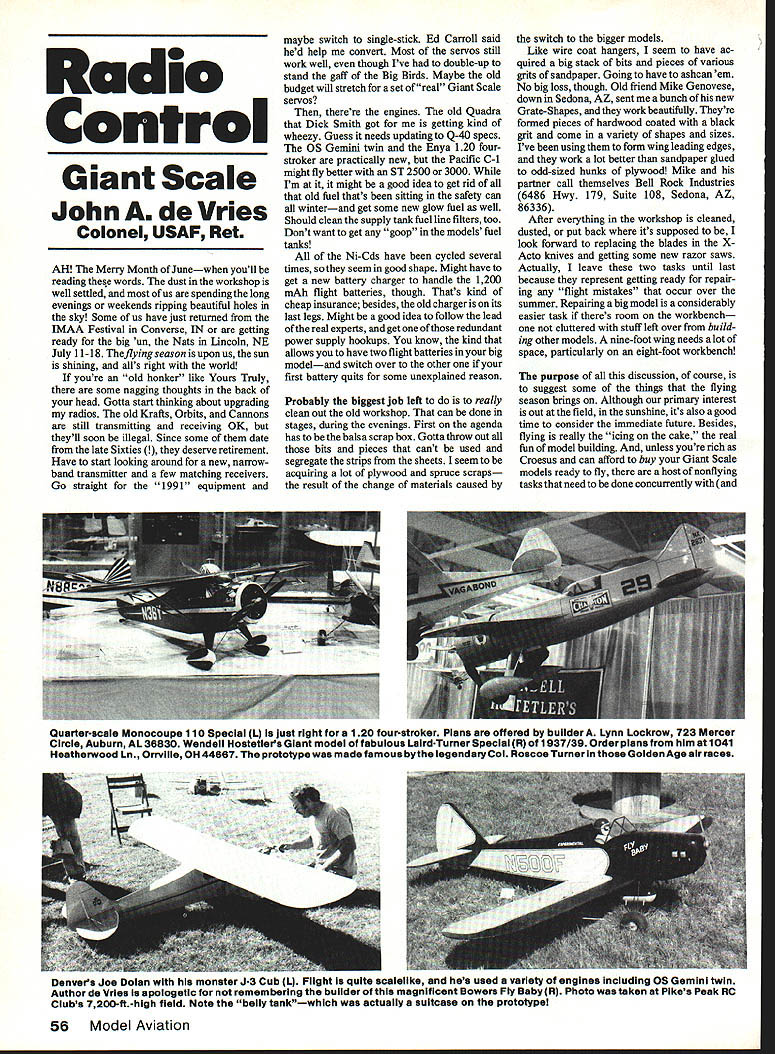
Radio Control: Giant Scale
John A. de Vries Colonel, USAF, Ret.
AH! The merry month of June — when you'll be reading these words. The dust in the workshop is well settled, and most of us are spending the long evenings and weekends repairing beautiful holes in the sky. Some of us have just returned from the IMAA Festival in Converse, IN, or are getting ready for the big 'un, the Nats in Lincoln, NE, July 11–18. The flying season is upon us, the sun is shining, and all's right with the world!
Preparing for the season
If you're an "old honker" like yours truly, there are some nagging thoughts in the back of your head. Gotta start thinking about upgrading my radios. Old Krafts, Orbits, and Cannons are still transmitting and receiving OK, but they'll soon be illegal since some of them date from the late Sixties. I've got to start looking around for a new, narrow-band transmitter and a few matching receivers. Go straight for the "1991" equipment and maybe switch to single-stick. Ed Carroll said he'd help me convert. Most of the servos still work well, even though I've had to double up to stand the gaff of the Big Birds. Maybe the old budget will stretch for a set of "real" Giant Scale servos?
Then, there're the engines. The old Quadra that Dick Smith got for me is getting kind of wheezy. Guess it needs updating to Q-40 specs. The OS Gemini twin and the Enya 120 four-stroker are practically new, but the Pacific C-1 might fly better with an ST 2500 or 3000. While I'm at it, it might be a good idea to get rid of all that old fuel that's been sitting in the safety can all winter — and get some new glow fuel as well. Should clean the supply tank, fuel lines, and filters, too. Don't want to get any "goop" in the models' fuel tanks!
All of the Ni-Cads have been cycled several times, so they seem to be in good shape. Might have to get a new battery charger to handle the 1,200 mAh flight batteries, though. That's kind of cheap insurance; besides, the old charger is on its last legs. Might be a good idea to follow the lead of the real experts and get one of those redundant power supply hookups — the kind that allows you to have two flight batteries in your big model and switch over to the other one if your first battery quits for some unexplained reason.
Workshop cleanup and tools
Probably the biggest job left to do is to really clean out the old workshop. That can be done in stages during the evenings. First on the agenda has to be the balsa scrap box. Gotta throw out bits and pieces that can't be used and segregate strips and sheets. I seem to be acquiring a lot of plywood and spruce scraps as a result of the change of materials caused by going to bigger models. Like wire coat hangers, I seem to have acquired a big stack of bits and pieces of various grits of sandpaper. Going to have to ashcan 'em. No big loss, though.
Old friend Mike Genovese down in Sedona, AZ, sent me a bunch of his new Grate-Shapes; they work beautifully. They're formed pieces of hardwood coated with a black grit and come in a variety of shapes and sizes. I've been using them to form wing leading edges, and they work a lot better than sandpaper glued to odd-sized hunks of plywood. Mike and his partner call themselves Bell Rock Industries, 6486 Hwy. 179, Suite 108, Sedona, AZ 86336.
After everything in the workshop is cleaned, dusted, or put back where it's supposed to be, I look forward to replacing the blades in the X-Acto knives and getting some new razor saws. Actually, I leave these two tasks until last because they represent getting ready for repairing any "flight mistakes" that occur over the summer. Repairing a big model is a considerably easier task if there's room on the workbench — not cluttered with stuff left over from building other models. A nine-foot wing needs a lot of space, particularly an eight-foot workbench!
The purpose of all this discussion, of course, is to suggest some of the things that the flying season brings on. Although our primary interest is out in the sunshine at the field, it's also a good time to consider the immediate future. Besides, flying is really the "icing on the cake," the real fun of model building. And unless you're rich Croesus and can afford to buy your Giant Scale models ready to fly, there are a host of nonflying tasks that need to be done concurrently with (and in preparation for) the switch to the bigger models.
Ignition system safety
It isn't news to most of us Giant Builders, but the IMAA safety code requires the use of switches in the ignition systems of our engines. The rule requires a method to shut down our Quadras, Zenoahs, and Sachs-Dolmers right now!
One of two installations is suggested:
- Provide an external switch that can be manually operated to kill the ignition.
- Install a servo-operated switch that does the same thing.
Prudent safety considerations suggest, however, that we provide both switches in the ignition line. Admittedly, both switches have to be on to get the engine to fire. (Yes, I've done a lot of prop-flipping when the servo-switch was Off!) The transmitter should be Off when you're cranking the engine in the model, and it's part of the start procedure to flip the servo switch On before activating the external switch.
On most models, the external switch has to be in an inconvenient position — right behind the engine/propeller. It's a darned good idea to point its position out to whoever is helping you start your engine! Your "crew" is in a much better position to activate the external switch than you are.
Engine shutoff methods for big two-cycle engines
The advent of the "big" two-cycle engines poses some new engine shutoff problems for us. Starting in idle is a good idea if you're using the two-bangers, particularly if you've set up your right trim so that full aft trim on the throttle stick acts as an engine cutoff. Setting up an engine in this way does take a bit of fiddling, but it's well worth the effort. Nothing spoils your day more than a runaway engine that you didn't expect!
For the super-careful builder, it doesn't take much effort to engineer some sort of carburetor intake "plug" that shuts off the engine's air. It can be mechanically operated or hooked into a small servo operated on an unused auxiliary channel on your transmitter.
The "plug" we're talking about can be just that — a shaped plug of balsa or other material that can be dropped into the carburetor intake of the engine. It can also be a sliding metal shutter positioned in a cylindrical tube. The big idea is that the "plug" will cut off carburetor air and stop the engine on command.
There is another method of closing down a big two-cycle engine, particularly if you're using a glow plug heater battery to keep it "popping" at idle. Use a servo-operated switch in the heater line turned Off, plus full engine servo retard, plus full-air engine servo trim — complicated as it may sound — and you can quiet a big two-banger in a hurry. Although it sounds like we're recommending engine control systems that have more ways not to work than to function properly, what we are talking about is a safe model! Being able to stop all that noise up front on command goes a long way toward Giant Scale model operation that's safe.
John A. de Vries 4610 Moffat Ln., Colorado Springs, CO 80915
Flying Near Airports? Be Careful!
Free Flight or Radio Control flying near airports, or in any situation which might involve the possibility of models being in the vicinity of full-scale aircraft operations, must be avoided — or conducted so as to eliminate any dangerous situations. Models should not be flown in the proximity of full-scale aircraft operations unless the flier has someone else with him for the sole purpose of watching for full-scale aircraft and supervising the flying so as to prevent accident possibilities.
Transcribed from original scans by AI. Minor OCR errors may remain.

