
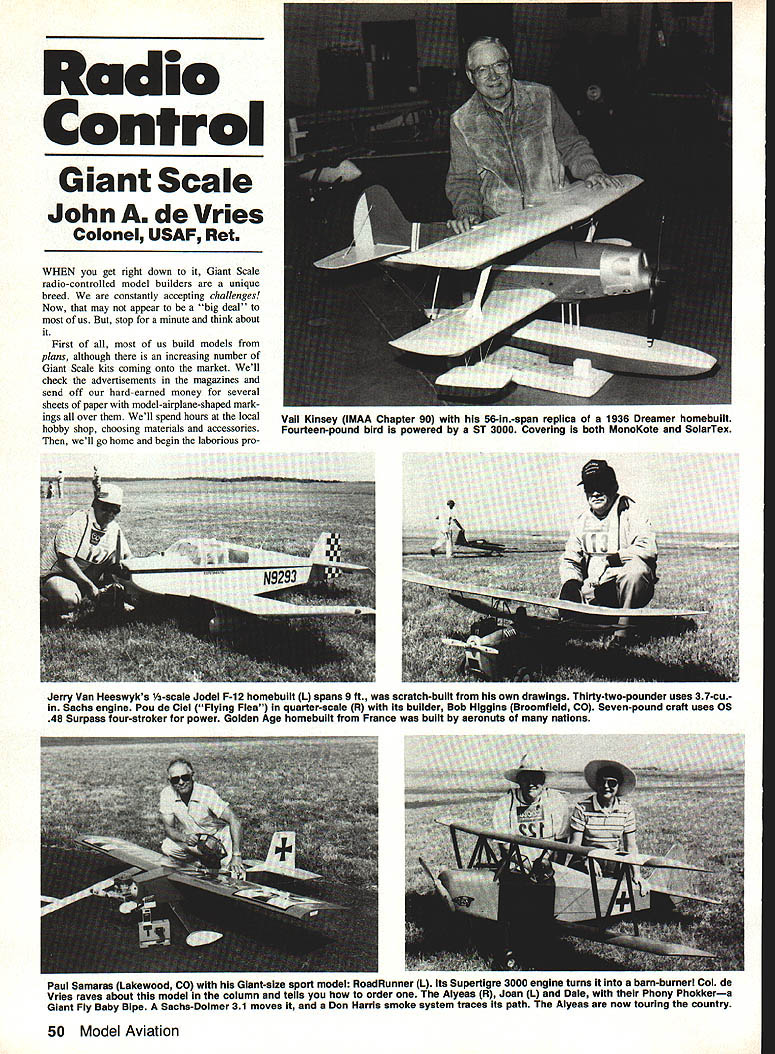
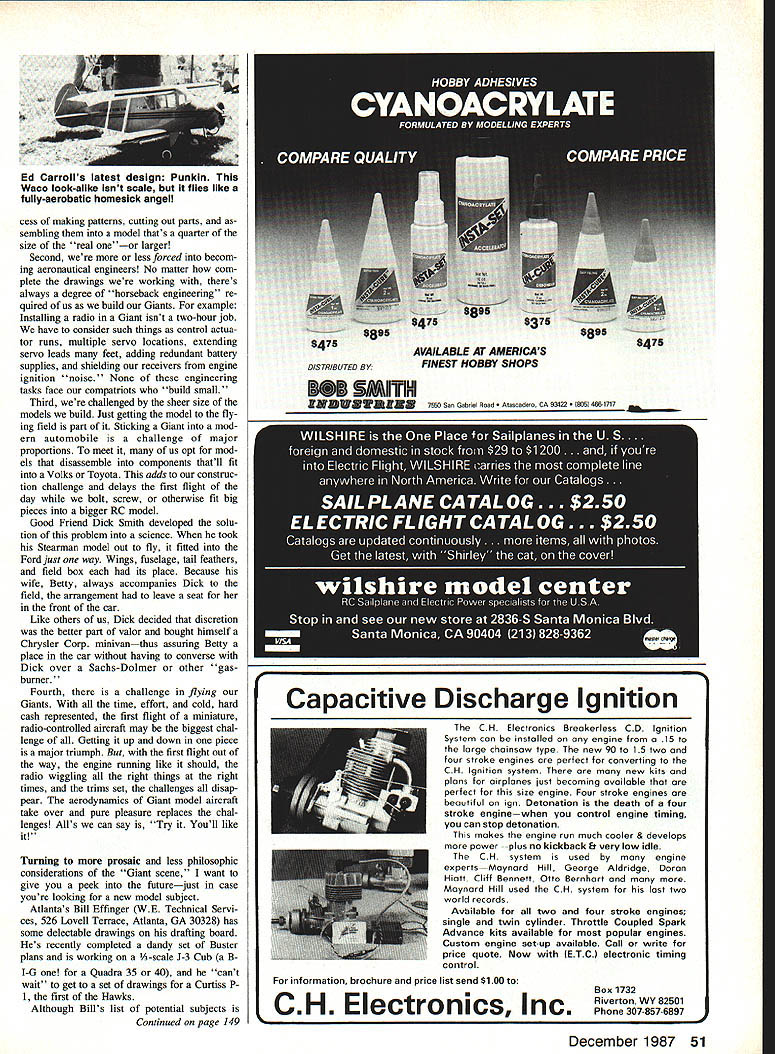
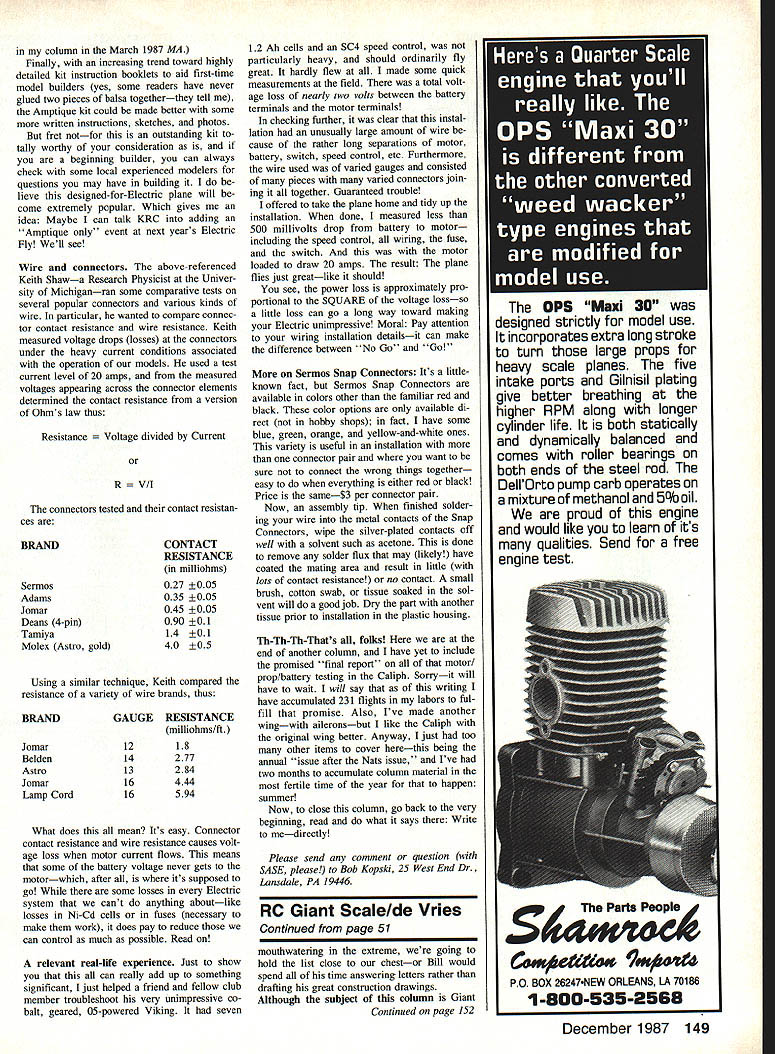
Radio Control: Giant Scale
John A. de Vries
Colonel, USAF, Ret.
When you get right down to it, Giant Scale radio-controlled model builders are a unique breed — we are constantly accepting challenges. Stop for a minute and think about it.
- Building from plans
Most of us build models from plans, although an increasing number of Giant Scale kits are appearing on the market. We check magazine ads, send off our hard-earned money for sheets of paper with model-airplane markings, spend hours at the hobby shop choosing materials and accessories, then go home and begin the laborious process of making patterns, cutting out parts, and assembling a model that's a quarter the size of the real thing — or larger.
- Becoming aeronautical engineers
No matter how complete the drawings and working plans are, there's always a degree of improvisation and engineering required to build Giants. Installing radio gear in a Giant isn't a two-hour job: you must consider control actuator runs to multiple servo locations, extending servo leads several feet, adding redundant battery supplies, and shielding receivers from engine ignition noise. None of these engineering tasks face builders of small models.
- The challenge of sheer size and transport
Just getting the model to the flying field is part of the job. Fitting a Giant into a modern automobile often forces disassembly into components that will fit Volkswagens, Toyotas, etc., which adds construction challenges and can delay the first flight while big pieces are bolted or screwed together. Good friend Dick Smith solved the problem by arranging his Stearman so the wings, fuselage, tail surfaces and field box each had their place for transport. He eventually bought a Chrysler minivan to make field trips easier.
- Flying Giants
Given the time, effort, and cold, hard cash represented, the first flight of a Giant can be the biggest challenge. Getting it up and down on that first flight is a major triumph. Once the engine runs properly, the radio controls move the right things at the right times, and the trims are set, the challenges disappear. Aerodynamics and the Giant model itself take over — pure pleasure replaces the earlier problems. Try it. You'll like it.
Looking ahead: new drawings and subjects
Atlanta's Bill Effinger (W. E. Technical Services, 526 Lovell Terrace, Atlanta, GA 30328) has some delectable drawings on the drafting board. He's recently completed a dandy set of Buster plans, is working on a 1/3-scale J-3 Cub, a B-1G Quadra (35–40), and is eager to get set drawings for a Curtiss P-1 and the early Hawks.
Giant Scale: trainers and sport models
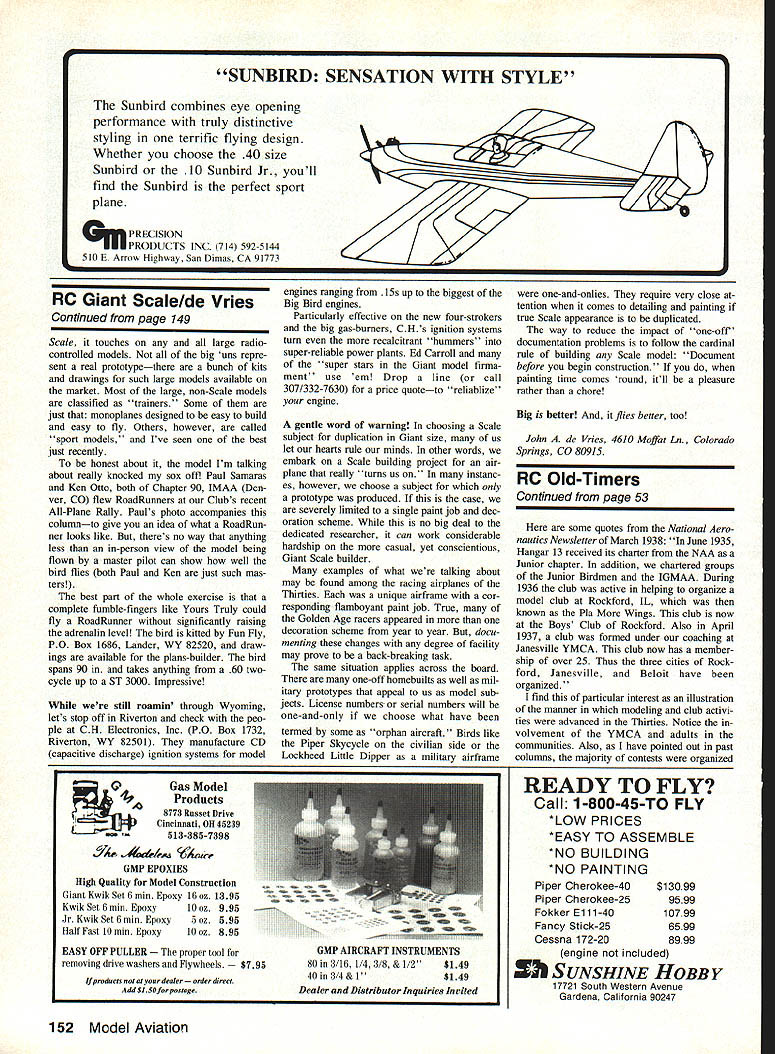
Although the subject of this column is Giant Scale, it touches on all large radio-controlled models. Not all big models represent real prototypes — many are trainers or sport models designed to be easy to build and fly. One impressive sport model I recently saw was the RoadRunner, flown by Paul Samaras and Ken Otto of Chapter 90, IMAA (Denver, CO), at our club's All-Plane Rally. The RoadRunner kit is produced by Fun Fly (P.O. Box 1866, Lander, WY 82520), spans 90 in., and accepts power from a .60 two-cycle up to an ST 3000. The airplane flies superbly and is forgiving enough for less-expert pilots.
Ignition systems for Giants
While we're in Wyoming, check out C.H. Electronics, Inc. (P.O. Box 1732, Riverton, WY 82501). They manufacture CD (capacitive discharge) ignition systems for model engines from .15s up to the largest Big Bird engines. Particularly effective on new four-strokers and large gas burners, C.H.'s ignition systems can turn even reluctant engines into super-reliable power plants. Ed Carroll and many of the Giant model "super stars" use them. For a price quote contact C.H. Electronics at 307-332-7630.
Choosing a Scale subject — a warning
A gentle word of warning: in choosing a Scale subject for duplication in Giant size, many builders let their hearts rule their minds. We often pick airplanes that really "turn us on" — but some subjects existed only as single prototypes. If so, you are limited to a single paint job and decoration scheme. While dedicated researchers can document changes, casual builders may find this back-breaking.
Many one-off racers of the 1930s and other unique homebuilts or prototypes fall into this category. Aircraft like the Piper Skycycle or the civilian counterpart of the Lockheed Little Dipper are effectively "orphan aircraft" with one set of serials or markings. They require close attention to detailing and painting to achieve true Scale appearance.
The way to avoid documentation headaches is simple: document before you begin construction. If you do, painting time will be a pleasure rather than a chore.
Big is better! And it flies better, too!
John A. de Vries 4610 Moffat Ln., Colorado Springs, CO 80915.
Transcribed from original scans by AI. Minor OCR errors may remain.

