
Radio Control: Giant Scale
John A. de Vries
Colonel, USAF, Ret.
The Ryan
THE RYAN is up on its gear! Fred Wallman (Richfield, MN) came through with two beautiful "bird cages," and they fitted with an absolute minimum of persuasion on my part. After a bit of filing of the attachment fittings already installed in the model, the complex assembly slipped in place. The shouldered bolts and their locknuts held everything securely. Fred, a master machinist for over 36 years, included a working oleo which was cast forward seven degrees—dead-on scale!
I still don't have wheels for the bird (they look exactly like Williams Bros. Golden Age rollers—except that I need eight‑inchers!). I'm working on it, though.
For the past couple of weeks I've been forming basswood strut "streamliners" to fit over Fred's ironmongery. It's almost a shame to cover up those beautifully brazed joints. We'll have a close-up photo in next month's column.
When the woodwork's done, I'm going to cover all the struts with Dacron cloth, shrink it in place, and give them a couple or three coats of fiberglassing resin. After a bit of sanding, the strut work should look just like the aluminum originals.
Construction details
Which leads us to the subject of this month's column: PATIENCE!
Those of us who have been in the Giant Scale business for any length of time know that our models take up a LOT of construction hours. Giant RC kits don't approximate the "shake-the-box-and-it's-ready-to-fly" construction sets available to our brethren with less lofty ambitions. Ninety percent of the birds you see at an IMAA (International Miniature Aircraft Association) rally started out as a set of mail-order drawings and a burning desire to create a large-scale model. Between desire and first flight, a lot of pleasant, productive hours must be spent in the workshop.
Take my Ryan as an example. The wing contains 39 ribs, each constructed in a single rib jig. The jig took about a week of evenings to put together. The 3/16-in. plywood rib noses took a weekend to cut out, sand and trim to exact shape. Gussets, of three different types, were cut from 3/64-in. ply and stored in three margarine tubs—about five hours' work using a gusset jig to ensure uniformity.
When I finally got around to assembling the ribs I could build about one a day. I made them from 1/8-in.-sq. spruce and couldn't use high-speed CyA glue because the strips would have stuck to the wooden jig. Between construction of ribs I waxed the old jig with an old candle to keep things from sticking. The 39 wing ribs took over a month and a half to make—not rapid construction jobs, of course.
The ribs could have been cut from balsa in a couple of nights and would have worked well; scale ribs would have been awfully expensive. Twenty-two-inch-chord ribs come per sheet of balsa. In this case the Ryan traded time and effort for expensive material, and the model is closer to scale—a definite plus.
Construction of a Giant Scale model takes time. Building a true miniature airplane isn't a weekend phenomenon for a lot of us; it's a winter project and well worth the effort.
Weight, power, and engines
A universal problem—one that's generated a lot of correspondence lately—is the dual bugaboos of overweight and underpowered Giant Scale models. Often power problems generate modelers' desire to use new four-cycle engines. Giant four-strokes ARE jewel-like engines in the 1–2 cu. in. range and appear ideal for some smaller quarter-scale birds if model weights are about 15 lb.; they are often ideal powerplants, particularly when they can be given a good supply of cooling air. But to ask them to motivate a 20-lb. anchor is cruel and unusual punishment.
There's often a Catch-22 in using two engines. Several kits specify such engine size; the model will be adequately powered if the design weight specified on the drawings and instruction sheet is adhered to. Too frequently, however, builders get carried away with scale detail, paint, epoxy—everything that adds weight—making the model well over the weight limit. Within reasonable limits Giant Scale designs will fly at greater than specified weights, but not as well as a lighter model. Wing loading isn't an infinitely expandable number if you expect any sort of flight performance.
Concurrently, there are only so many horses built into any given RC engine. Even with the absolutely correct propellers, some engines are working their little hearts out just to taxi the model in which they're installed. The point: if you suspect that your bird may weigh in on the heavy side (for any reason), plan for installing an engine that's bigger and stronger than the one recommended on the plans. And do it early in the construction sequence—to avoid having to butcher the front end of your bird after it's all nicely covered and painted.
Industry notes and classifieds
- Bob Holman has acquired a videotape of a Giant Scale meet held at Old Warden in England. Unfortunately, British video standards differ from ours and the tape won't play on a U.S. VCR; converting it (if possible) is rather expensive. If you'd like to see the tapes made available, drop Bob a line at:
- P.O. Box 741, San Bernardino, CA 92402
- Bob Hawkins (AMA 1822) has a goodly supply of Giant Scale items that poor health forces him to part with. A large SASE to Bob will produce a free list of his goodies:
- Bob Hawkins, 1200 E. Calle de la Cabra, Tucson, AZ 85718
- Tom Thumb Sky Tracings was sold a while back. Frank Ewing acquired the company name and the small (Schoolyard Scale) drawings. The Giant Scale kit line was purchased by Tom Wilkinson of Hangar One Hobbies, who continues to make them available:
- Hangar One Hobbies, 1402 Madison Ave., Montgomery, AL 36107
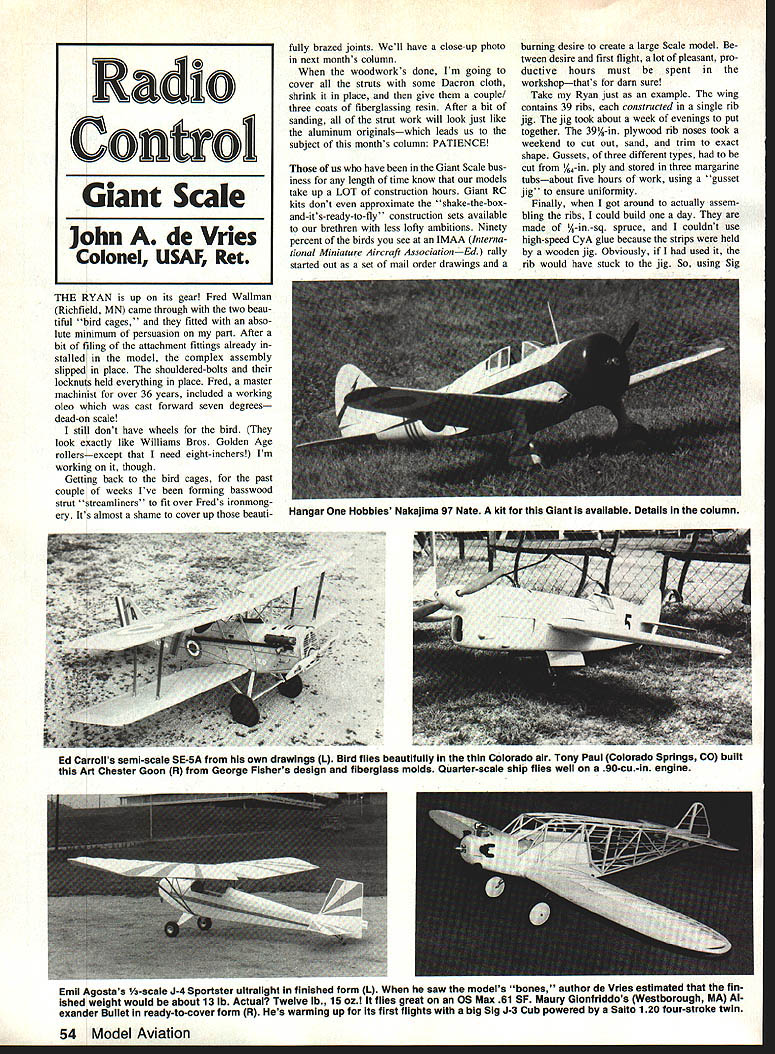
Tom Wilkinson has reissued his beautiful Giant Scale Nakajima Nate (seen by many at Toledo in 1987). It's a string-box kit; Tom promises to reconstruct the Japanese pre‑WWII fighter models and is contemplating drawings (and perhaps kits) for the Ta‑152, a one‑off scale "Benny" Howard Mr. Mulligan, and the Fieseler Storch.
Final thoughts
Giant Scale modeling rewards patience and planning. Trade-offs between time, materials, and detail are inevitable; know your limits, plan your powerplant early, and enjoy the many satisfying hours in the workshop that lead to a truly scale model.
Transcribed from original scans by AI. Minor OCR errors may remain.

