
Radio Control: Giant Scale
By John A. de Vries
Colonel, USAF, Ret. 4610 Moffat Ln. Colorado Springs, CO 80915
Shuttleworth Collection visit
Paradise! To a dyed-in-the-wool scale modeler, it is more fun than a visit to Disneyland — six hangars full of ancient, flyable aircraft. They're enough to raise your blood pressure several points! I recently had the opportunity to visit Great Britain's Shuttleworth Collection at Old Warden, and I practically went bananas.
The Collection was begun in 1932 by sportsman-pilot Richard Shuttleworth. One of his first acquisitions was a 1909 Blériot monoplane, similar to the craft Louis Blériot flew across the English Channel. Shuttleworth had the resources to restore the Blériot to flying condition and his own airport at Old Warden from which to fly it. With great devotion he continued to acquire interesting historical aircraft until his death in a crash of a Fairey Battle in 1940. After World War II, his wife Dorothy retained and added to the collection with the enthusiastic help of a trust she established.
Unfortunately for me, I missed the final flying day of the year, and it was a dark and rainy day when I was able to visit Old Warden. Taking photographs with available light in dimly lit hangars produced only prints suitable for the family album. Neither of these limitations took the edge off the visit, however.
The Shuttleworth craft are maintained in beautiful condition, and none of them were up on blocks. All are on their wheels and ready to be flown. When you can edge up to craft like the de Havilland Comet, a Hawker Hind, a Bristol Box Kite, a Spitfire Vb, or an S.E.5a, it's orgy time! A modeler can be spaced-out by a World War I German LVG reconnaissance biplane or a pristine example of its British counterpart, a Bristol F.2B Fighter.
Just around the corner, in the next hangar, you may find a Sopwith Pup, an Avro Triplane (like the Box Kite), a flying replica built for the film The Daring Young Men and Their Flying Machines, and a trio of Tiger Moths.
Next time I plan on writing ahead for the flying day schedule as well as permission to photograph the Collection from inside the "ropes."
Meeting Dr. Jim Larkin
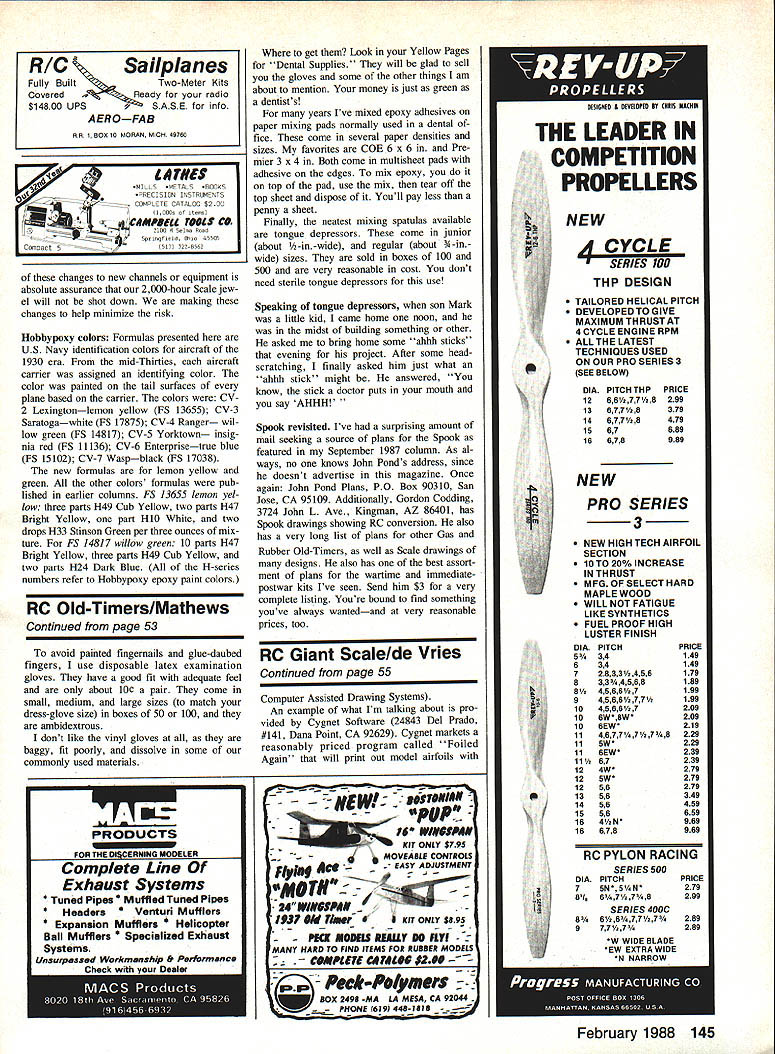
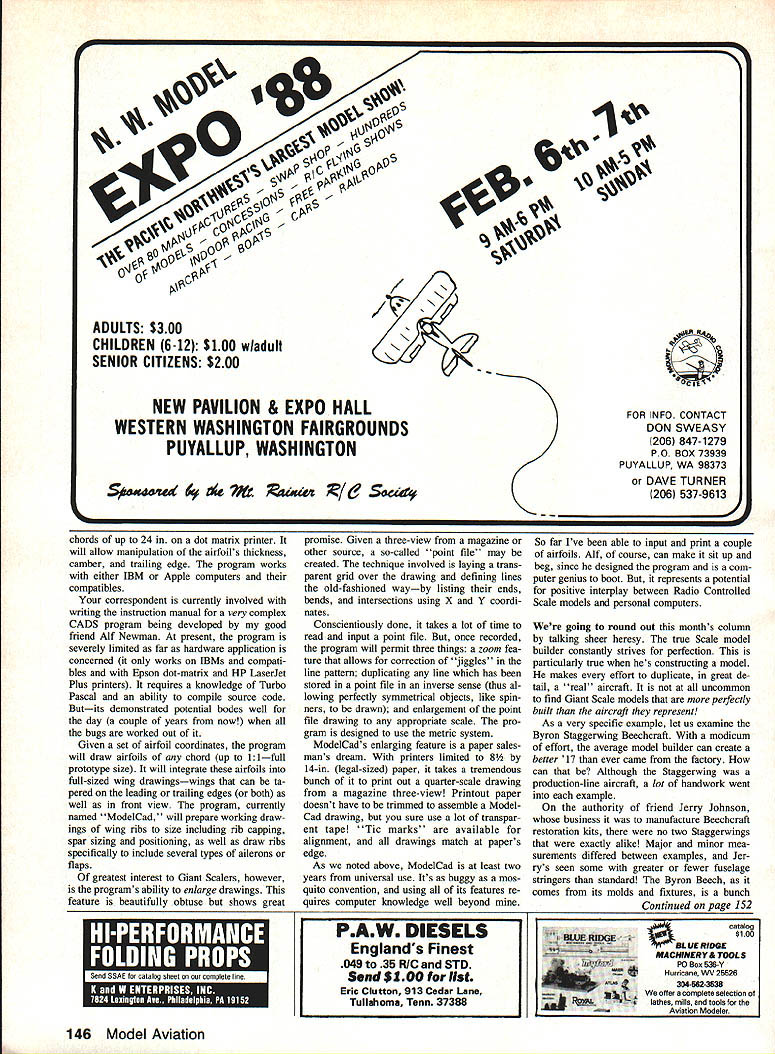
My British visit resulted in a meeting with a superb model designer and builder, Dr. Jim Larkin. Jim works for the U.S. Civil Service but will probably be retiring when this column sees print. The accompanying photographs show his latest model, a pre-prototype scale bird that is unique. Jim adopted the engine mounting system seen on the Custer Channel Wing in the early Fifties. Since the model is an amphibian, the prop is protected from water spray. First flight will probably be from an Idaho lake.
Computers and CADS
Although we don't have specific data to support the assertion, many of us Giant RC builders are "into" computers — the marvels of electronics are a natural extension of our interest in technology. Among other important uses, a home computer allows us to tune into the AMA's ModelNet:
- CompuServe address: 767033041
- The Source: ST6232
This column, as well as others in the magazine, is produced on a PC and submitted to Editor Carl Wheeley on a floppy disk.
Of more direct impact on the combined hobbies is the appearance of computer programs specifically aimed at RC modelers. For years PCs have been used by contest fliers for score keeping, but now there are computer programs that involve model aircraft applications well removed from the database–type score keeping of the past. We're talking CADS (Computer Aided Design Systems or Computer Aided Drafting Systems).
An example of what I'm talking about is a product from Cygnet Software:
- Cygnet Software, 24843 Del Prado, #141, Dana Point, CA 92629
- They market a reasonably priced program called "Foiled Again" that will print out model airfoils with chords of up to 24 in. on a dot-matrix printer. It will allow manipulation of the airfoil's thickness, camber, and trailing edge. The program works with either IBM or Apple computers and their compatibles.
ModelCad (Alf Newman)
Your correspondent is currently involved with writing the instruction manual for a very complex CADS program being developed by my good friend Alf Newman. At present the program is severely limited as far as hardware application (it only works on IBMs and compatibles and with Epson dot-matrix and HP LaserJet Plus printers). It requires a knowledge of Turbo Pascal and an ability to compile source code. But its demonstrated potential bodes well for the day (a couple of years from now) when all the bugs are worked out.
Given a set of airfoil coordinates, the program will draw airfoils of any chord (up to 1:1 — full prototype size). It will integrate these airfoils into full-sized wing drawings — wings that can be tapered on the leading or trailing edges (or both) as well as in front view. The program, currently named "ModelCad," will prepare working drawings of wing ribs to size including rib capping, spar sizing and positioning, and will draw ribs specifically to include several types of ailerons or flaps.
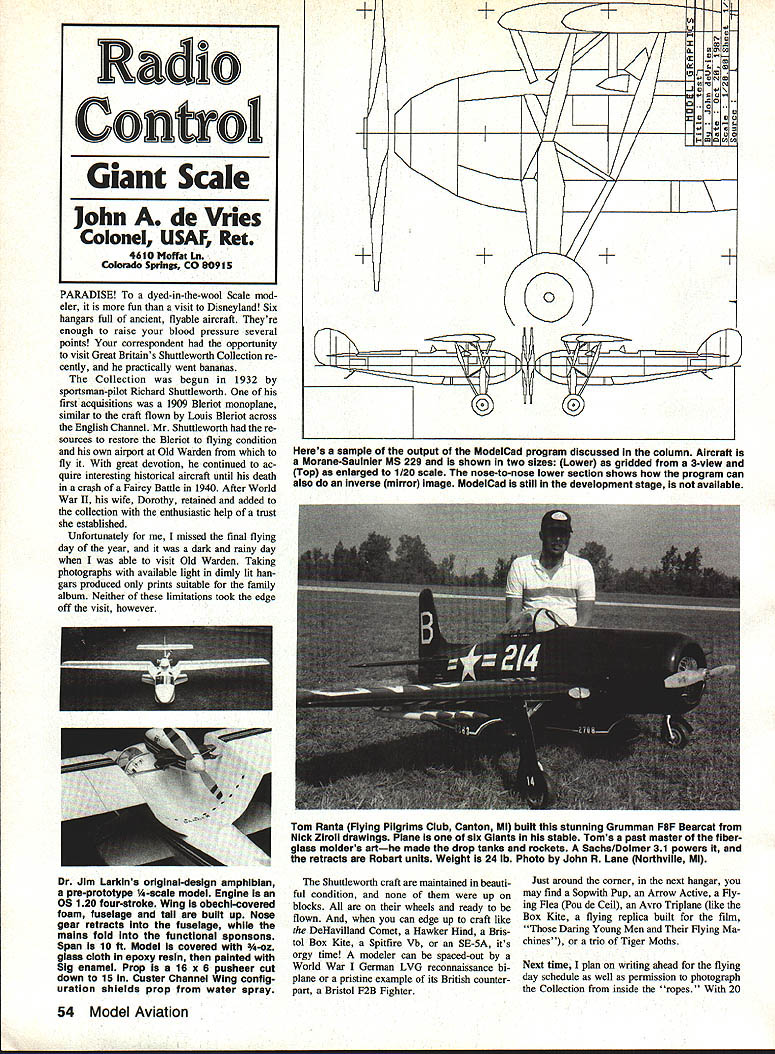
Of greatest interest to Giant Scalers is the program's ability to enlarge drawings. Given a three-view from a magazine or other source, a so-called "point file" may be created. The technique involves laying a transparent grid over the drawing and defining lines the old-fashioned way — by listing their ends, bends, and intersections using X and Y coordinates.
Conscientiously done, it takes a lot of time to read and input a point file. But once recorded, the program permits three useful operations:
- A zoom feature that allows correction of "jiggles" in the line pattern.
- Duplication of a stored line in an inverse sense (allowing perfectly symmetrical objects to be drawn).
- Enlargement of the point-file drawing to any appropriate scale.
The program is designed to use the metric system.
ModelCad's enlarging feature is a paper sizer's dream. With printers limited to 8½ by 14 in. (legal-sized) paper, it takes a tremendous amount to print out a quarter-scale drawing from a magazine three-view! Printout paper doesn't have to be trimmed to assemble a ModelCad drawing, but you use a lot of transparent tape. "Tic marks" are available for alignment, and all drawings match at paper edges.
As noted above, ModelCad is at least two years from universal use. It's as buggy as a mosquito convention, and using all of its features requires computer knowledge well beyond mine. So far I've been able to input and print a couple of airfoils. All, of course, can be made to sit up and beg, since the designer of the program is a computer genius to boot. But it represents a potential for positive interplay between radio-controlled scale models and personal computers.
Workshop tips and tricks
Where to get them? Look in your Yellow Pages under "Dental Supplies." They will be glad to sell you the gloves and some of the other things mentioned below. Your money is just as green as a dentist's!
- Mixing pads: For many years I've mixed epoxy adhesives on paper mixing pads normally used in a dental office. These come in several paper densities and sizes. My favorites are COE 6 x 6 in. and Premier 3 x 4 in. Both come in multi-sheet pads with adhesive on the edges. To mix epoxy, you do it on top of the pad, use the mix, then tear off the top sheet and dispose of it. You'll pay less than a penny a sheet.
- Mixing spatulas: The neatest mixing spatulas available are tongue depressors. These come in junior (about 1 in. wide) and regular (about 3/4 in. wide) sizes. They are sold in boxes of 100 and 500 and are very reasonable in cost. You don't need sterile tongue depressors for this use!
Anecdote: Speaking of tongue depressors, when my son Mark was a little kid I came home one noon and he was in the midst of building something or other. He asked me to bring home some "ahhh sticks" that evening for his project. After some head-scratching, I finally asked him just what an "ahhh stick" might be. He answered, "You know, the stick a doctor puts in your mouth and you say 'AHHH!'"
Spook plans
I've had a surprising amount of mail seeking a source of plans for the Spook as featured in my September 1987 column. As always, no one knows John Pond's address since he doesn't advertise in the magazine. Once again:
- John Pond Plans, P.O. Box 90310, San Jose, CA 95109.
Additionally, Gordon Codding has Spook drawings showing RC conversion and a very long list of plans for other gas and rubber old-timers, as well as scale drawings of many designs. He has one of the best assortments of plans for true wartime and immediate-postwar kits I've seen. Send him $3 for a very complete listing.
- Gordon Codding, 3724 John L. Ave., Kingman, AZ 86401.
Scale-building philosophy
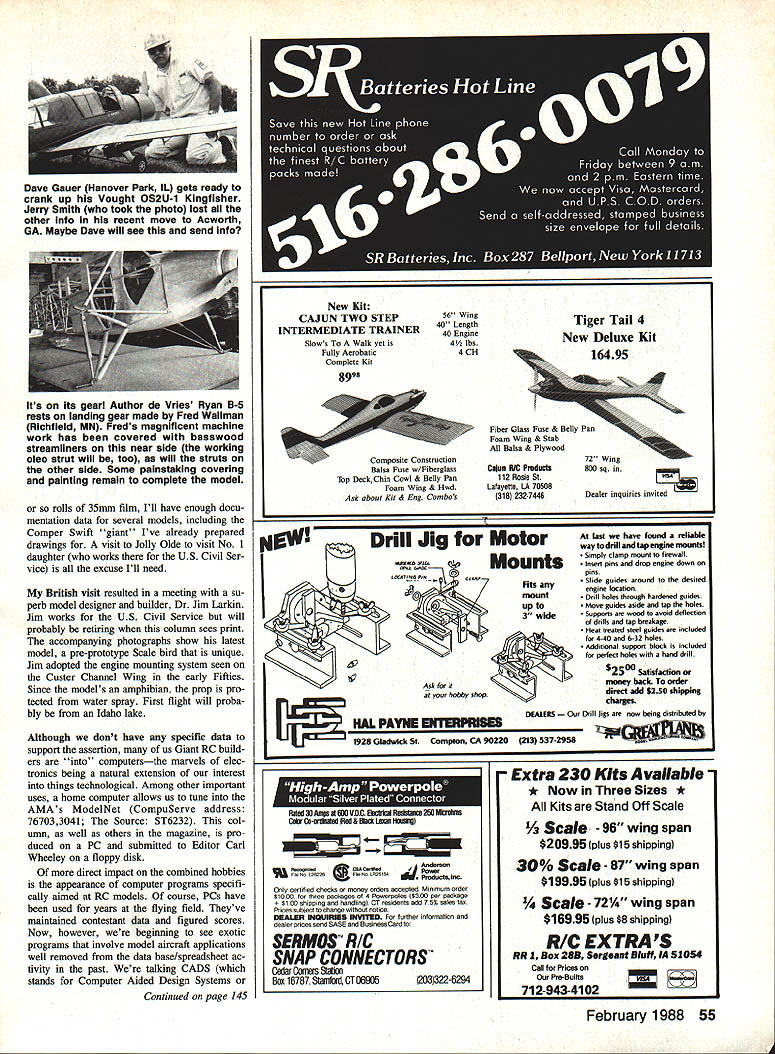
We're going to round out this column by talking heresy. The true scale model builder constantly strives for perfection, particularly in construction. He makes every effort to duplicate, in great detail, a "real" aircraft. It is not at all uncommon to find Giant Scale models that are more perfectly built than the aircraft they represent.
As a very specific example, let us examine the Beechcraft Staggerwing. With a modicum of effort, the average model builder can create a better "17" than ever came from the factory. How can that be? Although the Staggerwing was a production-line aircraft, a lot of handwork went into each example. On the authority of friend Jerry Johnson, whose business it was to manufacture Beechcraft restoration kits, there were no two Staggerwings that were exactly alike. Major and minor measurements differed between examples, and Jerry's seen some with greater or fewer fuselage stringers than standard!
Our point: Check a prototype of the Giant Scale model you may be constructing for its imperfections, then duplicate those inaccuracies for a "perfect" model. Or consider, as you build, that the real thing was imperfect, so you can relax your extreme standards a tad and enjoy the sanding.
Check a few "real" airplanes and you'll realize I'm right. Examples of authentic imperfections include:
- Pin striping that is not straight or equally thick for its entire length.
- Edges of painted-on license numbers that show evidence of paint leaking under the stencil.
- Windshields on antique birds showing cracks where they've been drilled for bolts or rivets.
- Removable cowl panels on warbirds showing outward bends on their corners, and Dzus fasteners being different colors or missing entirely.
- Plexiglass canopies showing "crazing," particularly on old aircraft.
- Clear "Pyralin" windshields, skylights, and windows yellowing with age.
The list is endless, but the important point is this: strive for perfection in building your scale model, but don't be too annoyed if you fall short. After all, the builders of the "real thing" haven't achieved it, either.
As they say in Jolly Olde England, "TTFN" (Ta Ta For Now).
Transcribed from original scans by AI. Minor OCR errors may remain.

