
Radio Control: Giant Scale
Bob Beckman
MORE mail call. In one day I got both a postcard and a letter from Jerry Bockius of Colchester, CT. His card starts out: "Dear Bob, I don't build 1/4-scale RC—or RC anything. However, I enjoy your column in M.A. Much of interest in the 'other disciplines' (FF, mostly; scale is mine). Your F9C landing gear article in May '80 M.A. was very interesting. In your April '80 column—Federal Standard Color Info—price noted for colour book $3.50. I zapped off my $3.50—GSA came right back and said two bucks more, or else! i.e. FS595A is $5.50."
Alas, another place where inflation has taken its bite. This is still a bargain, though, even at twice the price.
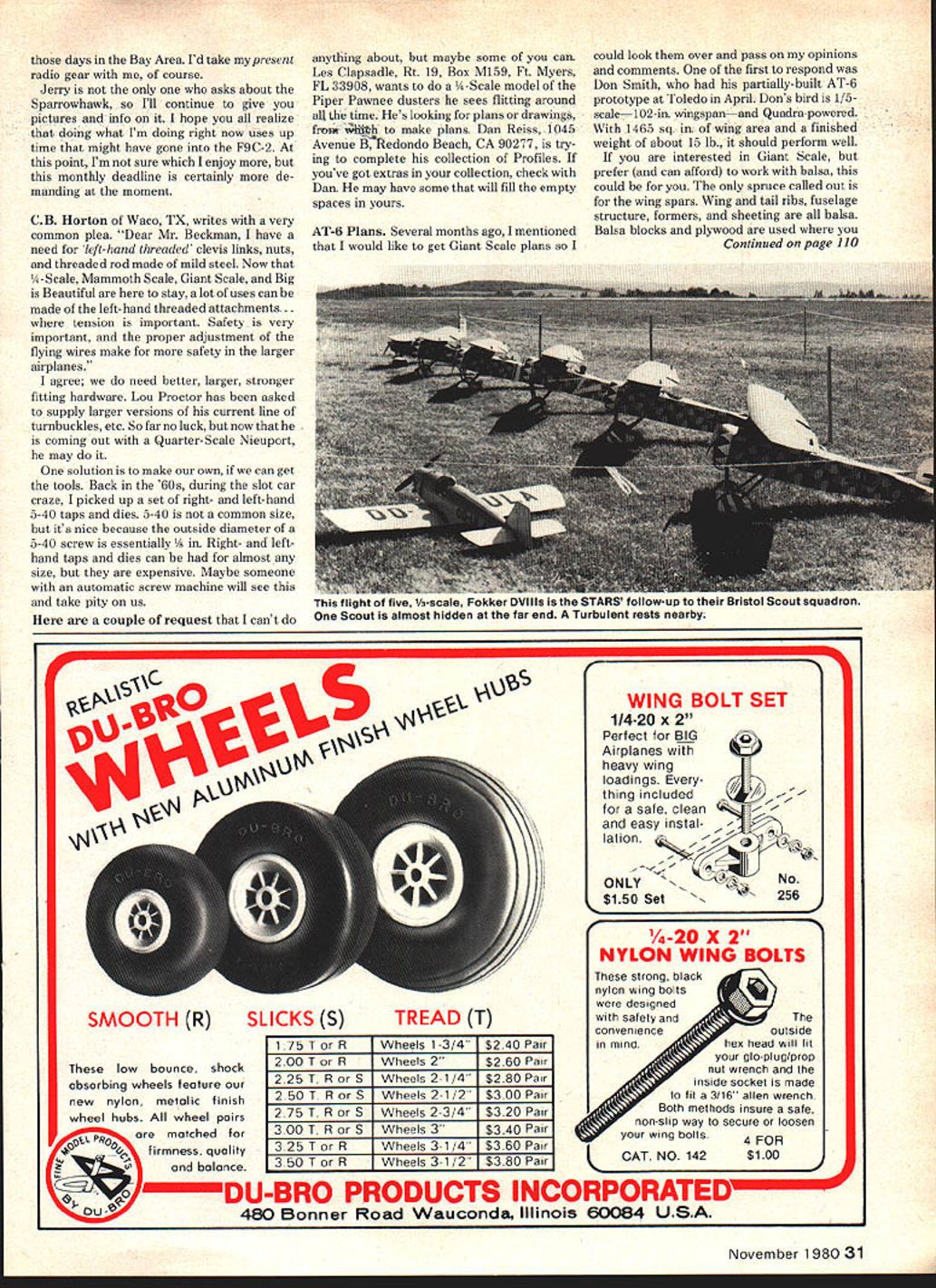
Jerry must have had a flashback just after mailing the card, because he sat right down and wrote this letter. "Dear Bob, your March '80 reference to living in the San Francisco Bay area in the early '50s clanged a gong here. We were there then, in Palo Alto. Flew FF with the late Bud Kosby and Bill Hittenberger at the Page Mill Rd. site, CL at the Palo Alto High School. Rockwood and Schneider were legendary names even then. Rockwood came down to Palo Alto one Sunday afternoon with one of those 9 ft. ships. His equipment and antenna array gave the impression of a small Nike site. Your F9C-2 is most interesting to us. We lived in NJ when they were operational. Saw them many times practicing hook-on and drop-off. One landed on a barnstormer's strip one afternoon, so we had a good close look, small even by a kid's standards. Don't know why he landed there—only about 20 miles from Lakehurst NAS. No unit marks, so perhaps it was a ferry flight. He took off after about 15–20 minutes. Takeoff visibility in that ship must have been hairy, but the takeoff run was short, to say the least. I like your approach to scaling down full-scale practice as opposed to scaling up model techniques. We'll follow your F9C-2 project, and hope you will include more photos in your column, particularly when completed. We're intrigued with trying to guess how you will handle the wing attachment."
Ah, nostalgics. I'd love to go back and relive those days in the Bay Area. I'd take my present radio gear with me, of course.
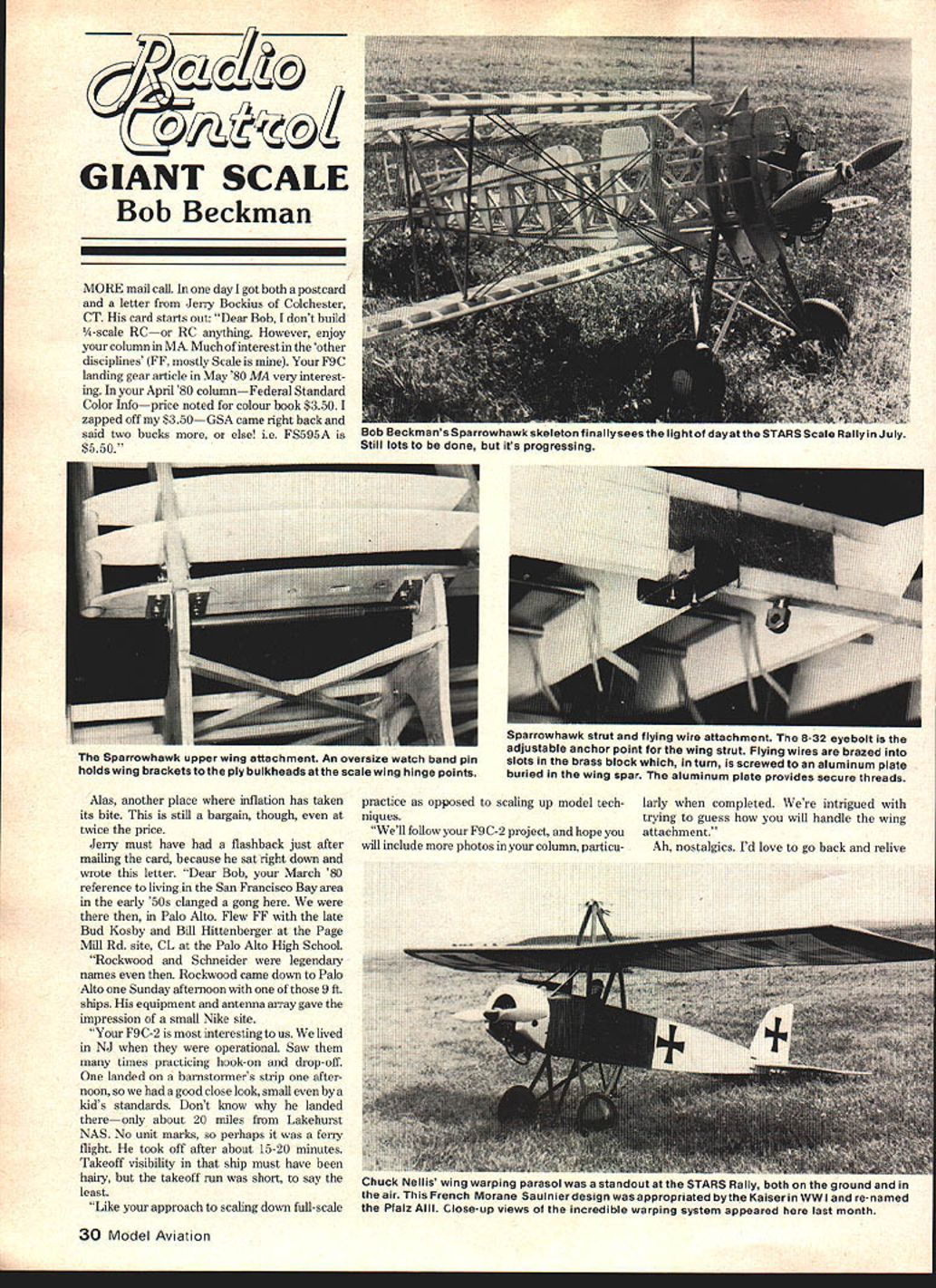
Jerry is not the only one who asks about the Sparrowhawk, so I'll continue to give you pictures and info on it. I hope you all realize that doing what I'm doing right now uses up time that might have gone into the F9C-2. At this point, I'm not sure which I enjoy more, but this monthly deadline is certainly more demanding at the moment.
C.B. Horton of Waco, TX, writes with a very common plea. "Dear Mr. Beckman, I have a need for 'left-hand threaded' clevis links, nuts, and threaded rod made of mild steel. Now that 1/4-Scale, Mammoth Scale, Giant Scale, and Big is Beautiful are here to stay, a lot of uses can be made of the left-hand threaded attachments... where tension is important. Safety is very important, and the proper adjustment of the flying wires make for more safety in the larger airplanes."
I agree; we do need better, larger, stronger fitting hardware. Lou Proctor has been asked to supply larger versions of his current line of turnbuckles, etc. So far no luck, but now that he is coming out with a Quarter-Scale Nieuport, he may do it.
One solution is to make our own, if we can get the tools. Back in the '60s, during the slot car craze, I picked up a set of right- and left-hand 5-40 taps and dies. 5-40 is not a common size, but it's nice because the outside diameter of a 5-40 screw is essentially 1/4 in. Right- and left-hand taps and dies can be had for almost any size, but they are expensive. Maybe someone with an automatic screw machine will see this and take pity on us.
Les Clapsadle, Rt. 19, Box M159, Ft. Myers, FL 33908, wants a 1/4-scale model of the Piper Pawnee dusters he sees flitting around all the time. He's looking for plans or drawings, from which to make plans. Dan Reiss, 1045 Avenue B, Redondo Beach, CA 90277, is trying to complete his collection of Profiles. If you've got extras in your collection, check with Dan. He may have some that will fill the empty spaces in yours.
AT-6 Plans
Several months ago, I mentioned that I would like to get Giant Scale plans so I could look them over and pass on my opinions and comments. One of the first to respond was Don Smith, who had his partially-built AT-6 prototype at Toledo in April. Don's bird is 1/5-scale—102-in. wingspan—and Oundra-powered. With 1,465 sq. in. of wing area and a finished weight of about 15 lb., it should perform well.
If you are interested in Giant Scale, but prefer (and can afford) to work with balsa, this could be for you. The only spruce called out is for the wing spars. Wing and tail ribs, fuselage structure, formers, and sheeting are all balsa. Balsa blocks and plywood are used where you would expect them. In other words, it has standard model building techniques—comfortable to most of us, and for the most part, adequate for the lower end of the Giant Scale range.
The plans are well-drawn and clear, with sufficient detail for the experienced modeler. I would not recommend them for a beginner. If you've had experience with built-up and sheeted fuselage and wing construction, you'll have no trouble understanding Don's plans.
Cowls and canopies can be a problem for big birds. A cowl built-up of balsa and ply is shown on the plans and should be quite effective. No information is provided on the canopy, but it is mostly simple curves that could be made from sheet plastic. I believe that includes the windshield. The only compound curve is in the aftermost section, and it is possible that a section cut from a large bubble canopy would be suitable. Don may have a canopy available by the time you read this.
One warning: several fittings (control horns, etc.) depend on soldered joints. Although the plans do not specify hard soldering (brazing), in my opinion it is necessary. Soft solder, even the so-called "silver solders," like Sta-brite, do not have the strength required.
In summary, Don's plans are adequate for experienced modelers, but lack the detail needed for beginners. Built as shown, the model should be fairly light and perform well with a Quadra or similar engine. Order from Aero Plan, 101 SW 2nd St., Pompano Beach, FL 33060. My notes don't include the price, but I believe it is about $20.
Future plan reviews
I presently have eight sets of plans waiting in line. It's obvious to me, now, that I won't have time and column space available until after the flying season. In the meantime, what I have on hand is listed below, and if anyone is interested in a particular plan and can't wait, send me an SASE, and I'll tell you what I can about it. The list:
- 1/4-scale Liberty Sport and Bucker Jungmeister by Wendell Hostetter
- 1/6-scale Druine Turbulent by Doug MacBrayer
- 2 in. = 1 ft. scale Curtiss P-40E by Bob Morse
- 1/6-scale Fairchild PT-19 by Jim Follin
- 1/4-scale Piper L-4B by Ken Runestadt
- 1 ft. = 1 meter scale Fokker D.VII by Bill Wendt
- 1/2-scale Ercoupe by Jim Messer
Bob Beckman, 8248 Holly Grove Ct., Manassas, VA 22110, (703) 369-2432.
Transcribed from original scans by AI. Minor OCR errors may remain.

