
Radio Control: Giant Scale
John A. de Vries Colonel, USAF, Ret. 4610 Moffat Ln. Colorado Springs, CO 80915
Introduction
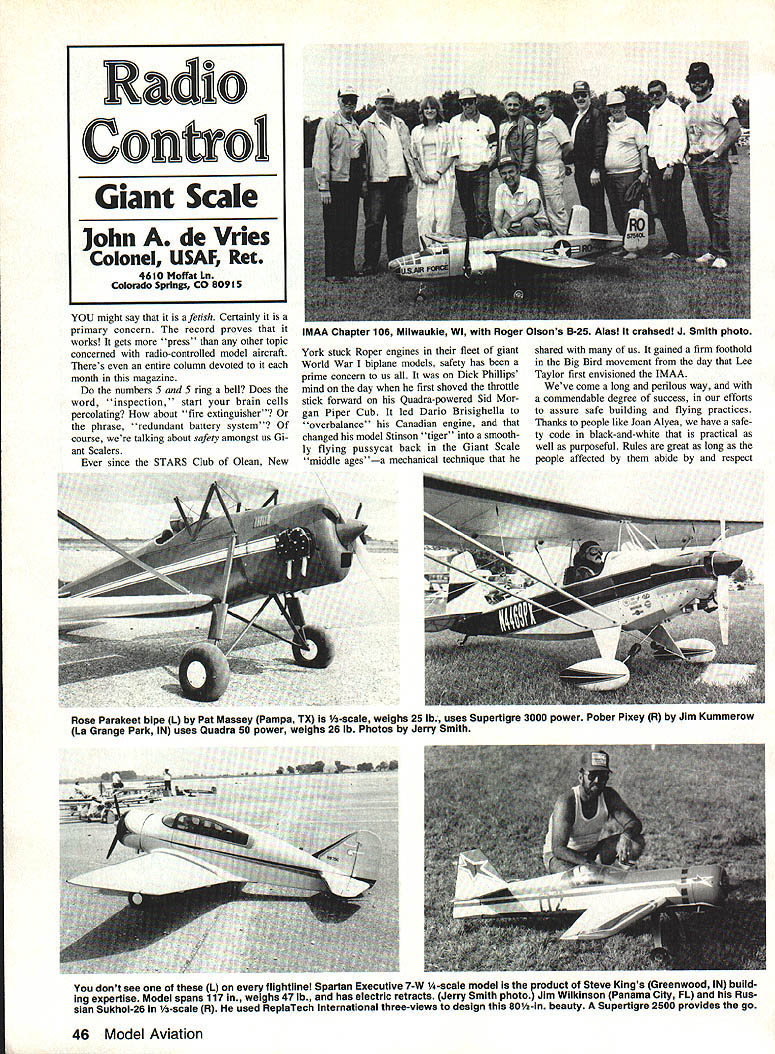
You might say it's a fetish. Certainly safety is a primary concern — records show safety gets more press than any other topic in radio-controlled model aircraft. Ever since the STARS Club of Olean, New York, stuck Roper engines in their fleet of giant World War I biplane models, safety has been a prime concern among Giant Scalers. From Dick Phillips shoving the throttle forward on a Quadra-powered Sid Morgan Piper Cub, to Dario Brisighella overbalancing a Canadian engine and changing his Stinson "Tiger" into a smoothly flying pussycat, the community has learned and shared techniques. The Big Bird movement and the creation of the IMAA by Lee Taylor further cemented safe practices.
Thanks to people like Joan Alyea, we now have a practical, purposeful safety code in black and white. Rules are valuable — but only if people abide by and respect them.
Safety at the Field
There are many practical steps clubs and fliers can take to make Giant Scale safer and more pleasant:
- Require the wearing of safety glasses or hoods when cranking gas-powered engines on the flight line. Big props can pick up gravel and hurl it at high speeds.
- Enforce a pilots-and-helpers-only policy in the pits. Most particularly, keep children behind the safety line or fence — brightly painted, noisy models attract kids, and without close supervision tragedy can be only one RPM away.
- Use knowledgeable, experienced builders as safety inspectors at contests, rallies, and fly-ins. Don’t leave the task to whoever happens to show up.
- Keep and use safety inspection checklists. Inspections should be thorough:
- Jiggle flying surfaces, wiggle engines, check wheels and axles.
- Verify wings and major attachments are secure.
- Inspect props for nicks and cracks.
- Pay particular attention to critical elements of the control systems and devices.
- Ensure readily available fire extinguishers and field boxes are present for fliers operating gasoline-powered engines.
- Insist on safety-approved gasoline containers and consider prohibiting electric fuel pumps for novice or uninformed fliers.
- Consider the effects of a gas-powered model crash in dry weeds around the flying site, even if the runway is hard-topped.
There’s real value in more than a “quick-and-dirty” inspection — thoroughness can prevent major problems.
Building Inspections and Mentoring
Before a model appears at the field, clubs should have a building inspection and mentoring program:
- Encourage experienced "old-timers" to volunteer time to help neophytes during construction.
- Correct unsafe building practices diplomatically — helping builders learn safe methods goes a long way toward safer RC flights later.
I could list a thousand-and-one elements that contribute to safe Giant Scale building and flying, but two things are most important when you launch into the Giant Scale scene:
- The name of the game is having fun — safely.
- Safety is your business — all the time.
Continued on page 152
Finishing: Avoiding and Repairing Hangar Rash
If your new Giant is ready for covering and finishing, you’ll want techniques that yield a prettier model. Hangar rash is a chief enemy: bonking wings against shop fixtures or laying a sanded fuselage on an X-Acto knife can create nasty scratches. Because final appearance depends on smooth sanding, repair hangar rash before covering.
- Small dings in balsa: apply a bit of saliva to the depression. The fibers swell as it dries; a smooth sanding will blend the repair.
- Dings in hardwood: cover with a damp rag and apply a hot iron. The steam expands the fibers and resmooths the surface.
- Large depressions or jagged holes: use a filler. Recommended: 3M Acryl-Blu Glazing Putty — it sands softer than balsa, feathers easily, finishes smoothly, and takes paint and resin well. It’s available at automotive refinishing suppliers.
To avoid hangar rash in the first place:
- Remove removable heavy bits (engines, propellers) and disassemble components where practical.
- Tape or otherwise protect clear plastic parts (windshields, canopies).
- Clear your workbench completely — a flat, bare bench reduces accidental dings. Remove epoxy bumps, buried pins, old blades, and snipped music-wire ends.
- Vacuum the bench area and use styrofoam blocks to lay parts on when not actively working on them.
- Keep finishing tools (sanding blocks, MonoKote iron, knives, razors, paints, brushes) on a separate board and store that board on a shelf under the bench.
- Plan every movement of a model component before changing its position; move deliberately and avoid banging parts into walls or tools.
A bit of forethought and workspace discipline will save time and yield a much cleaner finish.
Examples of Giant Scale Models (selected)
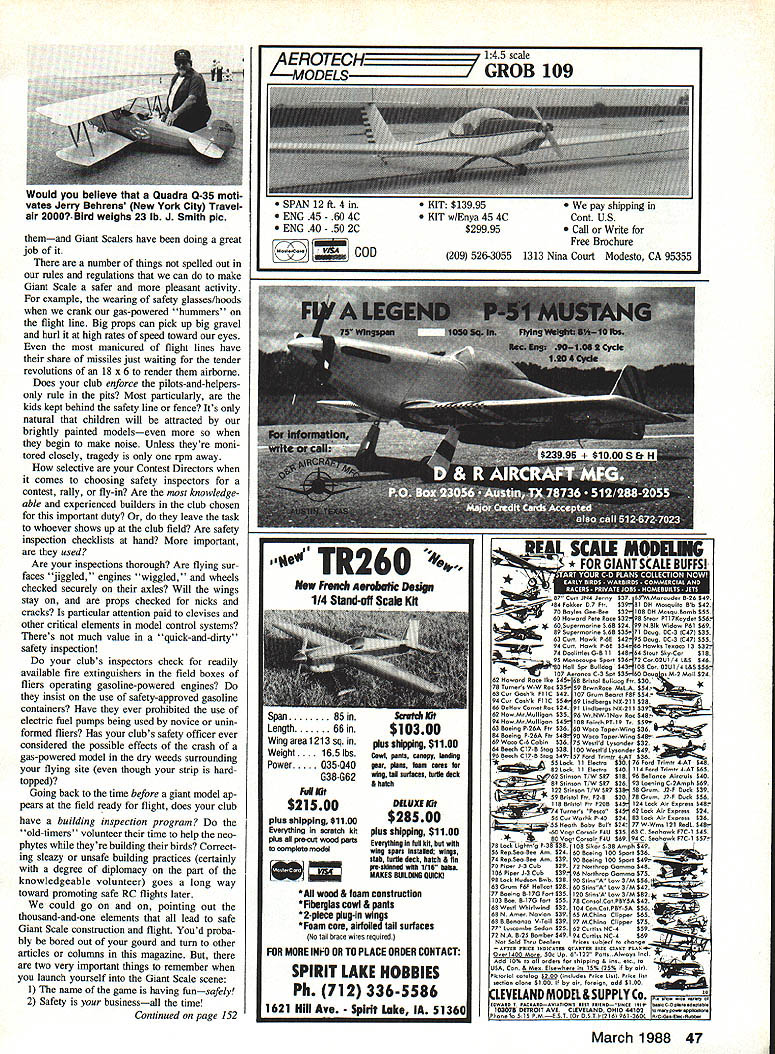
- Rose Parakeet biplane — L. Pat Massey, Pampa, TX — 1/4-scale, ~25 lb, Supertigre 3000 power. (Photo: Jerry Smith)
- Pober Pixey — R. Jim Kummerow, La Grange Park, IN — Quadra 50 power, ~26 lb. (Photo: Jerry Smith)
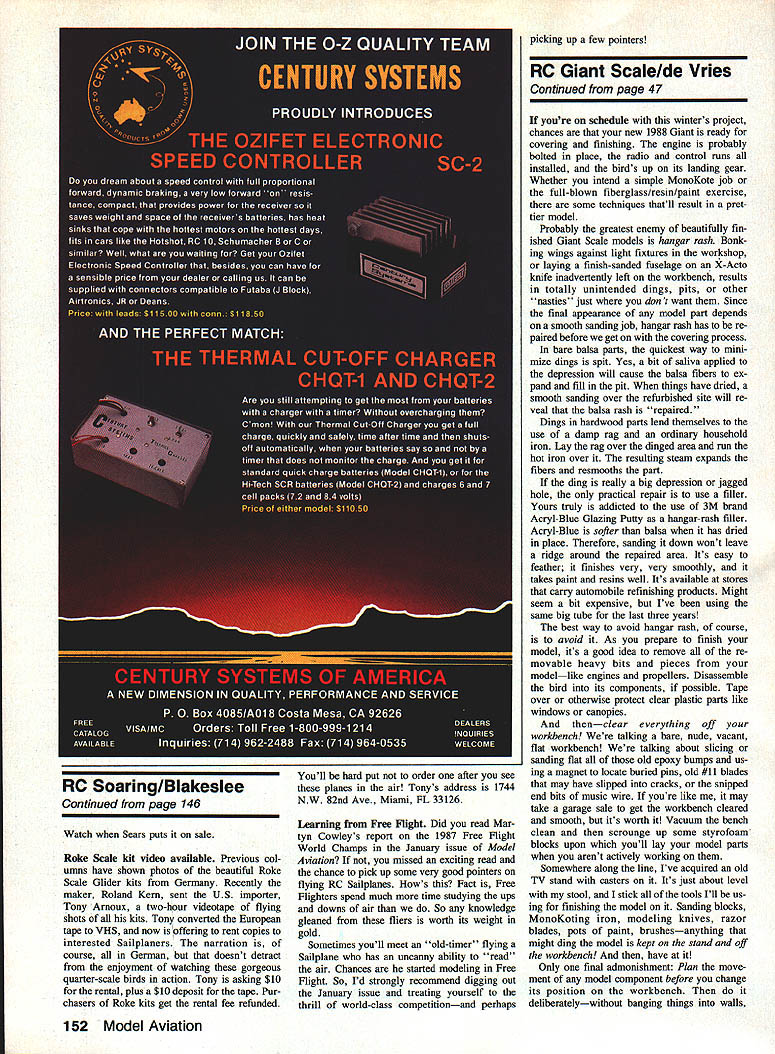
- Spartan Executive — 7-1/4-scale — spans 117 in, ~47 lb, electric retracts. (Photo: Jerry Smith)
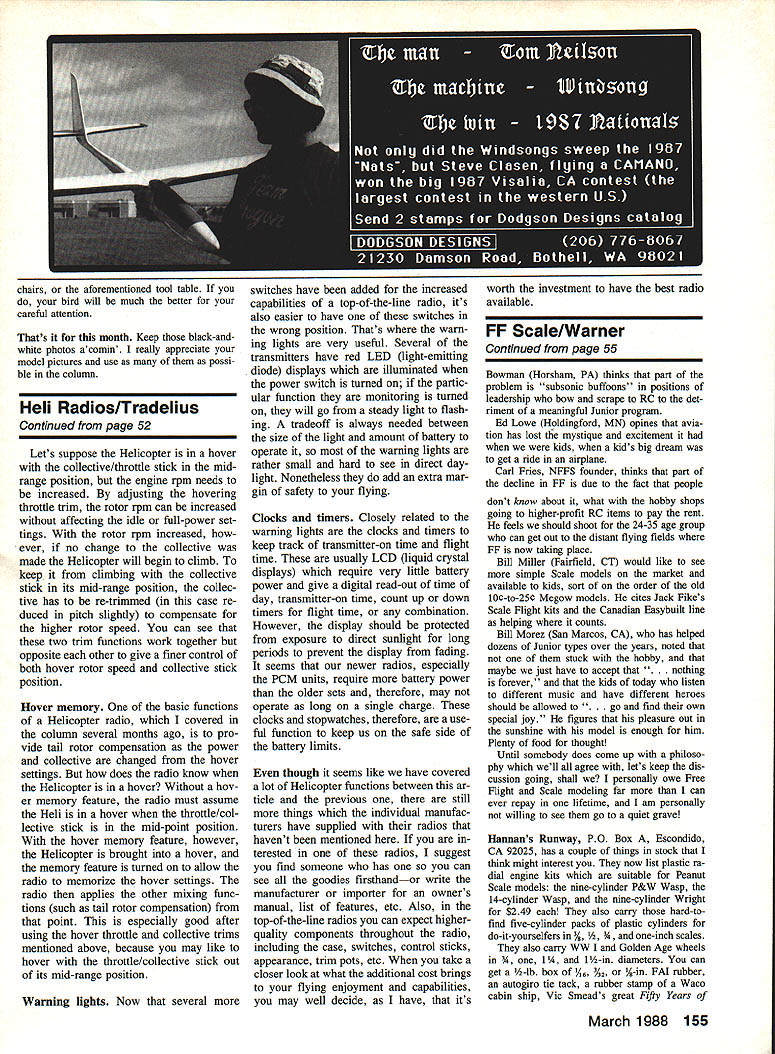
- Sukhoi-26 (1/3-scale) — Jim Wilkinson, Panama City, FL — 80 in span, Supertigre 2500 power. (Photos: Jerry Smith)
These examples show the range and craftsmanship in Giant Scale; safety and good finishing practices make them enjoyable to build and fly.
Transcribed from original scans by AI. Minor OCR errors may remain.

