
Radio Control: Giant Scale
John A. de Vries
Colonel, USAF, Ret. 4610 Moffat Ln. Colorado Springs, CO 80915
Lamentable
It's always been one of my major regrets. Although my foster father worked for the Eastman Kodak Company and was an award-winning photographer, I never had a camera as a kid. Oh, there was always the odd Brownie around the house but my mother appropriated it most of the time. So, even though the usual Sunday automobile ride ended up at a local airport, I didn't photographically record all those fabulous Thirties aircraft I saw.
I'm talking about some pretty exotic birds, too, such as:
- Roscoe Turner's Pesco Special
- Benny Howard's Ike and Mike
- Clarence Chamberlin's Curtiss Condor
- Numerous wire-bound biplanes that are antique treasures today
In 1938 I got a chance to attend the National Air Races in Cleveland and watched the introduction of Art Chester's Goon and Tony LeVier's Schoenfeldt Firecracker. I was "that far" from both of these famous pylon racers as well as lesser-known racers like the Pobjoy Flagship, but I didn't have a camera along!
I've always envied people like Pete Bowers, Warren Shipp, and Bill Larkins who always seemed to have a camera at hand during those Golden Days—and who recorded hosts of aircraft on film.
Later, people like Howard Levy became the photo historians of the Forties, and their photos serve as grist for our Giant Scale documentation mill. Most of us rely on their published and republished photographs when it comes to detailing our carefully built RC models.
Collecting Aeronautica
Almost by default, I began my collection of aeronautica back in those days of round engines and two wings. There were only two model airplane magazines, early on: Model Airplane News and Flying Aces.
A little later, Bill Barnes appeared on the newsstands, and I added it to the mass of paper I was acquiring. As today, model magazines weren't restricted exclusively to models but included news, photos, and three-views of full-scale aircraft. Today, the collection occupies over 12 three-drawer file cabinets and is growing at the rate of five or six magazines a month!
A couple of years ago, RCM published its Scale Reference Guide, a book annotating all of the plans in the model magazines starting from "Year One." To my great delight, I found that it served as an index to my magazine collection.
Why all this nostalgia claptrap in the Giant Scale column? I'm doing it primarily to recommend that you begin your own, personal collection of aeronautical data. You don't have to be an inveterate pack-rat like yours truly and save everything that's published. Depending on your personal interests, you can save articles, drawings, and data on the real birds that "turn you on" without filling the garage or basement with file cabinets!
You don't have to limit your collection to magazines. There are bunches of books on airplanes that provide the information for the models you're "going to build, someday." Books have a rather arcane advantage for the average model builder that is often overlooked: if you happen to be married, there's usually some "discussion" from your better half when you bring home a new Quadra or Airtronics goody from the local hobby shoppe. The more expensive the goody, the longer the "discussion"!
However, a new model magazine or book about airplanes, either model or full-scale, barely elicits a syllable from the bride. We aren't talking "coffee-table books" here (they're usually very expensive-looking). There are, however, libraries full of books of very great value that will gain only a cursory glance from your spouse — and provide years of pleasure to you as you hack Giant Scale models from balsa, plywood, and spruce!
Suppliers and Resources
Although the phrase is apocryphal, it has defined the extremely well-to-do model builder since the Brown Junior turned its first propeller: "He's got a bag full of prop nuts." Well, we want to report that there's just such a person — and he is more than interested in sharing his propeller nuts with us Giant Scalers.
- BC Products
Contact: Caffey Address: 111 N. Starkweather, Pampa, TX 79065 Notes: The company stocks 10 sizes of prop nuts, most of which are appropriate for our engine sizes. B.C. has nuts that fit the big (2000/3000) Supertigers as well as most of the gas burners.
Bob Banka is at it again! He's got a new photo listing printed, and it's big enough to choke a giraffe — well worth the three bucks he asks for it. Bob now claims to have over 50,000 aircraft photos, and I believe him! The new list from Scale Model Research, 2334 Ticonderoga Way, Costa Mesa, CA 92626, features an increased number of three-views, including some rather exotic ones. We're talking 3,000 three-views, including 500 Koku-Fan drawings.
Computers and Modeling
A couple of months ago, this column was devoted to the interrelationship between Giant Scale models and personal computers. A week or so after I'd mailed my manuscript off to Reston, VA, old friend Col. Art Johnson published a column on the same subject in RCM.
Although our concern has been with CADs (Computer Aided Design Systems—or mechanical drawing by computer), I've been reminded that there are a host of computer programs applicable to radio-controlled model aircraft that don't draw a single line.
Computer software has been developed that does everything from telling you which prop to hang on the front of your Zenoah to calculating the performance of your quarter-scale B-25. There are many modeler/computer experts who are programming like mad. Inevitably, someone is collecting these programs for publication.
Curtis Givens has approached V.P. Publishers, the company that yours truly and Dick Phillips have established. If you have a computer program that you'd like to have included in Curt's book, drop him a note at:
- Curtis Givens
5304 W. Riverview, Dayton, OH 45406
Of course, there are no bucks involved—only the prestige of having your name and program published and printed in a book. You'll receive a free copy of the book if he uses your program in its pages.
Workbench Tips
Some bits and pieces from the old workbench:
After you've fitted your wheels to their axles and trimmed the axles to be flush with the outside edge of their wheel collars, break out the soldering iron or torch. Remove the wheel collars, and solder a bit of tin-can metal to them that covers all of one end. The collars are brass and take the solder well. Trim the outside of the tin bits, and you'll have what looks like a scale hub cap! Even better from a mechanical viewpoint, the tin cover keeps you from jamming the wheel collars too far onto the axle—and binding the normal free running of your wheels.
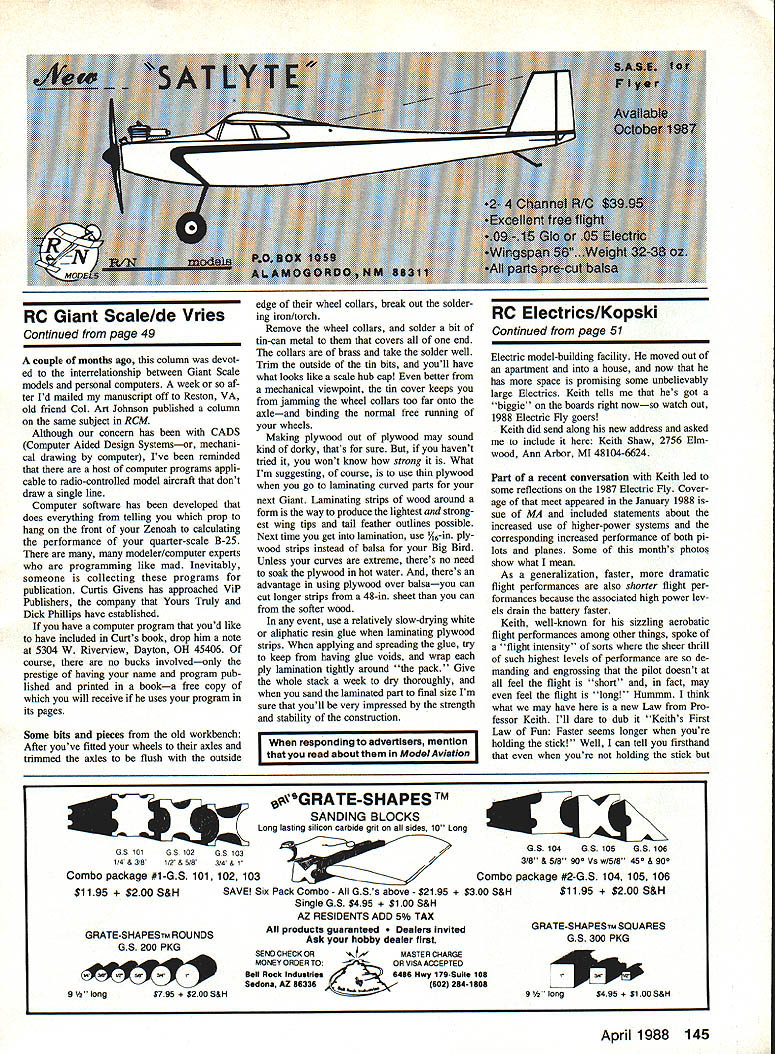
Making plywood out of plywood may sound kind of dorky, but if you haven't tried it, you won't know how strong it is. What I'm suggesting is to use thin plywood when you go to laminating curved parts for your next Giant. Laminating strips of wood around a form is the way to produce the lightest and strongest wings and tail feather outlines possible. Next time you get into lamination, use 1/8-in. plywood strips instead of balsa for your Big Bird.
Unless your curves are extreme, there's no need to soak the plywood in hot water. There's an advantage in using plywood over balsa—you can cut longer strips from a 48-in. sheet than you can from the softer wood.
In any event, use a relatively slow-drying white or aliphatic resin glue when laminating plywood strips. When applying and spreading the glue, try to keep from having glue voids, and wrap each ply lamination tightly around the "back." Give the whole stack a week to dry thoroughly, and when you sand the laminated part to final size you'll be very impressed by the strength and stability of the construction.
Transcribed from original scans by AI. Minor OCR errors may remain.

