

Radio Control: Giant Scale
John A. de Vries Colonel, USAF, Ret. 4610 Moffat Ln. Colorado Springs, CO 80915
Introduction
SNOWED under! Doctor Jim Pepino is responsible—and my office is full of paper. The latest "care package" from Scale Plans & Photo Service (3209 Madison Ave., Greensboro, NC 27403) just arrived. A large red mailing tube, brought to the door by my friendly mailman, contained three of Doc Jim's latest Giant Scale drawings: the de Havilland Chipmunk (with two cockpit configurations), a beautiful Fairchild PT-19 (including mods for the full‑canopy version), and the Waco YMF-7 Golden Age biplane.
All three drawing sets show Jim's excellent draftsmanship and exhaustive scale research. For example, he always provides accurate three‑views right on the plans and notes the degree of construction difficulty so the builder will know what he is getting into before the first bit of spruce or balsa is cut. Other nice touches include recommendations for suitable engines and a tabular indication of wood sizes and types required to complete the model.
Finally, Doctor Jim contracts with quality fiberglass parts manufacturers to provide cowlings, wheel pants, and other difficult‑to‑build parts for his designs. Man, I wish I had the time to build that Waco—it's absolutely gorgeous!
Telephone enquiries
The phone has been ringing off the hook lately. Nine long‑distance calls out of ten are enquiries about the suitability of particular Giant Scale engines for specific model designs. Although most scratch‑building drawings include engine recommendations, many of you seem to need additional assurance that a particular power plant will be adequate. Unfortunately, there is a lot of misinformation and misconception floating around about which engine to use.
Factors influencing engine choice
Choosing a power plant depends on many factors. A representative list includes:
- Model flying weight
- Model wing area
- Wing loading
- Aerodynamic drag
- Intended style of flying
- Flight altitude
- Availability and cost of engines
- Desire to maintain scale outlines (cowling fit)
- Brand loyalty and prior experience
- Propeller selection and efficiency
Rules of thumb and discussion
- Weight-based guidelines
- Experts suggest Giant Scale models in the 15–20 lb range should use smaller two‑cubic‑inch gas engines.
- Models weighing 20–35 lb often use engines such as the Quadra Q‑50.
- Birds 35 lb and up (approaching the AMA maximums) typically call for the larger Kawasakis, Sachs, Dolmars, and other heavy‑duty engines.
- Wing area and the square‑cube law
- A rule based on wing area or volume suggests larger models require proportionally larger engines. That isn't strictly true because larger models often fly more slowly and may not need proportionally more power.
- Wing loading
- Wing loading (expressed in ounces per square foot) can be a better indicator. High wing loading requires more powerful engines to maintain airspeed and performance.
- Aerodynamic drag
- Smooth, slick models (e.g., Lasers, warbirds) are less draggy and can get by with slightly less engine power than fully rigged biplanes, which have high drag.
- Weight and CG considerations
- Big engines mean more engine weight. If a Giant Scale ship comes out tail‑heavy, one solution is to mount a heavier engine on the firewall. Many builders prefer this practical fix rather than adding nose ballast—after all, you can always reduce throttle but you can't add cubic inches later.
Engine efficiency, availability, and the propeller
- Engine efficiency varies: some engines produce more power per cubic inch than others. That can allow the use of a smaller displacement engine if it’s efficient.
- Availability and cost at your local hobby shop or distributor often influence choice as much as technical fit.
- The proper propeller can make or break an installation. A good prop can significantly improve an engine's effective performance.
Altitude and cowling/scale considerations
- Flight altitude is a major factor—especially in the Rockies. At 5,000–7,000 ft above sea level you can expect roughly a 20% loss of engine power compared with sea level. Conversely, engines at sea level produce closer to full rated power.
- Scale appearances sometimes dictate engine choice: if you want to keep an accurate scale outline and hide the engine within the cowling, you may choose a physically smaller engine even if it sacrifices some power.
Brand loyalty and personal choice
- Brand loyalty is common: if you've had good results with a manufacturer's engines, you'll likely stick with them—provided they make the right sizes.
- Engine choice is ultimately personal. You can heed experts and designer recommendations, but you'll have to decide early in the building sequence which engine to use.
Examples from scratch builders
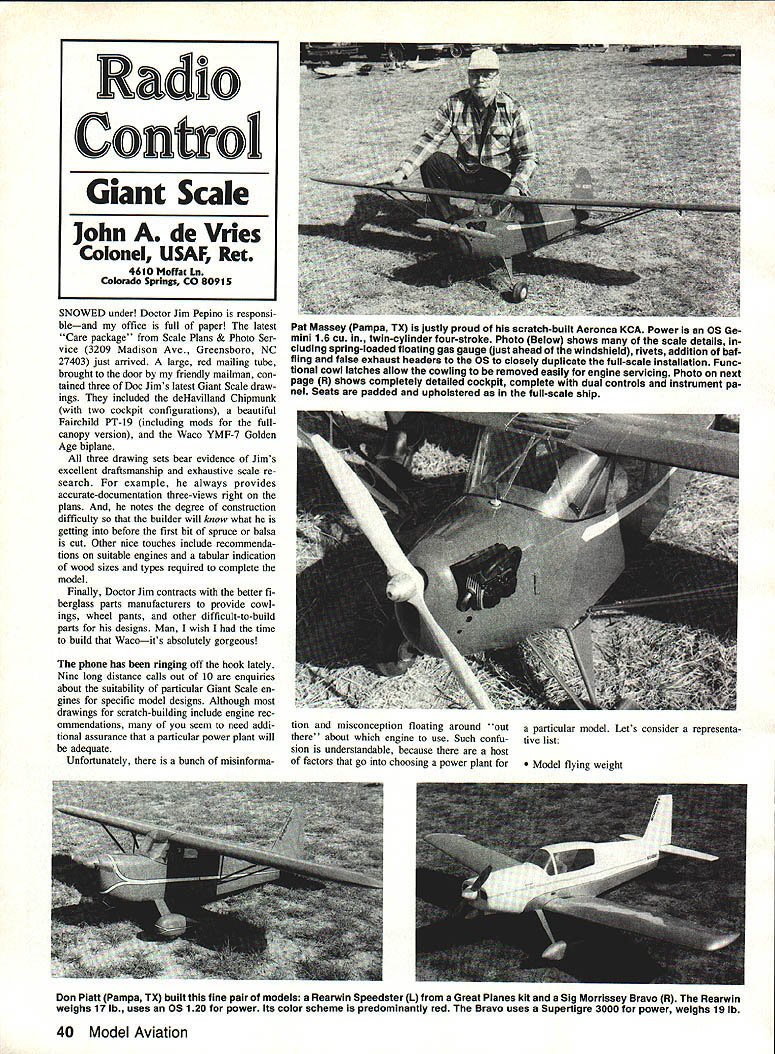
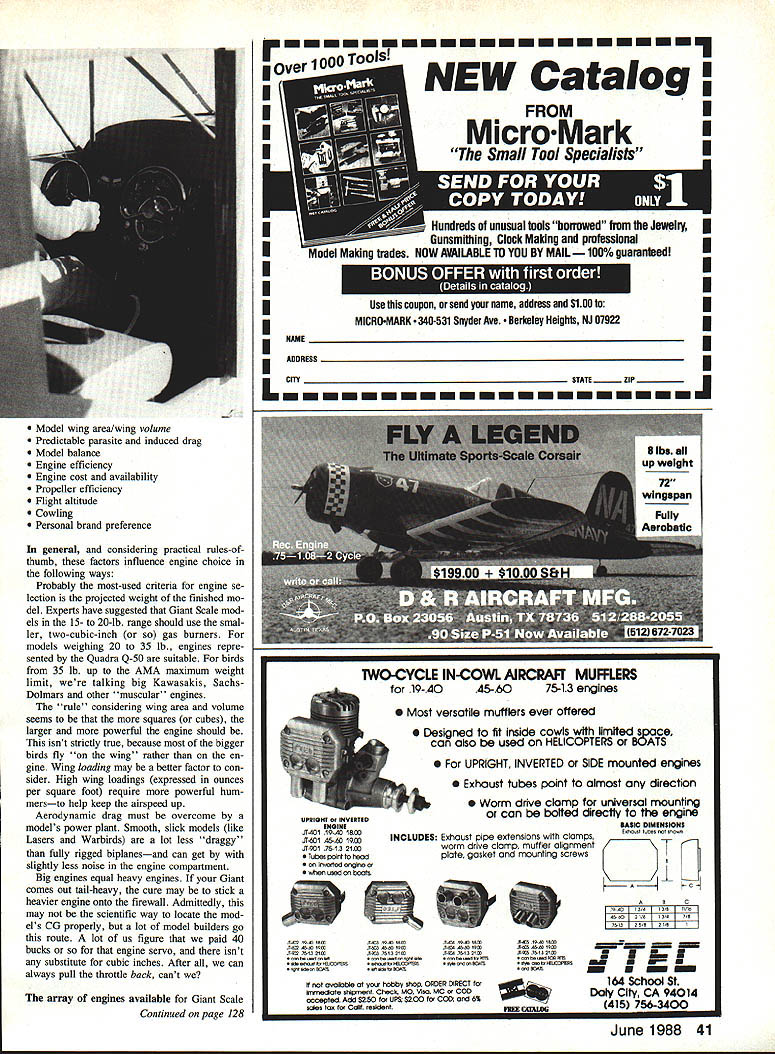
- Pat Massey, Pampa, TX, scratch‑built an Aeronca KCA powered by an OS Gemini 16 cu. in. twin‑cylinder four‑stroke. The model shows excellent scale detail: a spring‑loaded floating gas gauge just ahead of the windshield, rivet detailing, additional baffling, false exhaust headers, and cowl latches that allow easy cowling removal for engine servicing. The cockpit is fully detailed with dual controls and an instrument panel; seats are padded and upholstered true to the full‑scale ship.
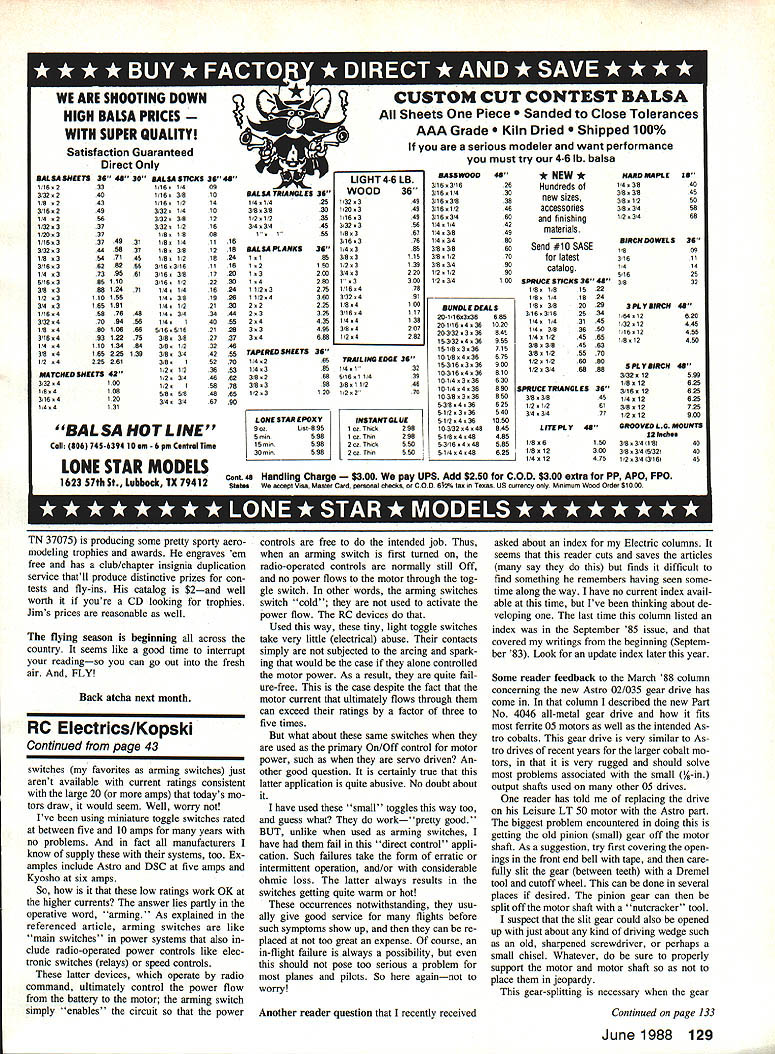
- Don Piatt, Pampa, TX, built a fine pair of models: a Rearwin Speedster (Great Planes kit) and a SIG Morrissey Bravo R. The Rearwin weighs 17 lb and uses an OS 120 for power; its color scheme is predominantly red. The Bravo weighs 19 lb and uses a Supertigre 3000 engine.
Final note and resources
For clubs and IMAA or AMA members who need help selecting an engine, Jim Jennings (Jennings Trophy Sales, P.O. Box 1121, Hendersonville, Tenn. 37077) maintains a current list of engines suitable for several popular giant‑scale models and may be able to help you decide which engine(s) to use for your model.
Engine choice takes thought and consideration—start early in the build and weigh the factors above to match the engine to your model and flying conditions.
Transcribed from original scans by AI. Minor OCR errors may remain.

