
Radio Control: Giant Scale
John A. de Vries Colonel, USAF, Ret. 4610 Moffat Ln. Colorado Springs, CO 80915
IMAA Rally of Giants (1988)
The IMAA Rally of Giants will be held August 24–28, 1988, at Alderman Airport, St. Clairsville, OH (Brush Run Park). Facilities include a 2,800-ft paved strip, a 500-ft closely cropped grass runway, and unlimited on-site camping.
- Host: Chapter #51, Wheeling, WV, headed by Chuck Shepherd
- Contact: Charlie Singer, 48 North 22nd Street, Wheeling, WV 26003
- Phone: 1-304-277-1476
- Pre-registration: $15 (includes pilot packet and gate passes)
- Friday-night picnic: $5.50 per person
- Saturday-night banquet: $16 per adult, $10 per child
- On-site: overnight storage and charging facilities available
- Requirement: individual fire extinguishers
CAD and design systems
This column has become a clearinghouse for information on computers and CAD (Computer Assisted Design) systems for Giant Scale model design.
- Leo F. Hood (206 Cecil Ave., West Lawn, PA 19609) is developing a program designed to work with dot-matrix printers (limited only by paper width).
- Features: rescaling drawings to larger or smaller sizes and storing airfoil data.
- Leo asks: Are modelers developing standard libraries (airfoil coordinate tables, engine views, etc.) suitable for transfer into CAD programs? If so, please contact him.
Easy Hinges
Mike Gretz (Montezuma, IA) sent a sample of surface hinges called Easy Hinges. Highlights:
- Designed to be installed dry, then bonded with thin C/A glue.
- Special coating wicks glue into precut hinge slots and locks them in place.
- After glue cures, flex the hinged surface back and forth several dozen times for a very durable hinge.
- Installing dry allows precise adjustment of the hinging gap before gluing.
- Big models may need extra hinges per surface; packs contain 24 hinges—usually plenty.
- Pins are generally unnecessary.
Recent Giant and Quarter-Scale projects
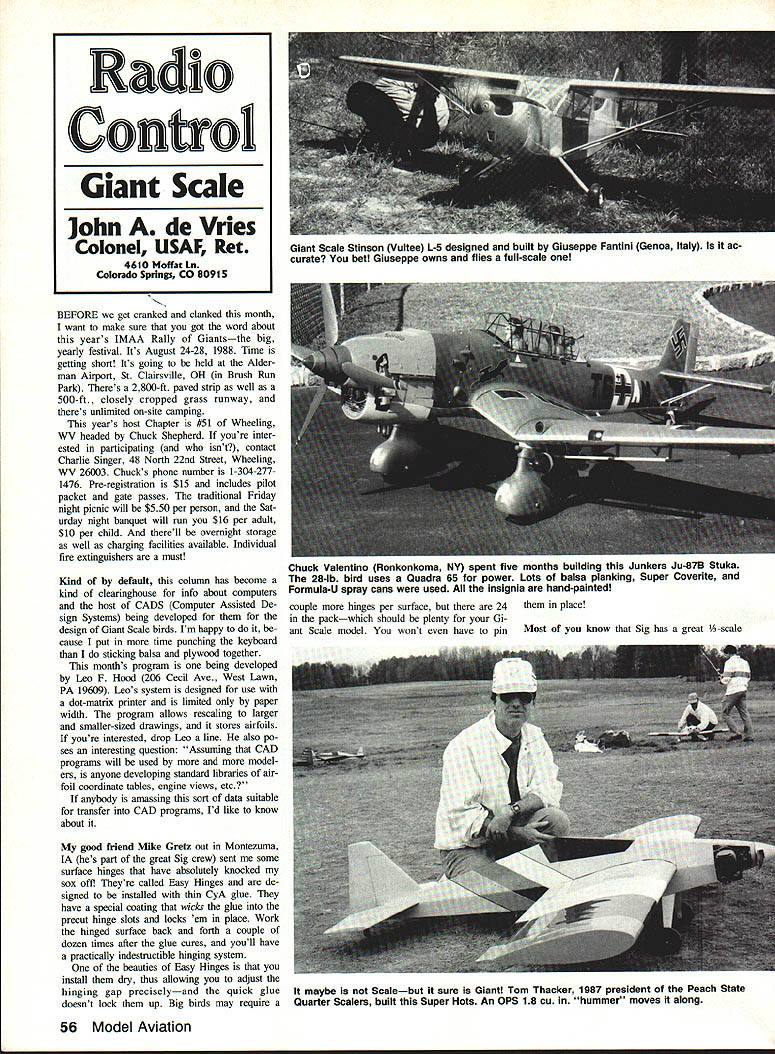
- Giuseppe Fantini (Genoa, Italy) built an accurate Stinson/Vultee L-5; he owns and flies the full-scale example.
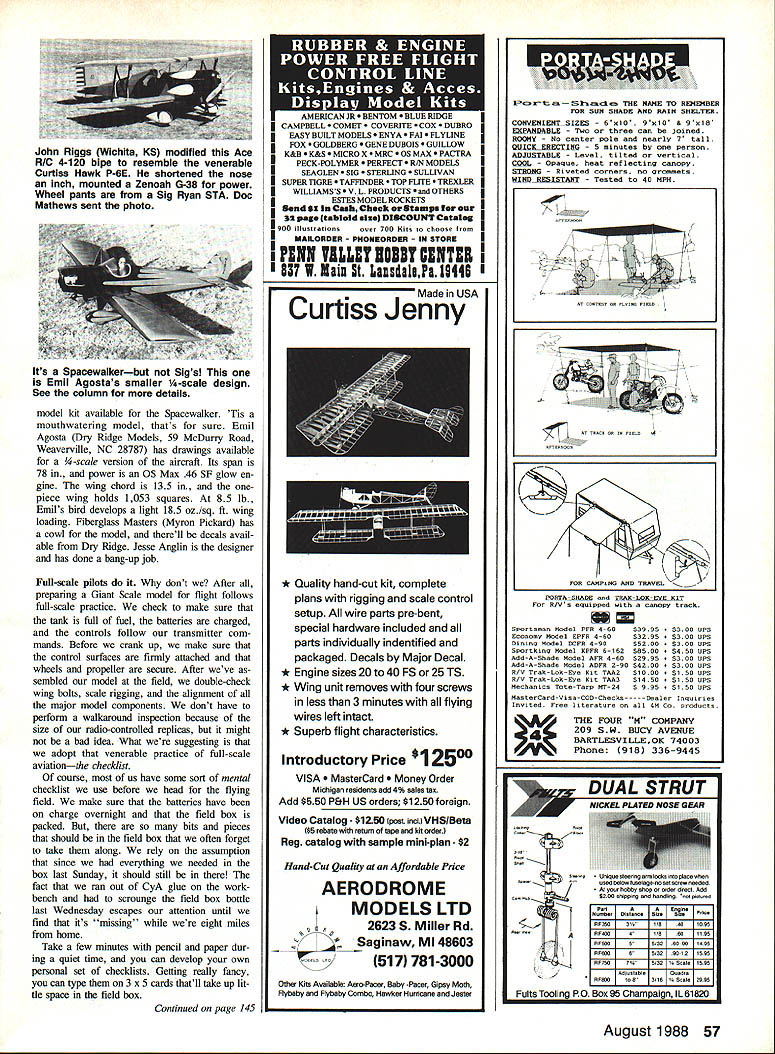
- Chuck Valentino (Ronkonkoma, NY) built a Junkers Ju-87B Stuka (28 lb) powered by a Quadra 65; used extensive balsa planking and Super Coverite Formula-U spray; insignia hand-painted.
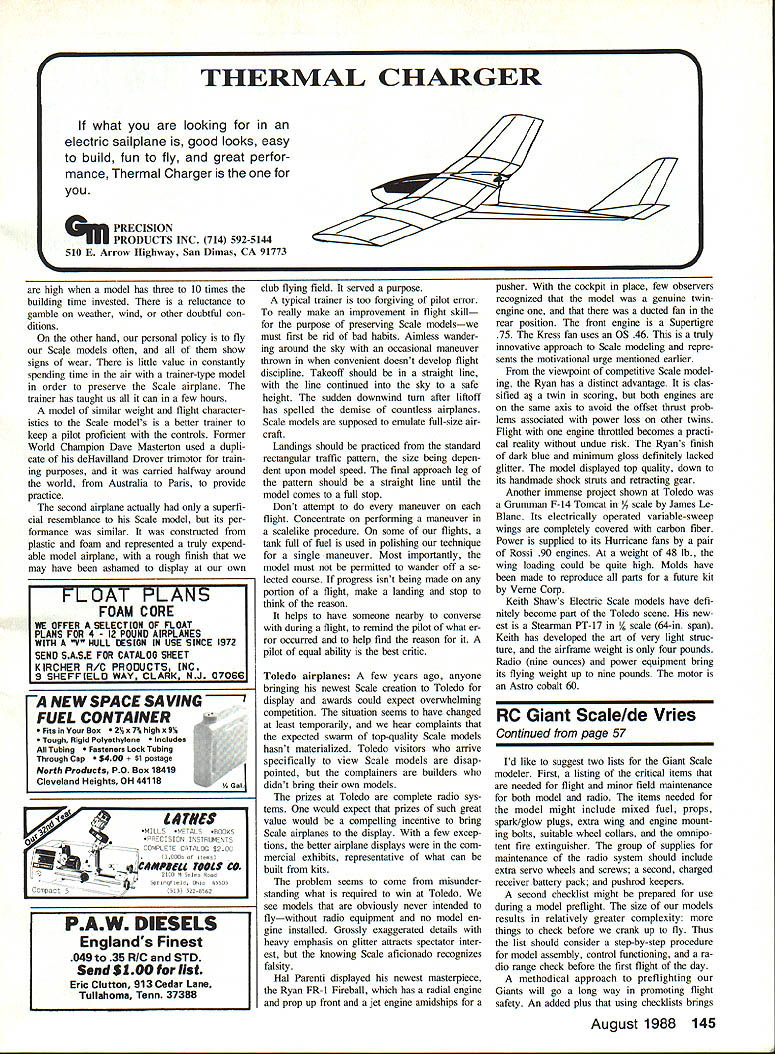
- Tom Thacker (Peach State Quarter Scalers) built "Super Hots" powered by an OPS 18 cu. in. engine.
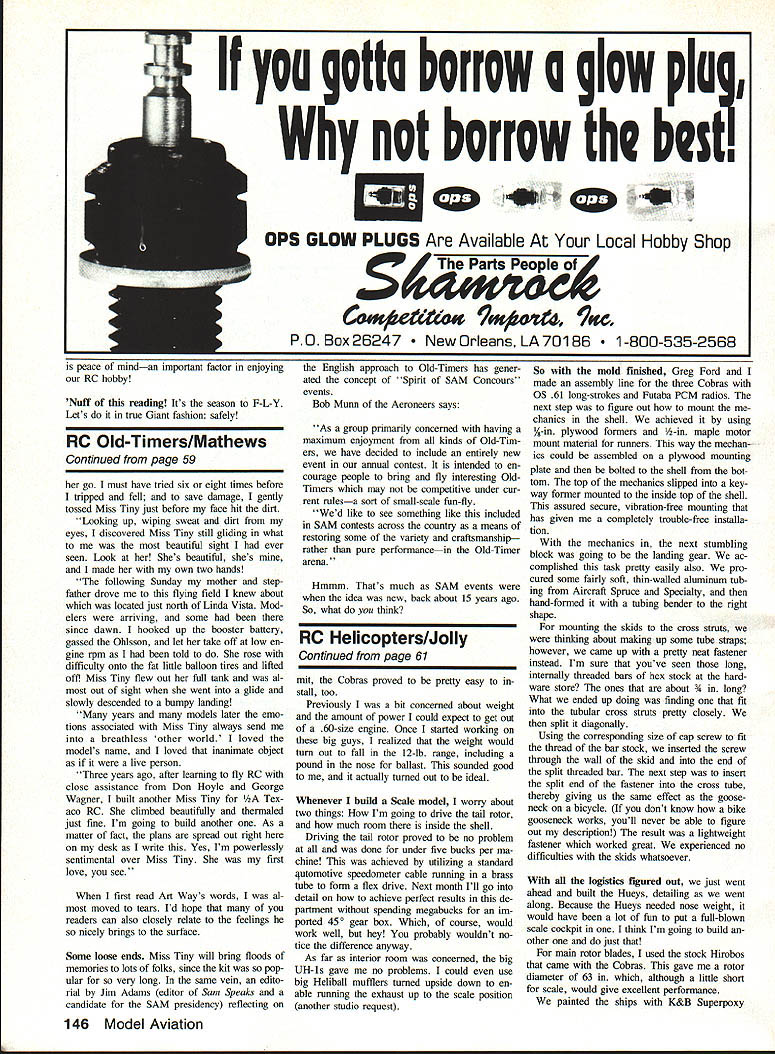
- John Riggs (Wichita, KS) modified an Ace R/C 4-120 biplane to resemble a Curtiss Hawk P-6E: shortened nose, Zenoah 0-38 power, wheel pants.
- Emil Agosta (Dry Ridge Models, 59 McDurry Road, Weaverville, NC 28787) offers drawings for a 1/4-scale aircraft: 78 in. span, OS Max 46 SF power, 13.5 in. wing chord, one-piece wing of about 1,053 sq. in., empty weight ~8.5 lb, light wing loading (~18.5 oz/sq. ft.).
- Fiberglass Masters' Myron Pickard has a cowl model; decals will be available. Dry Ridge's Jesse Anglin (designer) has done high-quality work.
Toledo show observations
- Prize structure at Toledo (complete radio systems) should attract top-quality Scale entries, but recent years saw fewer high-caliber Scale models on display.
- Problems include models that are obviously never intended to fly (no radio equipment, exaggerated or false detail). Spectators may be attracted to glitter, but experienced Scale judges look for authenticity.
Notable entries:
- Hal Parenti — Ryan FR-1 Fireball: a genuine twin configuration with a front radial engine (Super Tigre .75) and a ducted fan amidships rear (Kress fan driven by an OS .46). The model emphasized classic styling and authentic finish (dark blue and aluminum gloss) without glitter; it showed high-quality construction and retracting gear detail. The same-axis engine arrangement reduces offset-thrust issues when flying on one engine.
- James LaBande — Grumman F-14 Tomcat (1/6 scale): electrically operated variable-sweep wings covered with carbon fiber; powered by a pair of Rossi .90 engines driving Humphreys; weight ~48 lb. Molds have been made for possible kit production by Verne Corr.
- Keith Shaw — Electric Scale models: a 1/2-scale Stearman PT-17 (64 in. span) showing very light structure. Airframe weight ~4 lb; radio (about 9 oz) and power equipment increase the flying weight. Motor: Astro Cobalt I-6.
Training, preservation, and flight discipline
Scale models often represent many times the building time and cost of typical trainers. Owners may be reluctant to expose them to risky conditions, but preserving a Scale model by not flying it is counterproductive. Key points:
- Use an expendable or simpler trainer with similar weight and flight characteristics to stay proficient. Example: World Champion Dave Masterson used a duplicate of his DeHavilland Drover trimotor for training—an expendable model with similar performance.
- Typical trainers can be too forgiving. To improve skill and preserve Scale models, practice disciplined flying:
- Takeoffs: straight line, continuing into the sky to a safe height; avoid sudden downwind turns after liftoff.
- Traffic pattern: use a standard rectangular pattern; size depends on model speed. Final approach should be a straight line until the model comes to a full stop.
- Maneuver practice: concentrate on one maneuver per flight and polish technique over multiple flights. If progress stalls, land and analyze the problem.
- Critique: have a nearby helper or a pilot of equal ability to point out errors and help diagnose problems.
Preflight and field checklists
Adopt the full-scale aviation practice of using written checklists. Relying solely on memory leads to forgotten items and field improvisation. Suggested approach: prepare small 3 x 5 cards or typed checklists to keep in the field box.
Suggested items to carry for model and field maintenance:
- Model supplies: mixed fuel, spare props, spare spark/glow plugs, extra wing and engine mounting bolts, suitable wheel collars, fire extinguisher.
- Radio supplies: extra servo arms and screws, a second charged receiver battery pack, push-on connectors.
- Tools and spares: (add your personal items—screwdrivers, pliers, Allen wrenches, epoxies, adhesives, tape, etc.)
Suggested final preflight checklist (sample sequence):
- Assemble model per instructions; verify all bolts, nuts, and fittings are secure.
- Verify control surface attachments; check for free and correct movement and proper travel direction.
- Confirm engine/motor mount, propeller, and wheel security.
- Connect and check all control linkages and clevises; verify safety pins/clips.
- Perform range check and transmitter/receiver function check.
- Ensure batteries are charged and properly installed; fuel tank full.
- Double-check wing bolts, scale rigging, and alignment of major components.
- Verify required safety equipment (fire extinguisher) is on hand.
- After taxi to takeoff end, re-confirm throttle control and control surface response.
A methodical approach to preflight and field operations promotes safety and increases confidence when your model taxis to the runway.
Transcribed from original scans by AI. Minor OCR errors may remain.

