
Radio Control: Giant Scale
John A. de Vries Colonel, USAF, Ret. 4610 Moffat Ln. Colorado Springs, CO 80915
BUILDING a Giant Scale RC model airplane is a wondrously complex undertaking. It requires talent, skill, intelligence, and no small measure of manual dexterity. It involves woodworking, metalworking, a rudimentary knowledge of electronics, and a familiarity with aerodynamics. Viewed by the neophyte constructor, it can be a truly daunting task.
Many model builders have spent years learning the techniques needed to construct a successful miniature aircraft. Others embark with minimal experience, helped by books, magazines, and the instructions included in Giant Scale kits purchased from local hobby shops or by mail order. That models get built and flown by beginners almost defies understanding, because there is no formalized training or instructional program to teach model construction. There is a school for radio-control fliers (First U.S. R/C Flight School, 521 S. Sawyer, Shawano, WI 54166), but nothing comparable for Radio Control model builders.
Getting help from clubs and fellow builders
When model builders start cutting balsa they're largely on their own—unless they're an AMA or IMAA member. There is, however, substantial help only a phone call away from skilled model builders in your local model club or chapter. Nothing beats the personal, direct assistance of a knowledgeable fellow RC enthusiast when it comes to solving sticky construction problems. That is one of the prime reasons to join an AMA‑chartered club or an IMAA chapter.
- Clubs usually have a master builder whose experience will be shared on request.
- Even if there isn't a single master builder, there's likely a member who's encountered and overcome the difficulty you're facing.
- The cooperative spirit between model builders is a wonder to behold.
Probably the most instructive part of a club meeting is the almost-universal show-and-tell. Members bring recently constructed birds for the edification of all. It's a golden opportunity to share the trials, tribulations, and ultimate triumphs of model construction. If you want to learn how to build RC models, just look and listen.
IMAA Chapter 90: Winter Project Review / Technical Seminar
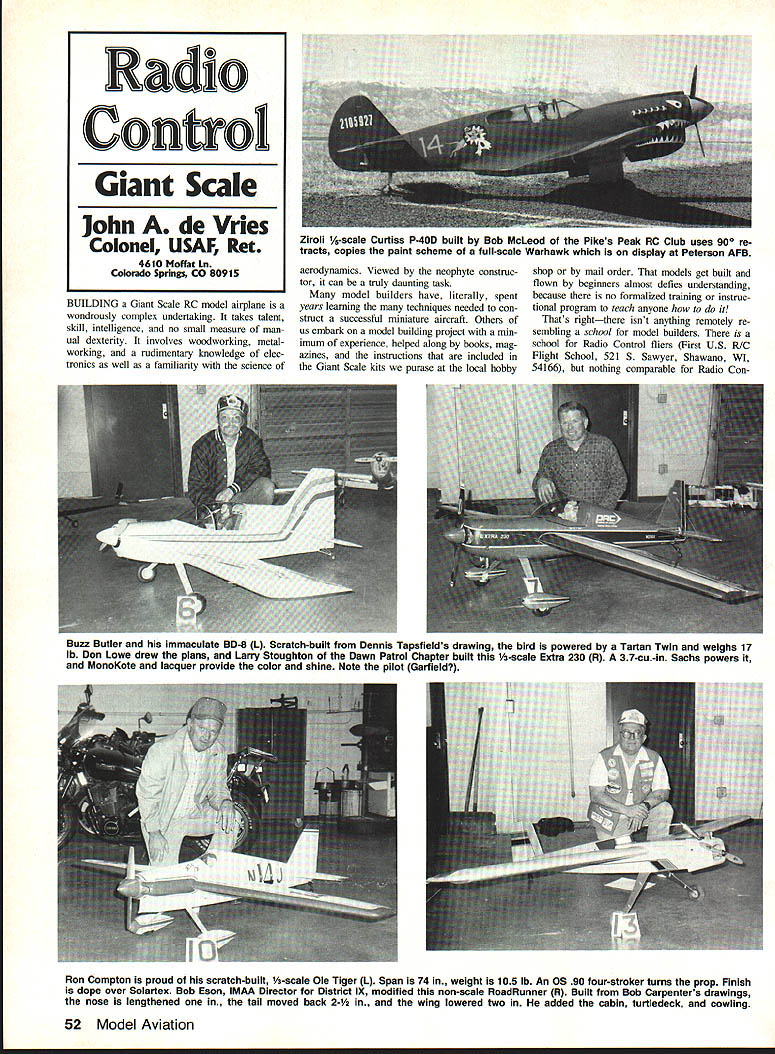
IMAA Chapter 90 (Colorado Dawn Patrol, Denver) has raised show-and-tell to the ultimate experience. Smack-dab in the middle of winter they schedule a Winter Project Review and Technical Seminar on the floor at Wayne's Automotive, covering Giant Scale RC models at various stages of construction. This year's date was March 19, 1988. Practically everybody in the chapter participates in what has become a premier learning experience. Wandering among the models provides an outstanding educational opportunity, particularly if you stop and chat with the individual builders.
The chapter supplements the show-and-tell with hands-on demonstrations and seminars. This year’s presentations included:
- Bob Eson: Use of Solar Film laid over a Solartex base.
- Bob Higgins: Brazing and sweating nonferrous metals; demonstration included joining two aluminum pop cans.
- Ron Compton: Techniques for working with plastic foam board.
- Ken Otto: Techniques for heat-sealing components using coatings of white glue.
- Vail Kinsey: Silver-soldering techniques and application to engine mufflers.
- Leo Ford: Fiberglass molding techniques, including male and female molds and the use of release agents.
- Steve Mangels (District IX Radio Frequency Coordinator): Facts about narrow‑band and broadband transmitters and receivers.
There’s a lot to recommend in following Chapter 90’s lead—this is a supreme example of modelers helping modelers while having a ball doing it.
Club transmitter certification and flight-safety measures
Our club has taken the plunge and voted to certify all of its RC transmitters. At our May meeting there was a certification "orgy"—over 200 transmitters were checked and stickered. Although it isn't an AMA requirement, the goal is to reduce electronic hazards at the club field.
This has been combined with the use of six carefully spaced concrete-block pilot positions, which should minimize radio interference. Now, if we can only convince people not to turn on unless they have the pin, electronic safety at the field will be greatly improved.
Test flight: aileron flutter case study
A good friend recently test-flew a newly developed Giant Scale model. He is an ace pilot—often called on to make first flights. After a meticulous safety inspection, he was a bit apprehensive about the aileron control installation. The designer had chosen plastic pushrods that were not supported through their full length. The ground check, with the engine running, showed proper control movement, so an initial test flight was attempted.
After a few tries the model was airborne and easily trimable. During the photo pass at reduced airspeed the photographers thought they heard something. On the second pass, with the engine at full throttle, they confirmed their suspicion: the ailerons were fluttering alarmingly. The blur at both wing tips and the noise of the flutter were audible over the roar of the engine.
The pilot reduced throttle to slow the aircraft and made a gentle straight-in approach. The off-runway landing caused the bird to tumble, but the damage was relatively small.
The assembled experts concluded the flutter resulted from the unsupported aileron pushrods. They recommended either:
- Adding pushrod tie-downs every three inches along their length (the solution adopted), or
- Installing internal dynamic balances within the wing, forward of the aileron spar.
The repair included increasing pushrod support and changing the inner plastic rod of the two-piece pushrods to a less temperature-sensitive flexible cable. After another test flight the bird performed perfectly—all evidence of flutter was gone and the model was a joy to fly.
Lessons learned
- A test flight of a new model or design is exactly that—a test. The pilot must be prepared for the unexpected and be qualified to meet it.
- Control surfaces must function correctly in the air. Surface flutter can render a model uncontrollable or cause it to disintegrate in flight.
- Flutter is aggravated by high airspeeds; if you suspect flutter, slow the aircraft and land immediately.
- Even with a proficient test pilot, having qualified observers on hand for initial flights is invaluable. Unencumbered by flying, their observations can prevent disaster.
That does it for this month.
Back atcha next month!
Transcribed from original scans by AI. Minor OCR errors may remain.

