
Radio Control
Giant Scale
John A. de Vries Colonel, USAF, Ret. 4610 Moffat Ln. Colorado Springs, CO 80915
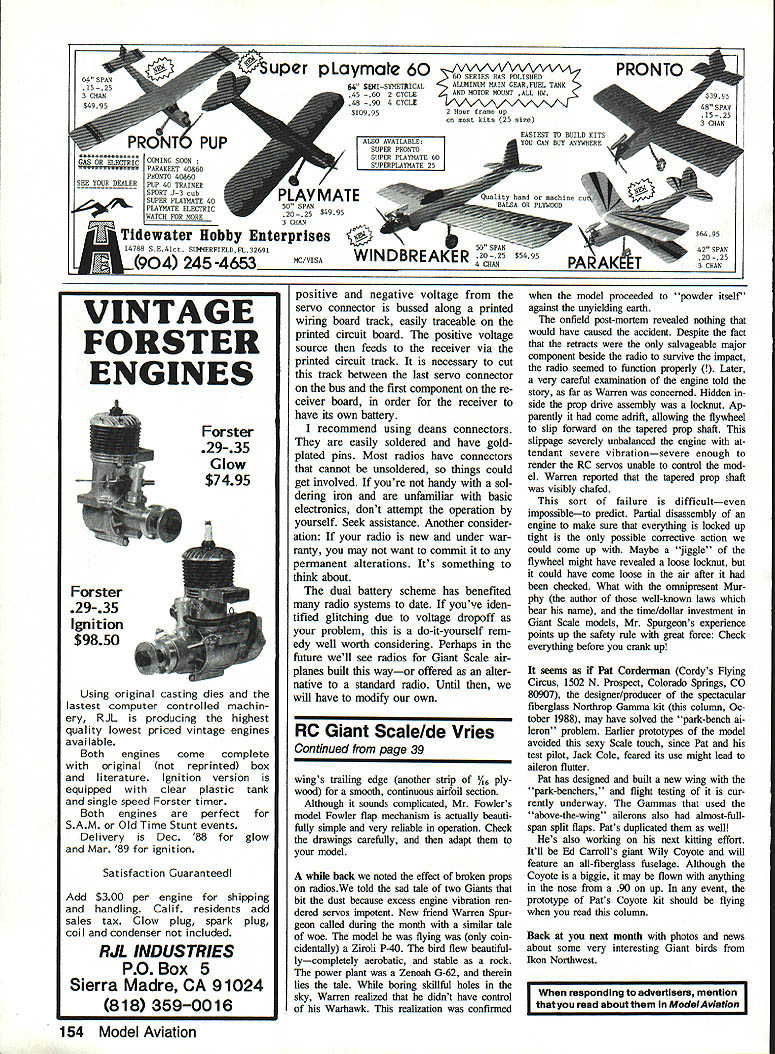
HOT TOPIC for this month is Fowler flaps for Giant Scale models. Charles Fowler (Alameda, CA) dropped in, and we talked half a day about the mechanism he's designed. Later, when he got back home, he sent me his test wing panel. It is a slick installation. Below I describe it so you can adapt Charles' design to your particular Scale model.
Before we begin, there are three admonitions to consider:
- Charles' mechanism is not specifically intended for any one Scale model. He tested it on a non-Scale "goat" to prove its functioning.
- Some fiddling will be required to adapt the design to a specific model. How much flap extension and drop angle you get depends on the bellcranks you use and the length of the flap-action pushrods.
- Although components are readily available in most hobby shops, the solidity of the mechanism requires knowledge of silver soldering. There are only four solder joints to be made, but each joins brass to music wire, so stronger solder is recommended.
For Giant Scale installations, each flap should be operated by its own servo to provide necessary redundancy. Depending on your installation, it may also be possible to link both flaps mechanically for even greater redundancy.
Charles Fowler's Fowler-flap mechanism is a closed-loop type. Although the entire system uses pushrods, it connects to both sides of the flap servo arm. This arrangement allows:
- Proportional channels to hold intermediate positions between Flaps Up and Flaps Down.
- A true pull-pull action so the flaps will move and resist blowing back (streamlining) under aerodynamic loads.
The mechanism consists of two major systems:
- One system moves the flap hinge line back and out from the trailing edge of the wing.
- The other system restrains the rearward movement of the flap itself, thereby lowering the flap.
Both systems operate from the same pair of slightly modified standard 90° nylon bellcranks for .60-size models. The bellcrank modifications are minimal and mostly trimming with an X-Acto knife.
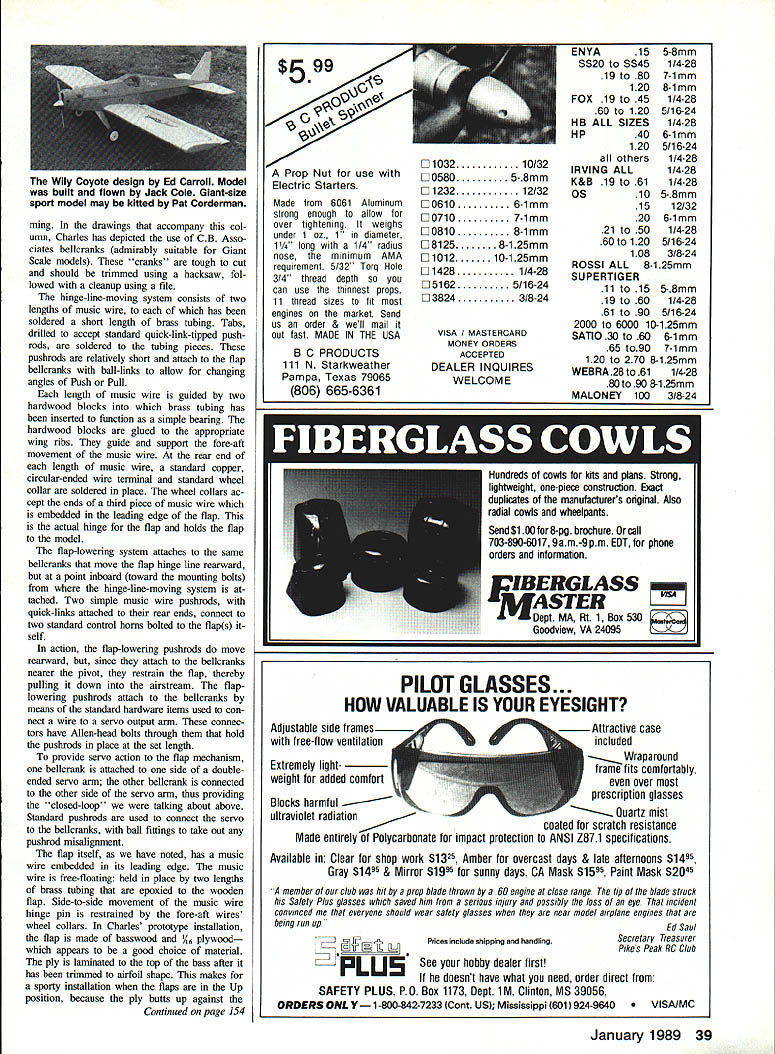
Charles Fowler's flap mechanism is shown in two positions in his drawings: flaps extended (right-hand portion) and flaps retracted (left-hand portion). Parts include:
- A — heavy music wire portion of the flap-extension system
- B — hardwood guide blocks
- C — wheel collars and tabs silver-soldered to wire
- D — flap retaining rods
- E — modified 90° aileron-type bellcranks
- F — heavy music wire flap hinge pin
- G — wheel collar silver-soldered to flap extension rod (also keeps wire F moving)
- H — flap servo
- I — flap control horns
- J — bellcrank sliding wire pushrods
- * — pushrod from servo to bellcrank (not shown)
Hinge-line-moving system (details)
- Two lengths of music wire have a short length of brass tubing soldered to each; tabs are drilled to accept standard quick-link-tipped pushrods.
- The relatively short pushrods attach to the flap bellcranks; ball-links allow angle changes.
- One push-pull length of music wire is guided by two hardwood blocks; the brass tubing serves as simple bearings. The hardwood blocks are glued to appropriate wing ribs to guide and support fore-and-aft movement of the music wire.
- The rear end of this music-wire length uses a standard copper circular-ended wire terminal with a wheel collar silver-soldered in place. The wheel collars accept the ends of the third piece of music wire embedded in the leading edge of the flap and act as the actual hinge of the flap.
Flap-lowering system (details)
- The flap-lowering rods attach to the same bellcranks that move the flap hinge line rearward. Two music-wire pushrods with quick-links on their ends connect the bellcranks to standard control horns bolted to the flaps.
- Because these pushrods attach nearer the bellcrank pivots, when the bellcrank moves they move rearward a shorter amount and restrain the flap, pulling it down into the airstream.
- The flap-lowering pushrods attach to the bellcranks by the same hardware used to connect a servo to a servo output arm; Allen-head bolts through these connectors hold the pushrods at the set length.
Servo hookup and flap construction
- One bellcrank is attached to one side of a double-ended servo arm and the other bellcrank to the opposite side, creating the closed-loop system. Standard pushrods with ball fittings connect the servo to the bellcranks to accommodate misalignment.
- The flap has a music wire embedded in its leading edge. The music wire is free-floating but held by two lengths of brass tubing epoxied to the wooden flap. Side-to-side movement of the hinge pin is restrained by the fore-aft wheel collars.
- In Charles' prototype the flap is made of basswood; a plywood hinge tab makes a neat installation when the flaps are in the Up position, as the plywood butts against the mounting structure.
Study the drawings and adapt the details—bellcrank geometry, pushrod lengths, and hinge placement—to suit your model.
Radio Control: Giant Scale
By Charles H. Fowler — Design and Drawings
Before I begin, three admonitions to consider:
- This mechanism was developed for Giant Scale models but was tested on a non-Scale "goat" to verify functioning.
- Expect to fiddle with the installation: flap extension and drop angle depend on bellcranks used, pushrod lengths, and how the mechanism is built into your wing and flap.
- The mechanism requires silver soldering skills. There are only four solder joints, but they are on brass and music wire; use stronger silver solder for durability.
For Giant Scale installations it is advisable to have each flap operated by its own servo for redundancy. It may also be possible to mechanically link both flaps for additional redundancy.
Fowler's flap mechanism is a closed-loop type: pushrods connect to both sides of a flap servo arm. This provides:
- Rigid maintenance of intermediate flap positions when using a proportional channel.
- Pull-pull action ensuring the flaps move reliably under radio control and resist aerodynamic blowback.
Drawing C — Fowler parts
- A. Heavy music wire portion of flap-extension system
- B. Hardwood guide blocks
- C. Wheel collars and tabs; silver-soldered to wire
- D. Flap retaining rods
- E. Modified 90° aileron-type bellcranks
- F. Heavy music wire flap hinge pin
- G. Wheel collar silver-soldered to flap extension rod (also keeps wire F moving)
- H. Flap servo
- I. Flap control horns
- J. Bellcrank sliding wire pushrods
The hinge-line-moving system
- Two lengths of music wire each have a short length of brass tubing silver-soldered to them. Tabs are drilled to accept standard quick-link-tipped pushrods; the tubing pieces accept the pushrod ends which are silver-soldered to them.
- The pushrods attach to the flap bellcranks with ball-links to allow changing angles.
- One push-pull length of music wire is guided by two hardwood blocks with brass tubing acting as bearings. The hardwood blocks are glued to wing ribs to guide and support fore-and-aft movement.
- The rear end of this music wire accepts a copper circular-ended wire terminal with a wheel collar silver-soldered in place. The wheel collars accept the ends of the third music-wire piece embedded in the flap leading edge. A plywood hinge tab holds the flap on the model.
The flap-lowering system
- Attaches to the same bellcranks that move the hinge line rearward, toward the hinge-line mounting bolts.
- Two simple music-wire pushrods with quick-links on their rear ends connect the bellcranks to standard control horns bolted to the flaps.
- Because these pushrods attach nearer the bellcrank pivots, they move rearward less and restrain the flap, pulling it down into the airstream.
The hinge-line-moving system and flap-lowering rods together provide the desired flap geometry and operation. Study the drawings carefully, then adapt them to your model.
Transcribed from original scans by AI. Minor OCR errors may remain.

