
Radio Control: Giant Scale
John A. de Vries
Colonel, USAF, Ret. 4610 Moffat Ln. Colorado Springs, CO 80915
Ever since the Aeronca was a pup, model builders have been duplicating Aeronca aircraft. The reason, of course, is that most "AirKnockers" were stable, high-wing monoplanes that have always flown well in model form.
Giant Scalers have duplicated several Aeronca prototypes, first because there were great Nosen and Balsa USA kits available, and more recently because very scale-like twin-cylinder, four-stroke glow engines were available to simulate the original E-113C Moorehead two-banger. The "Flying Bathtub"—the Aeronca C-2/C-3—was beautifully drawn in five-view by the late Paul Matt in his Historical Aviation Album series. Paul's drawings proved to be the documentation for the Bathtub and subsequent Aeronca models.
National Aeronca Association
A recent letter from Bob Aberle announced the organization of the National Aeronca Association. The association is devoted to the restoration of full-scale Aeroncas, so it will certainly be a treasure chest of model documentation. They publish a great magazine devoted to the Cincinnati-built lightplane and all of its successors (including wartime L-3s and PT-19s). An Aeronca museum is also in the works. If your interests lie in reproducing Aeronca aircraft, you can contact the Association at:
- National Aeronca Association
- 266 Lamp & Lantern Village
- Chesterfield (St. Louis), MO 63017
- Phone: 314-391-8999
New Paul Matt Collection Volume
While we're still talking Aeroncas, our good friends at Sunshine House, Inc., who purchased the Paul Matt collection, have just announced a new book titled Aeronca—The Best of Paul Matt. They've extracted all of the Aeronca articles and drawings from the Historical Aviation Album series and packaged them in an 88-page volume that's really definitive. Contact:
- Sunshine House, Inc.
- P.O. Box 2065
- Terre Haute, IN 47802
The book includes 14 pages of drawings and 160 photos.
High-Lift Mechanisms and Innovations
Charles Fowler (Alameda, CA) is still at it! As this is written, he's flying his "goat" that features his scale Fowler–Fowler flap mechanism described in detail in last month's column. His latest invention is a model high-lift mechanism designed to droop a wing's leading edges. It can be tied in mechanically to his flap-actuation system. As Charles continues his test program, we'll keep you advised about the effects of the flaps—and later, the functioning of the droop device.
Ikon N'West Giant Scale Kits
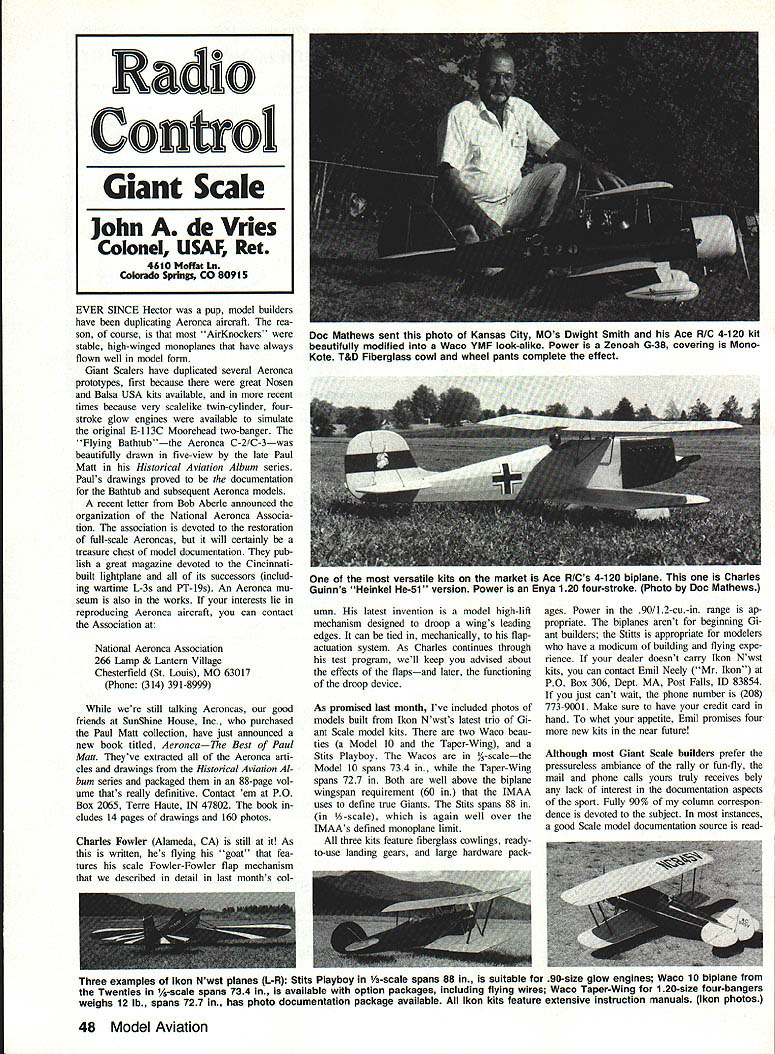
As promised last month, I've included photos of models built from Ikon N'West's latest trio of Giant Scale kits. There are two Waco beauties (a Model 10 and the Taper-Wing), and a Stits Playboy. The Wacos are in 1/3-scale—the Model 10 spans 73.4 in., while the Taper-Wing spans 72.7 in. Both are well above the biplane wingspan requirement (60 in.) that the IMAA uses to define true Giants. The Stits spans 88 in. (1/3-scale), which is again well over the IMAA's defined monoplane limit.
All three kits feature fiberglass cowlings, ready-to-use landing gears, and large hardware packages. Power in the .90–1.20 cu. in. range is appropriate. The biplanes aren't for beginning Giant builders; the Stits is appropriate for modelers who have a modicum of building and flying experience. If your dealer doesn't carry Ikon N'West kits, you can contact Emil Neidy ("Mr. Ikon") at:
- Emil Neidy, P.O. Box 306, Dept. MA
- Post Falls, ID 83854
- Phone: 208-773-9001
Make sure you have your credit card in hand—Emil promises four new kits in the near future.
Scale Documentation and Research
Although most Giant Scale builders prefer the pressureless ambiance of the rally or fun-fly, the mail and phone calls yours truly receives belie a lack of interest in the documentation aspects of the sport. Fully 90% of my column correspondence is devoted to this subject. It's only the truly obscure scale subject that requires any sort of digging.
There are some prototype aircraft, albeit widely used, that defy documentation. A request from Israel for large-scale model drawings and workable three-views for the Boeing 707 recently defeated the "system." Definitive three-views for the great Bridi kit have eluded acquisition. The same situation prevailed for the Northrop Gamma—until Harry Dickinson (Pomona, CA) came up with some detailed photographs of the Gamma's construction.
Unfortunately, there isn't a comprehensive listing of scale drawings available. There are some excellent compendiums of the plans included in the pages of various U.S. model magazines. RCM, Model Airplane News, and Model Builder drawings have been treated in this way and are excellent sources of what has been available. Good friend Johnny Carroll (Dublin, Ireland) compiled a stunning list of scale drawings in European modeling magazines, but the availability of the sources in the U.S. is meager at best.
Correspondence: How to Request Information
Probably the greatest frustration felt by all magazine columnists is the letter that begins, "Please send all the information you have about the ..." The letters represent anything from the P-51 and the J-3 Cub to the most obscure modeling subject. The impression such letters give is that the modeler is on a fishing expedition and doesn't really know what he or she wants in the way of documentation. Then too, many of us receive the "form letter"—a Xeroxed request that has the columnist's name pencilled in at the top. We know that the same epistle has been sent to everybody and his brother at all the magazines! That's fishing with a net!
From experience we know that the letter which requests information on a specific real aircraft represents a true desire on the part of the modeler to acquire documentation that will be used. Such letters are welcome and are usually answered to the best of the columnist's ability. The inclusion of a self-addressed, stamped envelope with the requesting letter also indicates a positive attitude—and goes a long way toward producing a timely, worthwhile response.
So, even though you may never attend one of your Giant Scale models in a competitive event, there appears to be a need to document it—if only to improve its scale-like appearance. We all appreciate this need and will help within the constraints of available research data and time. However, when you write anyone asking for documentation information, please be as specific as you can about the aircraft type you're interested in. And, to expedite things, an SASE (of the large, business size) is always appreciated.
I hope that you all had a pleasant holiday season, and that Santa brought you the Giant Scale goodies you had your eye on.
Transcribed from original scans by AI. Minor OCR errors may remain.

