
Radio Control: Giant Scale
John A. de Vries Colonel, USAF, Ret. 4610 Moffat Ln. Colorado Springs, CO 80915
Introduction
Ah! The merry month of May! The flying season is well under way in most parts of the country—or soon will be. This month's column was inspired by a "car person" who also flies R/C — a 6-ft. Pitts rigged with smoke. The main topic is redundant (dual-servo) installations on Giant Scale models and how to cope with servo or engine-servo failures in flight.
Servo Failures and Emergency Procedures
Locked Rudder (hard-over)
I have seen only one true servo hard-over. Joe Bridi was flying a Dirty Birdy when his rudder servo locked full right. Joe, a master RC pilot, managed a safe landing by:
- Reducing model speed to just above stall to lessen the rudder effect.
- Using maximum aileron rate to keep the wings level.
- Allowing a wide, sweeping right turn to line up with the runway and landing normally.
The rudder is the most powerful turning control; its effect is airspeed-dependent—greater at high speeds and less as the aircraft slows.
Aileron Hard-over (one aileron locked)
If one aileron servo locks at full travel while the other aileron servo functions, you can often maintain level flight by:
- Holding the working aileron full opposite to the failed surface.
- Applying a touch of opposite rudder (trim can help hold this).
- Slowing the model to reduce aerodynamic forces.
This situation is generally less critical than a rudder hard-over.
Split Elevator (one elevator servo locked)
A hard-over failure of a split elevator system can be serious depending on altitude and attitude. At altitude, the surviving elevator half should be adequate to maintain level flight. Attitude control can be managed by:
- Increasing or reducing engine power to change pitch (power on = nose up, power off = nose down).
- Preparing for a potentially fast, hot landing if the engine cannot be throttled back.
Engine Servo Failure
- Low-throttle failure: Bring the model in for the best possible landing while maintaining speed above stall.
- Full-throttle failure: Circle until the fuel runs out. A servo-controlled shutoff switch for giant gas burners can be very helpful—line things up, shut off the engine, and make a normal landing.
Multiengined Models (engine-out)
Diagnosing an engine-out condition can be difficult. Typical signs are a reduction in speed and a severe rolling tendency. Recommended actions:
- Reduce power on the good engine to lessen asymmetric thrust and rolling.
- Slow the model within reasonable limits while maintaining enough speed for control.
- Use ailerons and rudder to counter roll and yaw.
- Maintain speed to keep aerodynamic controls effective and allow a single-engine go-around if needed.
In full-scale aviation, the maintained speed after an engine loss is called the "single-engine speed," typically 15–20 mph above stall.
Pilot Response and Preparation
The real problem of servo failure has two parts:
- Recognize the condition as early as possible.
- Maintain your cool.
An observer on the ground can be invaluable—calm, clear recommendations can help steady the pilot. Smooth, gentle corrective inputs and an early landing consistent with maintaining control are essential. Redundant control systems in Giant birds may save your airplane in an emergency.
International: Large Model Association (LMA)
Phil Kent (Scale column, British RCM&E) provided information about the Large Model Association in the U.K. The LMA maintains a register and directory of large models; at the time of the report they listed 568 registered Giant models and assign a registration number to each.
- Example: Model LMAO is a 100 in. span De Havilland Comet, built and flown by R.L. Rawle of Chorleywood.
Contact:
- Mrs. Joan Lockwood-Goose
Westerley, 8 Bilton Lane, Dunchurch, Rugby, CV22 6PT, England
Documentation, Catalogs, and Plans
Both Doc Pepino and Bob Banks have recently sent new catalogs with expanded photo packs and scale drawings.
- Bob Banks — Scale Model Research
2334 Ticonderoga, Costa Mesa, CA 92626 Catalog: $3 (add $2.50 for overseas airmail)
- Doc Pepino — Scale Plans & Photo Service
3209 Madison Ave., Greensboro, NC 27403 Catalog: $3 for North American models (add $2 for overseas airmail)
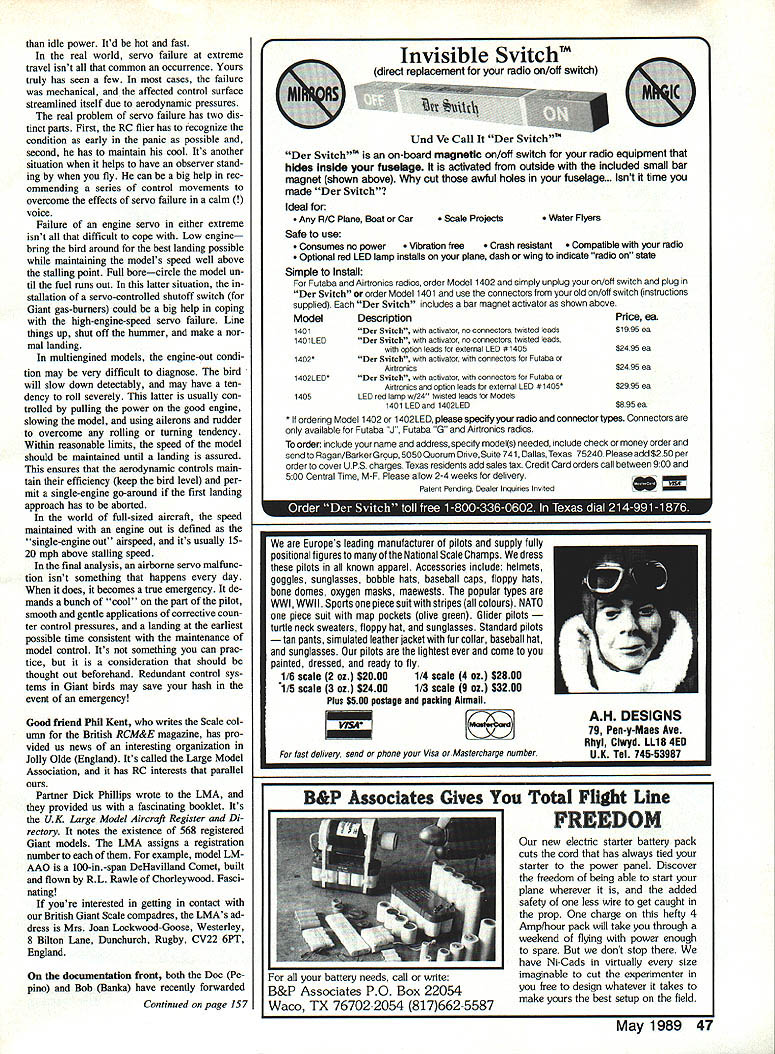
Emil Neely (Ikon N'West) has produced a Giant Scale Curtiss Robin:
- Ikon N'West, P.O. Box 306, Post Falls, ID 83854
- Features: Both OX-5 and Curtiss Challenger versions.
- Span: 98 in.; Flying weight: about 14 lb.; Recommended power: 1.08 cu in.
- Ikon N'West kit catalog: $3
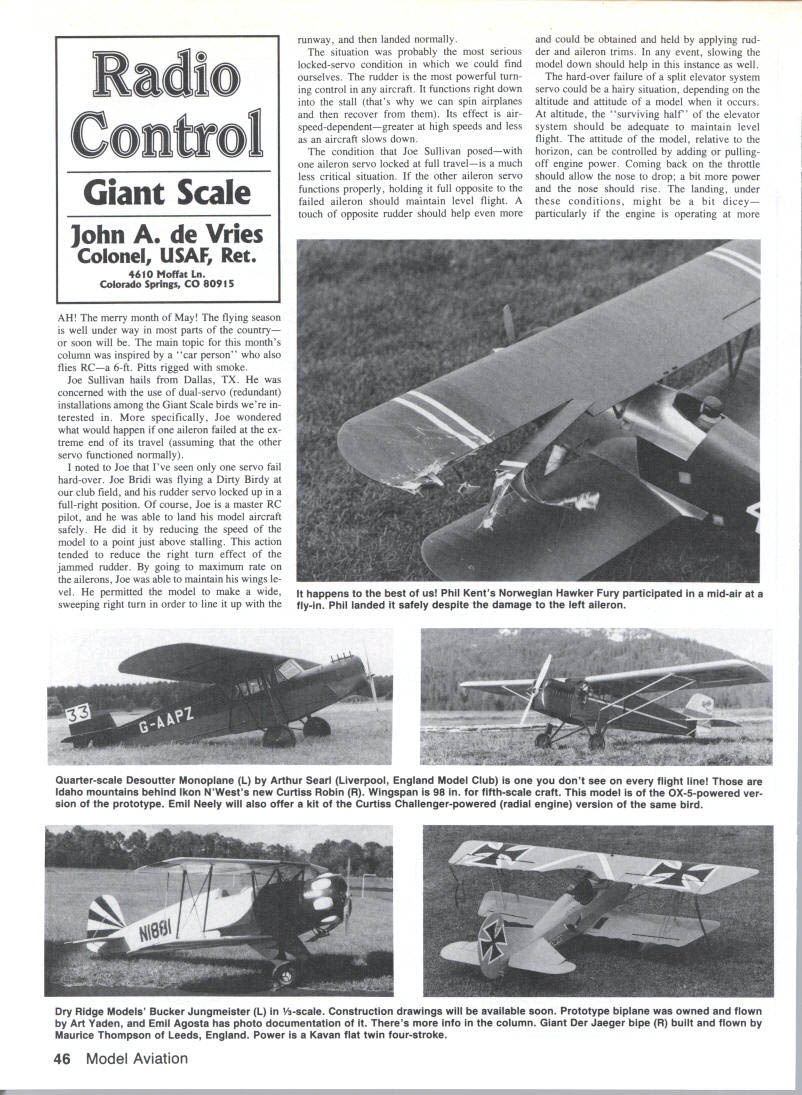
Emil Agosta's current project is a large Bucker Jungmeister:
- Dry Ridge Models, 59 McCurry Road, Weaverville, NC 28787
- Span: 86.3 in.; Length: 74.5 in.
- Building drawings: $60 per set (available around the time this column appears).
Events: 1989 IMAA Rally of Giants
Les Hard, editor of High Flight, reports the 1989 IMAA Rally of Giants will be held June 14–18 in Odessa, TX.
Contact:
- Robbie Carson, 6576 Amber Drive, Odessa, TX 79762
Phone: (915) 368-5874
Registration:
- Pre-registration/landing fee: $15 (by June 1)
- On-site registration: $20
Like other IMAA rallies, it will be a relaxed fly-and-gab fest for U.S. Giant Scalers.
Transcribed from original scans by AI. Minor OCR errors may remain.

