
Radio Control: Giant Scale
John A. de Vries Colonel, USAF, Ret. 4610 Moffat Ln. Colorado Springs, CO 80915
DOCUMENTATION
You've heard about this before — and it bears repeating: the ideal form of scale-model documentation is to have the prototype on hand. Any Giant Scale model worth its salt should be a replica of a specific prototype. What better way to produce a winning miniature aircraft than to have the real thing available for comparison?
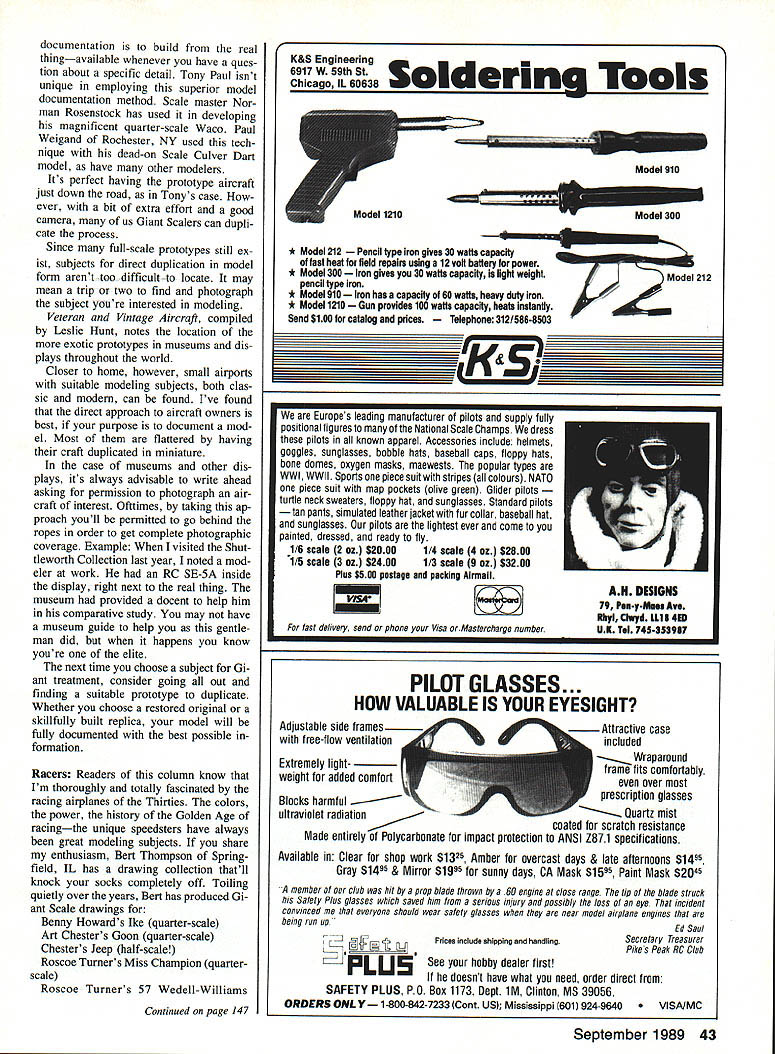
That's what Tony Paul did when he set out to build a dead-on quarter-scale J-3 Cub. Tony located the Cub at Meadowlake Airport, about 10 miles east of Colorado Springs, CO. The full-scale airplane's owner, Jonnie Pinell, Jr., who also owns and operates the Hangar Restaurant at Meadowlake, was willing to cooperate with Tony's modeling efforts. Jonnie's Cub, N-3485K, was built in 1947 and he bought it in 1957 when it had 300 hours in the logbook. Flown frequently since, the J-3 now has about 1,500 hours on the clock. The airplane has a metal wing spar and may be flown solo from the front cockpit.
Tony's Cub started as a Balsa U.S.A. kit. Before the box was opened he spent a day with a 35mm camera photographing Jonnie's craft from many angles, concentrating on details. Then the kit box came off and he went to work. One year later the model Cub was completed: it weighs 17 lb and is powered by a Zenoah G-38 driving an 18 x 6 prop. Covering is Ceconite with a dope paint finish.
Throughout the building process Tony made several trips to Meadowlake Airport to ensure his model duplicated Jonnie's full-scale Cub precisely. When a minor flap on the model was nearly complete, Jonnie changed propellers — Tony had made a scale prop for static judging purposes, but it was no longer scale, so he made a new prop. Tony has flown his model and, much to his delight, it duplicates Jonnie's in the air. The first flight was exceptional; no trim changes were necessary.
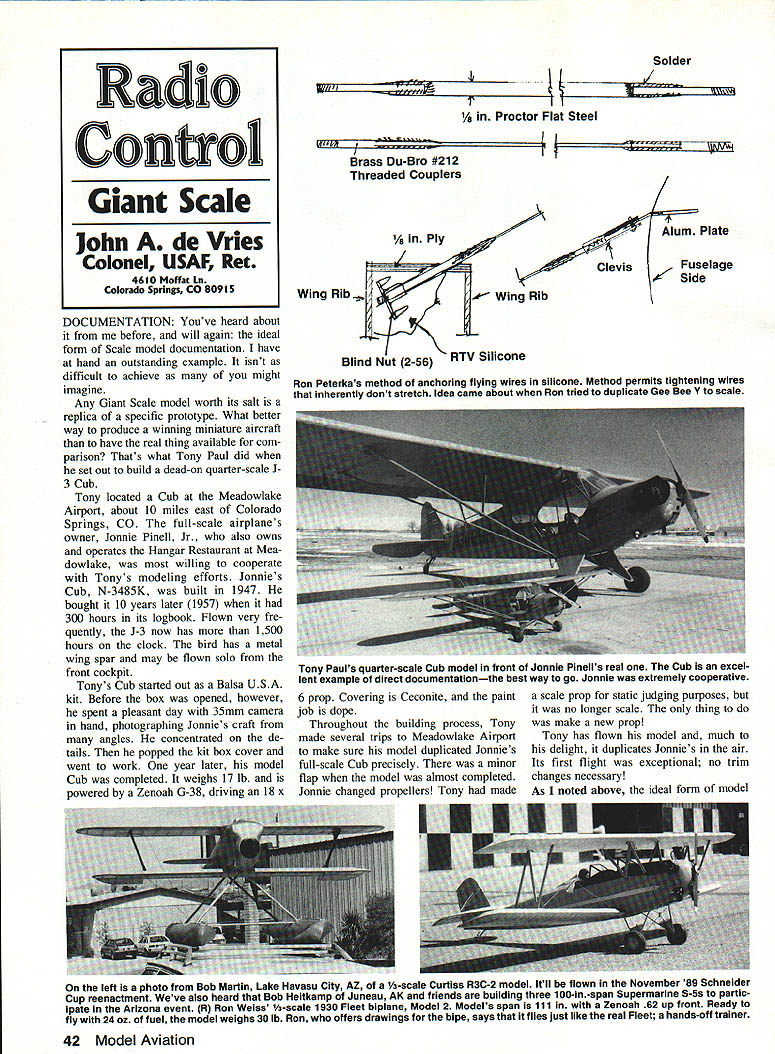
Tony used a number of specific hardware and rigging items: Proctor flat-steel pushrods, brass Du-Bro #212 threaded couplers, Winz blind nuts, and 2-56 RTV silicone plate clevises. For the flying-wire attachments Tony used Ron Peterka's method of anchoring wires with silicone; the silicone permits tightening the wires because it inherently does not stretch. The idea arose when Ron tried to duplicate Gee Bee Y-scale rigging.
As noted above, the ideal form of documentation is having the real thing available. Scale master Norman Rosenstock used this technique for a magnificent quarter-scale Waco. Paul Weigand of Rochester, NY used it for a dead-on scale Culver Dart. Many other modelers have followed the same approach. If the prototype isn't in your neighborhood, a bit of extra effort and a good camera will often allow you to duplicate the process.
Since many full-scale prototypes still exist or are on display, subjects for direct duplication aren't too difficult to locate. Leslie Hunt's Veteran and Vintage Aircraft notes locations of exotic prototypes in museums and displays worldwide. Closer to home, small airports often have suitable classic and modern subjects. The direct approach to aircraft owners usually works best — most are flattered by having their craft duplicated in miniature.
For museums and displays, write ahead to request permission to photograph. Often you'll be allowed behind the ropes for complete photographic coverage. Example: when I visited the Shuttleworth Collection last year I noted a modeler working on an RC SE-5a inside the display, right next to the real thing. The museum provided a docent to help him in his comparative study. You may not always have that level of access, but when it happens you know you are one of the fortunate few.
The next time you choose a subject for Giant treatment, consider going all out and finding a suitable prototype to duplicate. Whether you choose a restored original or a skillfully built replica, your model will be fully documented with the best possible information.
Racers
Readers of this column know I'm fascinated by the racing airplanes of the 1930s — the colors, the power, and the history of the Golden Age of racing make them great modeling subjects. Bert Thompson of Springfield, IL has produced a remarkable collection of Giant Scale drawings. Over the years Bert has produced drawings for:
- Benny Howard's Ike (quarter-scale)
- Art Chester's Goon (quarter-scale)
- Chester's Jeep (half-scale)
- Roscoe Turner's Miss Champion (quarter-scale)
- Roscoe Turner's '57 Wedell-Williams
RC Giant Scale — Continued
Ron Peterka of Glendale, CA has been working on a Gee Bee Y from old American Modeler plans. The drawings specified flying wires made of elastic cord, but Ron wanted wires that looked scale. He found that Proctor 1/8-in.-wide flat steel strips and Du-Bro threaded connectors duplicated the prototype's wires. He slit the brass connectors with an X-Acto saw blade, soldered the tapering ends of the wires to them, and filed to produce scale braces.
A problem arose because the anchor points for the bracing wires were inside the wing structure and the steel wires wouldn't stretch. Ron solved this by screwing a blind nut onto the wing end of the wire, protecting the rest of the threaded portion with bits of plastic tubing, then covering the entire end of the bracing wire (inside the wing) with RTV silicone rubber. When the silicone set, he was able to unscrew the wire, leaving a secure silicone anchor inside the wing.
The fuselage end of the bracing wire was attached to a plate running through the model's fuselage. Since the front of the brace was exposed, Ron used a clevis for attachment. Assembly for flight is simple: screw the wire into the wing socket and then clip the clevis to the fuselage fitting. One suggestion to complete Ron's tensioning idea is to add a nut on the fuselage end of the wire before the clevis is put on; the nut will lock the wire in a streamlined position and prevent vibration from unscrewing the wire in flight. Thanks for the great idea, Ron!
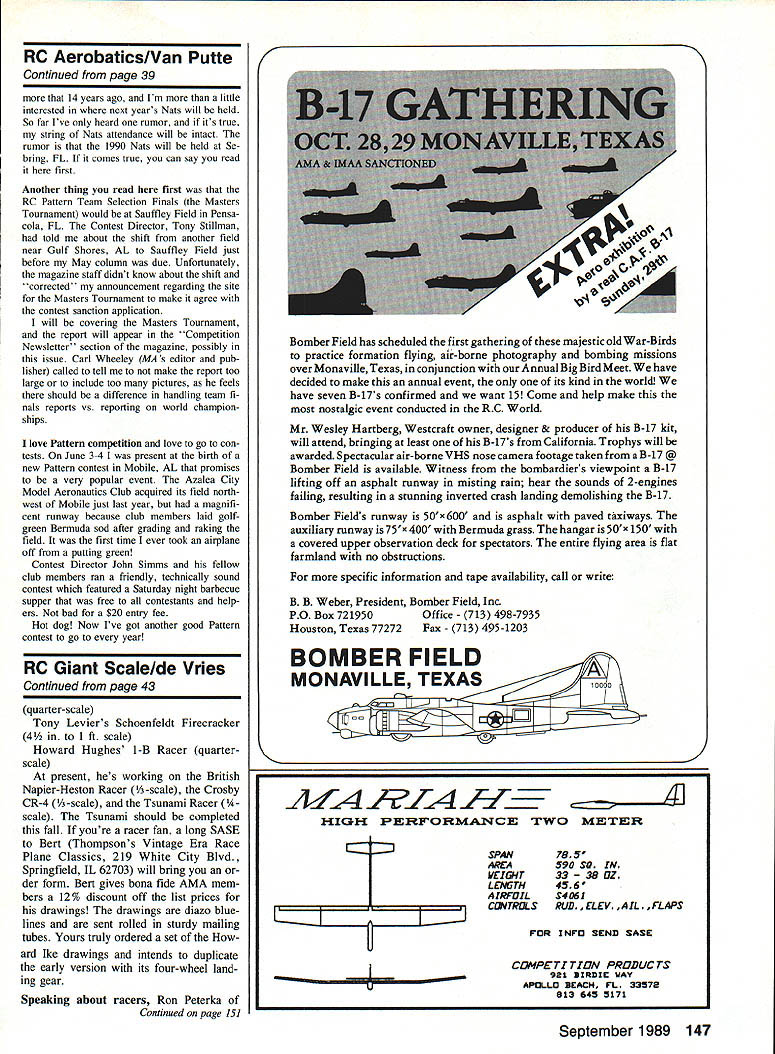
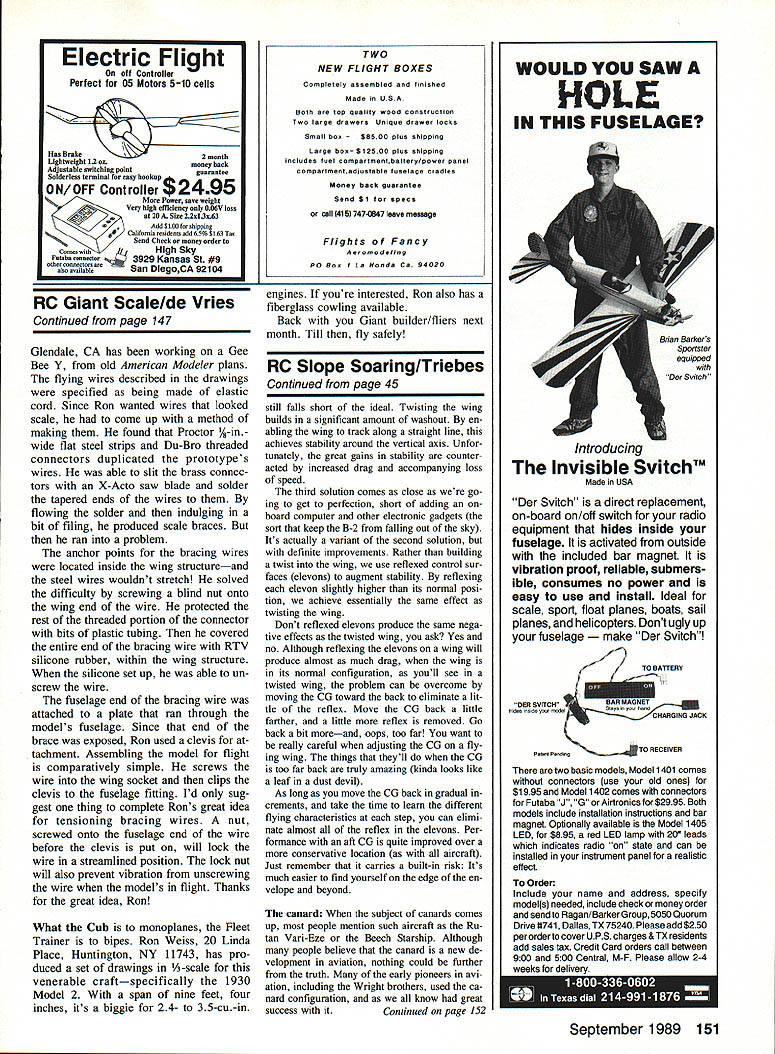
What the Cub is to monoplanes, the Fleet Trainer is to biplanes. Ron Weiss, 20 Linda Place, Huntington, NY 11743, has produced a set of 1/4-scale drawings for the 1930 Model 2 Fleet Trainer. With a span of 9 ft. 4 in., it's a big model suited to 2.4- to 3.5-cu.-in. engines. Ron also has a fiberglass cowling available.
Back with your Giant builder/fliers next month. Till then, fly safely!
Transcribed from original scans by AI. Minor OCR errors may remain.

