
Radio Control: GIANT SCALE
Bob Beckman
Reflections on the season
It is mid-October as I write this, and, hopefully, we in the East will have a few more weeks of good flying weather. As for organized fly‑ins, however, the season is over for me. I was lucky enough to get to four major Giant Scale fly‑ins in 1980: two in the West and two in the East. In addition, I made it to Toledo in April and have had discussions and correspondence with modelers all over the country. As a result of all this, I have some observations and opinions that might be worth sharing.
It will come as no surprise when I say that 1980 was the year when Giant Scale proved itself to be a major part of our hobby. The trend was obvious early in the year at the various trade shows. At Toledo, for example, close to half of the aircraft present were 1/5‑scale or larger. In addition, many of the accessory items displayed were oriented toward big birds.
It was impossible to keep up with all the fly‑in activity throughout the year. In 1979, there were a handful of fly‑ins exclusively for big birds, plus a few that included them along with other classes. In 1980, it seemed that almost every weekend there was a Giant Scale fly‑in somewhere, and most scale contests included the category.
From the technical standpoint, engines were the big item this past year. Detroit has its K‑cars, and Giant Scale has its K‑engines. The Kioritz and two Kawasaki engines really broadened the power options for Giant Scale aircraft. These engines were designed for portable blower use, and consequently have characteristics that suit our application more closely than do the chainsaw‑derived engines. I hear that there may soon be a second, larger (3+ cu. in.) Kioritz.
The geared‑down glow engine prop‑drive units seem to be disappearing. In four gatherings this year I saw fewer prop‑drives than at one fly‑in last year. Fuel cost is probably the reason, plus the fact that it is hard to justify the extra complexity now that gasoline burners are so available and reliable. On top of all that, it just doesn't feel right to watch a Quarter Scale Cub that sounds like a pylon racer.
As for what's being flown, and how well, I saw some trends which surprised me. You would expect that West Coast modelers, with their more‑or‑less year‑round flying season, would stand out as fliers, and the Easterners, who have to live with a three‑ to six‑month "building season," would shine in that area. Not so. On the average, the flying I saw at the two eastern events was superior, while the western fly‑ins had the greater number of new, innovative, and scratch‑built aircraft.
One thing that really comes through loud and clear is that Giant Scale activity is not concentrated in any one area; it is alive and well throughout the country, building up steam for another banner year in '81.
Engine testing
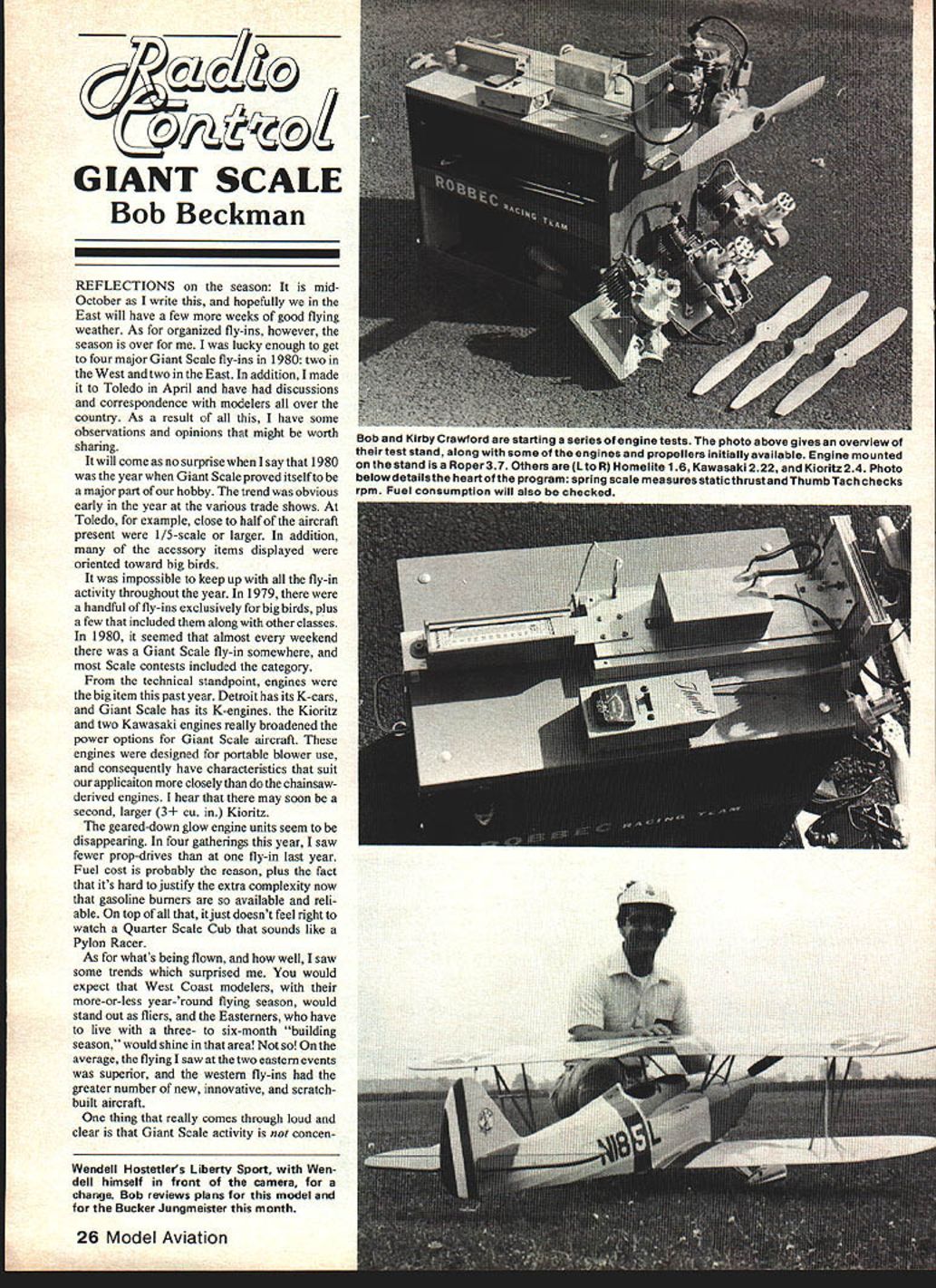
In an effort to come up with answers for the many engine‑related questions I get, Kirby Crawford and I are starting a series of engine tests. We intend to examine as many engine/propeller combinations as we can lay our hands on, with primary concern for gasoline burners.
Deliberately, the testing will not be particularly sophisticated. Static thrust, rpm, fuel consumption, etc., are things the average modeler can understand and appreciate. We're interested in providing useful information, not in writing fancy dissertations on engine theory.
Engines on hand or promised include:
- Two slightly different Homelite 1.6 cu. in. conversions
- Quadra
- Kawasaki 2.22 cu. in.
- Kawasaki 3.15 cu. in.
- Kioritz
- Roper 3.7 cu. in.
We hope to add more engines to the list and to include commercially available props.
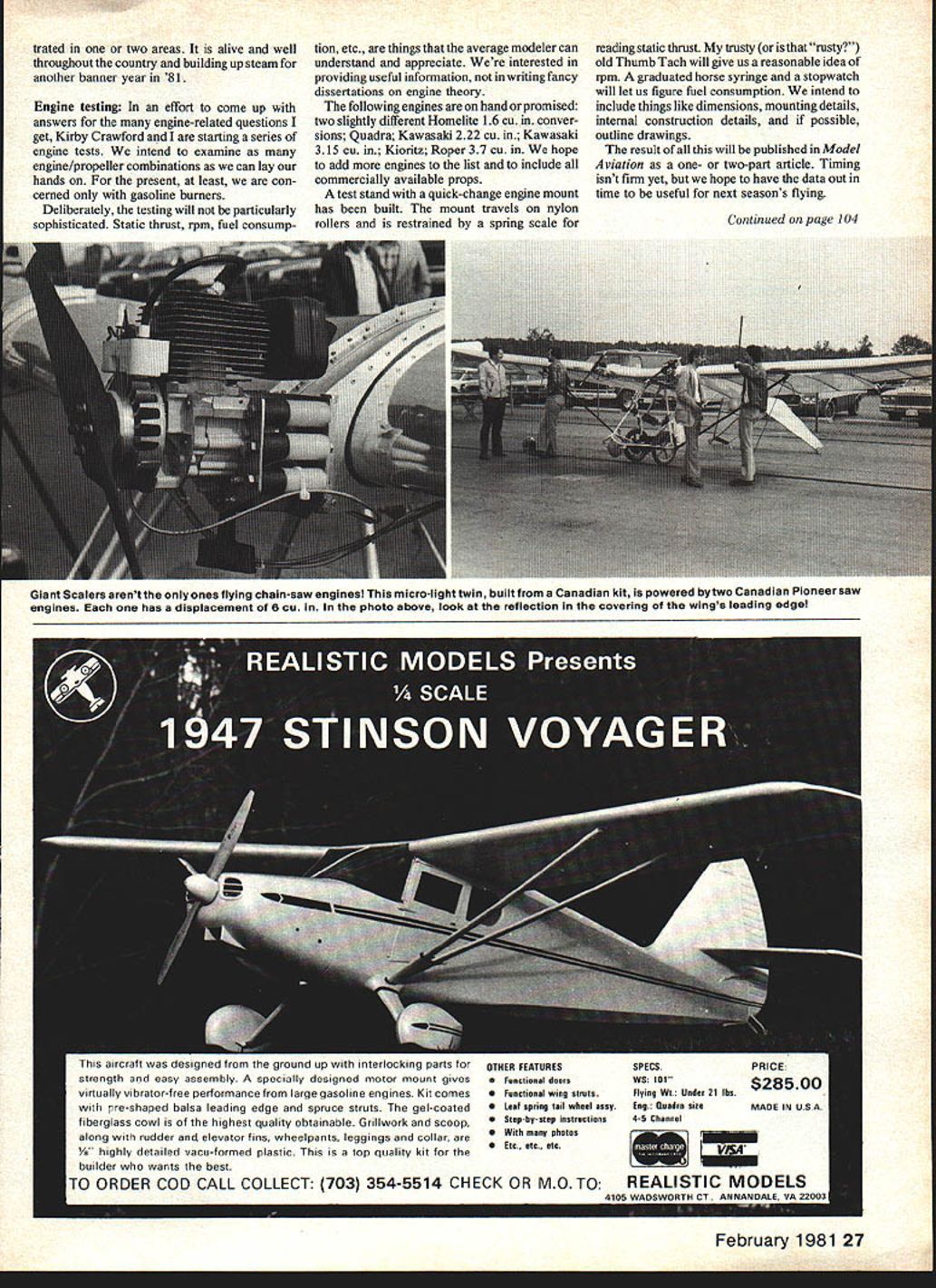
The test stand has a quick‑change engine mount. The mount travels on nylon rollers and is restrained by a spring scale for reading static thrust. A Thumb‑Tach will give us a reasonable idea of rpm. A graduated horse syringe and a stopwatch will let us figure fuel consumption. We intend to include dimensions, mounting details, internal construction details, and, if possible, outline drawings.
The results will be published in Model Aviation as a one‑ or two‑part article. Timing isn't firm yet, but we hope to have the data out in time to be useful for next season's flying.
Hostetler's super scale plans
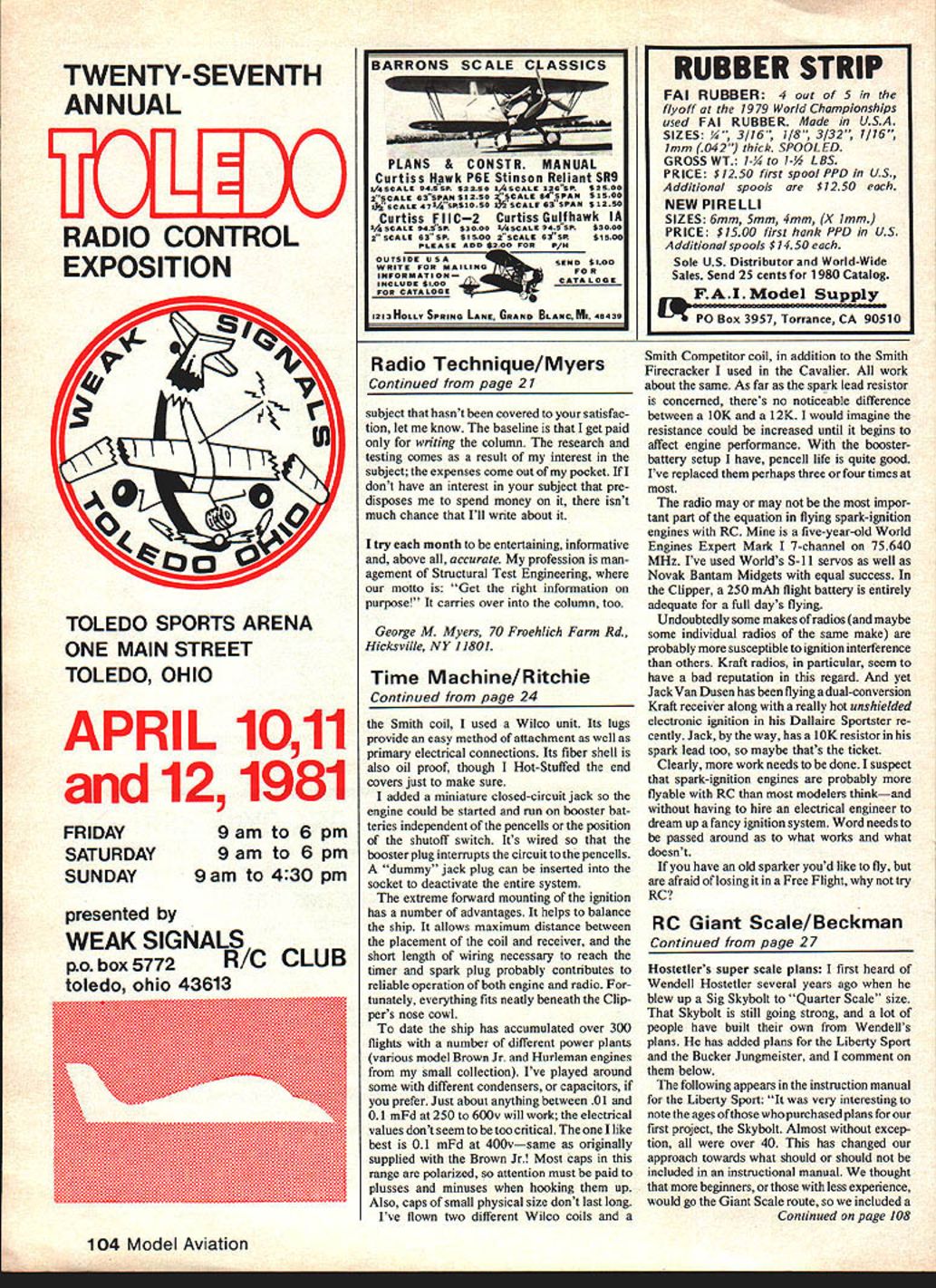
I first heard of Wendell Hostetler several years ago when he enlarged a Sig Skybolt to "Quarter Scale" size. That Skybolt is still going strong, and many people have built their own from Wendell's plans. He has added plans for the Liberty Sport and the Bucker Jungmeister; both are discussed below.
The Liberty Sport instruction manual notes: "It was very interesting to note the ages of those who purchased plans for our first project, the Skybolt. Almost without exception, all were over 40. This has changed our approach towards what should or should not be included in an instructional manual. We thought that more beginners, or those with less experience, would go the Giant Scale route, so we included much more detail in the building instructions. However, we have not tried to write a book, and the plans are intended for the experienced modeler as well."
The Liberty Sport is a two‑place semi‑scale design that can be built full‑house or simplified for the sport flyer. The structure is conventional all‑wood construction with a number of subassemblies to facilitate building and transport. The plans are complete with full‑size drawings, sectional views, material lists and step‑by‑step assembly instructions.
The Bucker Jungmeister plan follows Hostetler's same thorough approach and complements the Liberty Sport for the modeler who prefers a single‑seat aerobatic type. Both plans reflect practical building techniques and are aimed at producing durable, flyable Giant Scale models rather than museum pieces that are difficult to repair.
The two plans are similar in many ways. Each consists of two sheets (42 in. x 82 in.) and an instruction manual. The manuals contain useful information on engines, servos, flying, etc., in addition to construction details. A particularly useful item in each is the relatively complete bill of materials.
Anyone who has built the Sig Liberty Sport will have a feeling of déjà vu when working with these plans. In addition to the expected changes in materials and sizes, there are two significant differences:
- Wendell uses a simple and effective method for making the tail surfaces removable, which aids transportation.
- The aileron arrangement: the full‑scale airplane has lower wing ailerons only. The Sig kit shows an optional, non‑scale enlargement of the ailerons, but roll performance was never outstanding. Wendell opted to go to four ailerons to increase performance. The servos drive the lower wing units, with coupling struts to the upper wing ailerons. Unless you are a scale purist, the added flight agility far outweighs the slightly non‑scale appearance.
Construction follows usual modeling practice, with some material substitutions. Basswood is specified in many areas; it is a nice material to work with but is not readily available, especially in longer lengths. Spruce could be substituted if desired.
There is a lot of balsa called out. There are substitutes for balsa that can reduce the cost of big birds. Foam‑core board, available from artists' supply stores, makes excellent wing ribs and fuselage formers and could replace full‑length 3/16‑in. sheet balsa fuselage sides in some applications. The cost difference would be significant. Balsa blocks used for filling and shaping can often be replaced with rigid insulation foam. Keep in mind that foam cannot take dope; a little Hobbyoxy No. 2 glue brushed onto the exposed foam surface protects it.
In summary, Wendell's plans are well drawn and contain sufficient detail for all but the rank beginner. Both designs have been successfully flown; I have seen Wendell fly his Liberty Sport and it is smooth and realistic in the air. I can certainly recommend them. Both plans were listed at $21.50 in my notes, though inflation may have changed that.
Write to: Wendell Hostetler, 1041 Heatherwood Lane, Orrville, OH 44667.
Bob Beckman 8248 Holly Grove Court Manassas, VA 22110 (703) 369‑2432
Transcribed from original scans by AI. Minor OCR errors may remain.

