

Radio Control: Giant Scale
John A. de Vries Colonel, USAF, Ret. 4610 Moffat Ln. Colorado Springs, CO 80915
Season and Building
JINGLE BELLS, jingle bells, and all that there. 'Tis the season to be jolly. It's also the season to be intensely involved in building next year's Giant Scale model—at least in the less temperate (read: cold and snowy) parts of the country. Of course, our friends in southern California and Florida are still merrily flying around last year's models. Others among us are laboring mightily, trying to garner an AMA All-Season Flyer patch at the club field while assembling spruce sticks, plywood firewalls, and bent wire at home in the workshop.
The big 'uns' popularity seems to be increasing unabated. IMAA notes that its membership is bounding right through the 5,000 mark.
Who Is Building Giants
I can tell from the mail I've been getting that established RC builders/pilots aren't the only ones gravitating to our area of interest. Even rank beginners are displaying a fascination with Giant models. Most of the letters I receive request help deciding which model and engine to choose as a first big project. About 80% of the information requests indicate a desire to start with a gas burner as opposed to the larger glow-plug engines.
Choosing Your First Giant
Generally, my response is on the conservative side: a model that'll weigh between 15 and 20 lb. in flying trim. If the correspondent indicates interest in a Scale ship, I suggest one of the simpler high-wing monoplane kits. Normally they don't require extreme talent to build or fly, and yet they can be dolled up with scale detail without severe weight penalties.
If the Giant Scale convert has some RC building and flying experience, he or she might consider building the first large model from scratch using one of the available drawing sets.
It will be readily apparent that there are definite differences between the big 'uns and the little 'uns. Large RC construction techniques are closer to full-scale practice, although previously learned modeling techniques are used. Whether you build a first Giant from a kit or from plans, the model designer's engine recommendations should be used. If the prototype model flew well with a particular power plant, chances are the model will too. The most difficult part about recommending first Giants is dissuading people from choosing models which common sense would indicate are well beyond their capabilities.
Although it's a fact that larger RC models fly better than smaller ones, a big Mustang, Jug, or P-47 isn't the place to start. Among hobby shop owners it's known as Flying Fortress Syndrome—RC beginners often have visions of a remotely controlled B-17 as their first modeling effort. The same fascination for big, complex first projects afflicts potential Giant builders.
It's apparent from letters that seasoned RCers want to make the move up. "Making haste slowly" is a difficult concept; we accept it's mandatory if a Giant Scale project is to succeed. With investments of $500–$1,000 in just a single model, it's plain common sense to choose a project that has a high probability of succeeding. A letter that starts "I've been reading the column for years..." can usually be predicted as to its next paragraph.
So, faithful disciples decide they want to join the Giants; please consider a simple, honest, easily built and flown RC model if you want to be happy building and flying miniature model aircraft and also want to stick with us.
Engines and Powerplants
As far as engine recommendations are concerned, I usually suggest power plants in the lower regions of the spectrum. Gas burners, like the smaller Quadras and Zenoahs, will handle 15–20-lb. models easily, while providing the neophyte Giant builder/flier with good early experience with gas engine operation.
Construction and Scale
If the prototype model flew well with a particular power plant, chances are the model will too. Larger RC construction techniques are closer to full-scale practice, although previously learned modeling techniques are used.
Mighty Lite Plywood
Although we've never met, I feel I know Frank Tiano from reading about his modeling exploits over the years. As mentor to the Top Gun Scale extravaganza through columns in Scale R/C, Modeler, Model Airplane News, and R/C Report, Frank proves himself an outstanding person in the hobby. Recently formed Frank Tiano Enterprises, 2460 Southwest 85th Terrace, Davie, FL 33324, sent a bit of Mighty Lite plywood. I was astounded. Although the sample was mailed from Florida (usually rather damp) to Colorado (almost always dry), it arrived flatter than a pancake. Not a warp to be seen! Since there's a lot of ply in a large-scale model, flatness and warp-resistance are highly desirable. It looks as if the fuselage of my Pacific C-1 is going to have Mighty Lite skins.
Wily Coyote — Fiberglass Model
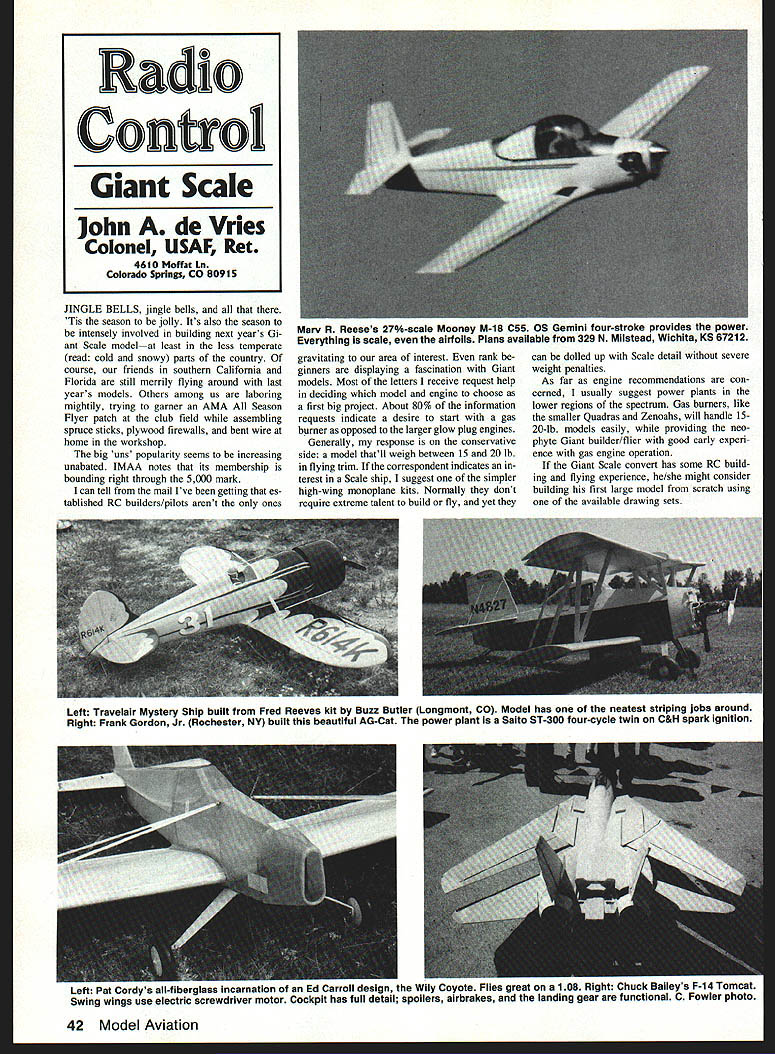
Pat Cordy (Cordy's Flying Circus, 1502 N. Prospect, Colorado Springs, CO 80907) appears ready to start knitting his all-fiberglass version of Ed Carroll's Wily Coyote. The low-wing Giant has been jazzed up to a near-scale version of the prototype—wing struts, formed nylon landing gear struts, built-in stand/dynamic engine mount, etc. Jack Cole has been test piloting, flying the heck out of his version. The model's name is a Colorado response to Wyoming's Roadrunner, which is a pretty spiffy Giant flier in its own right (Fun Fly, P.O. Box 1686, Lander, WY 82520).
If you're interested in spectacular fiberglass work and a non-scale—but great-flying—model, drop Pat Cordy a line and ask about Wily Coyote.
Electric Screwdrivers as Motors
The magic words today for Giant builders seem to be electric screwdrivers. It's not as strange as it sounds. The proliferation of small, hand-held electric screwdrivers, available at reasonable prices, makes them logical choices for use as rechargeable battery-powered electric motors in our big birds. They're useful in all manner of auxiliary applications.
An example is the F-14 Tomcat being built by Chuck Bailey of Fremont, CA. Chuck enlarged a set of Jim Oompon F-14 drawings by 24% and aims to power his ducted-fan model with two Picco .80s with Dynafans. He has disassembled an electric screwdriver to provide a strong, geared source of power to swing the Tomcat's wings.
My initial reaction was to wonder how the motor affected radio reception. The motor has a commutator and brushes, which could possibly be a source of unacceptable radio noise. Not so, according to Chuck. He ran an exhaustive series of radio range checks, and concluded that a simple diode across the motor leads renders it electronically silent. He had to design a rack-and-pinion gear system to sweep the wings, as well as a reduction drive. The mechanism includes ball-bearing pivots in aluminum mounts, all in a model that's expected to weigh 27 to 30 lb. We're talking a true Giant here—the fully extended wingspan is a healthy 96 in.
Applying electric screwdriver motors to landing-gear retracts and flaps seems to be gaining favor. The mechanisms are complex and take a bit of metalworking expertise. Powerful RC race-car electric motors are being considered as prime movers for Giants as well. The only caution: if you go the electric-motor route, no matter what its original source, make darn sure that it doesn't goof up your radio reception!
Left-Handed Transmitter
I don't know why somebody didn't think of it before, but the people at Ace R/C, Inc. did. They're coming out with a southpaw single-stick RC transmitter! Using their Olympic V electronics, they simply reversed everything and came up with a transmitter specifically designed for the 15% of the RC community who are left-handed. If you're interested, drop 'em a line at P.O. Box 511, Highspire, MO 64037. Sets include Ace's '91 receiver (or their standard receiver) and all Ni-Cads—but no servos. It allows you to use any positive-pulse, high-powered servos.
Closing
I sincerely hope that all you readers have a Merry and a Happy!
Transcribed from original scans by AI. Minor OCR errors may remain.

