
Radio Control: Giant Scale
John A. de Vries Colonel, USAF, Ret. 4610 Moffat Ln. Colorado Springs, CO 80915
Johnson Air Base and the P-61 Black Widow
Back in the good old days following WWII I flew Mustangs with the "brown-shoe" Army Air Force 40th Fighter Squadron, based at Johnson Air Base near Iruma, Japan. We shared the ramp with the 339th Night Fighter Squadron, which flew the twin-engined Northrop P-61 Black Widow. Two GIs from the 339th and I formed the sum total of the Johnson Model Club and flew our control-line ships from the base baseball diamond. Our only source of model supplies was in Honolulu — but that's another story.
The inspiration for this month's column came from Art Hershberger of Wisconsin. Art is fascinated with the P-61 and is designing an 82‑in. span RC version powered by two .60 glow engines. He planned booms, a crew nacelle and fixed tail surfaces attached to a monolithic wing center section, with removable wingtip panels for transport. To make the model more practical, Art decided to compromise scale by using extended ailerons (the real P-61 used spoilers for primary roll control, which Art is not duplicating).
To simplify construction I suggested a composite wing center section built with ribs and spars. An open-structure center section makes aligning and squaring the booms, horizontal stabilizer and crew nacelle much easier. Outer wing panels could be cut from foam — easy to make, not highly stressed, and suitable for hinged ailerons. Art’s pièce de résistance was an aluminum-tube main spar with telescoping aluminum tip-spar extensions. The tip panels would slip into the main spar and be secured with a hidden setscrew at the top of the boom; with retracts the setscrew could be accessed through the main wheel wells.
I’m looking forward to seeing Art’s drawings; I expect they’ll reflect an easy-to-build school of Giant Scale design.
Rally of Giants (IMAA)
Now’s the time to prepare for the 10th annual Rally of Giants, the IMAA’s big event of the year. Scheduled for June 28–30 and July 1 at Oshkosh, WI, Giant models will be flown at Wittman Field (home of the Experimental Aircraft Association) and from a local lake. This will be the first rally to include flying facilities for float-equipped models (flying boats and amphibians). Check the spring issue of High Flight (IMAA’s quarterly magazine) for specifics or contact IMAA headquarters.
Designers, Plans, and New Models
- A. Lynn Lockrow — Auburn, AL
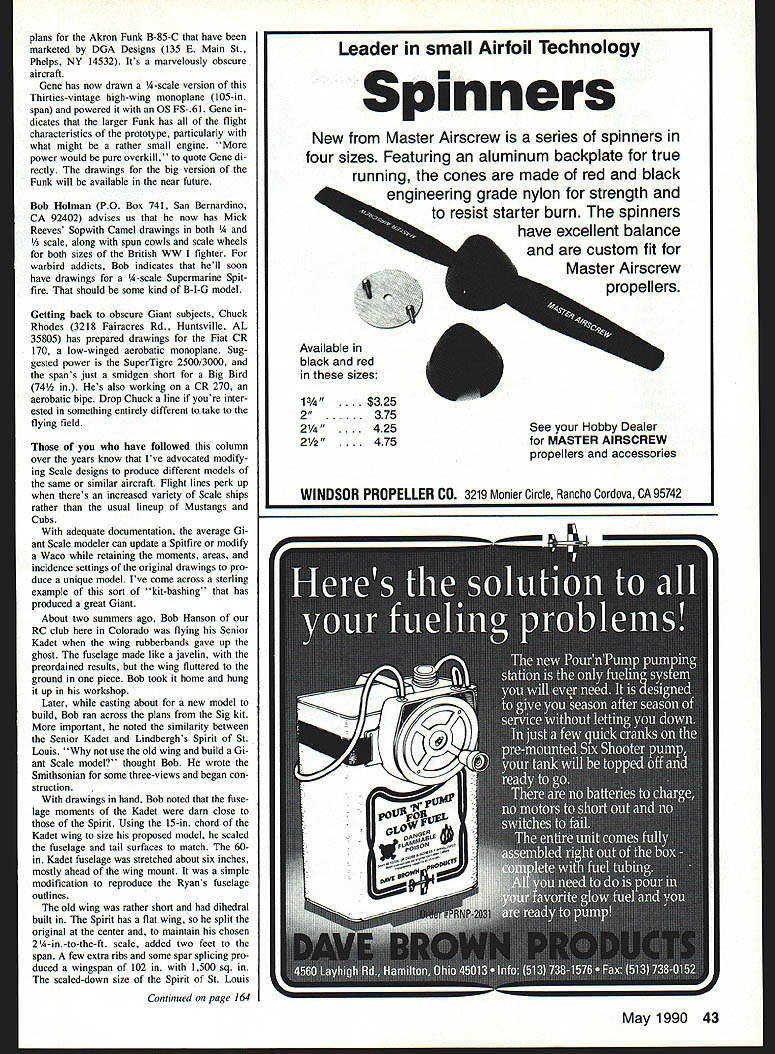
Many will remember Lynn for his superb Fairchild 22 and Clipped-Wing Monocoupe 110 Special Giant Scale drawings. Work at Auburn University has cut into his designing time, but he’s found enough hours to build an Ikon N’West Monocoupe 90-A. Lynn reports the kit is easy to build and that the model “flew like the proverbial homesick angel.” We look forward to his big Monocoupe plans.
- Gene DeCook — Canandaigua, NY
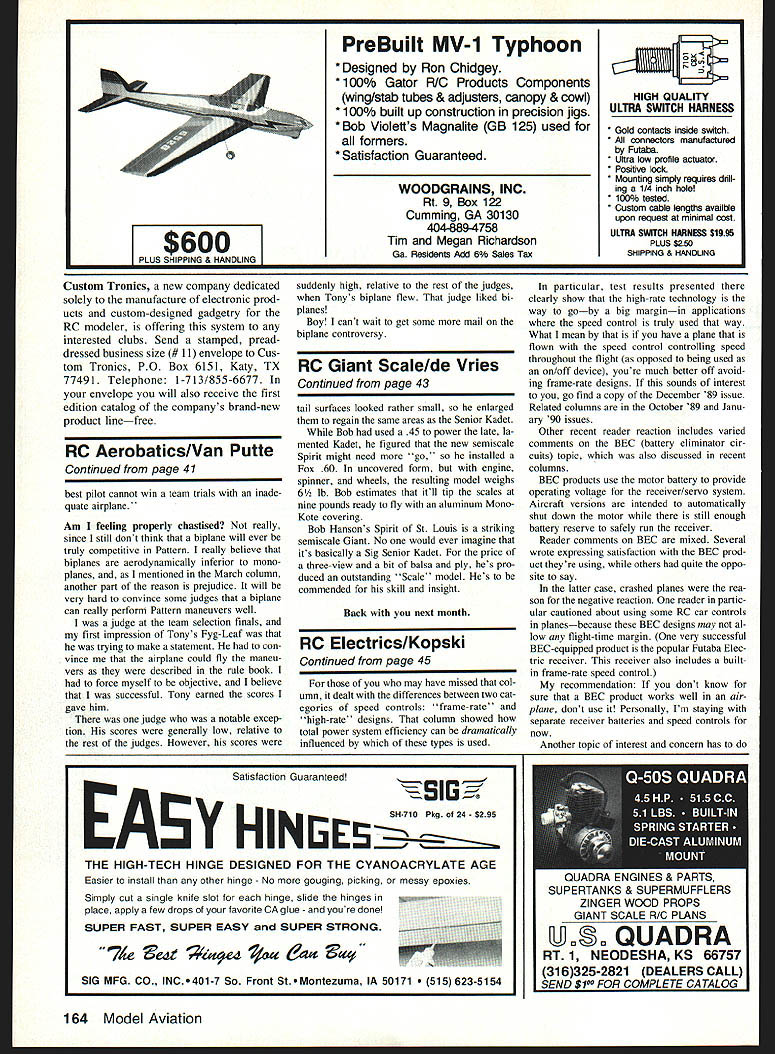
Gene drew the 3/8-scale plans of the Akron Funk B-85-C marketed by DGA Designs (135 E. Main St., Phelps, NY 14532). He has now drawn an A-scale version (a thirties-vintage high-wing monoplane) with a 105‑in. span, intended to be powered by an OS FS‑61. Gene indicates the larger Funk has flight characteristics similar to the prototype; a larger engine would be pure overkill. Drawings of the big Funk will be available in the near future.
- Bob Holman (P.O. Box 741, San Bernardino, CA 92402)
Bob now has Mick Reeves’ Sopwith Camel drawings in both 1/4 and 1/3 scale, along with spun cowl and scale wheels for both sizes. He also indicates he will soon have drawings for a 1/4-scale Supermarine Spitfire — that should be a big model.
- Chuck Rhodes (3218 Fairacres Rd., Huntsville, AL 35805)
Chuck has prepared drawings for the Fiat CR.170, a low-wing aerobatic monoplane (span 74-1/2 in.). Suggested power is the SuperTiger 2500/3000. He’s also working on a CR.270 aerobatic biplane. Contact Chuck if you’re interested in something different to take to the flying field.
Kit-Bashing Example: Senior Kadet to Spirit of St. Louis
A sterling example of productive "kit-bashing" came from Bob Hanson of our RC club in Colorado. Two summers ago Bob was flying his Sig Senior Kadet when the wing rubber bands failed. The fuselage crashed, but the wing fluttered down intact. Bob hung the wing in his workshop, and later decided to build a Giant Scale Spirit of St. Louis using the old Kadet wing.
He wrote the Smithsonian for three-views and compared the Kadet moments with those of the Ryan NYP (Spirit of St. Louis). The Kadet fuselage moments were very close to the Ryan’s. Using the Kadet's 15‑in. wing chord as a basis, Bob scaled the fuselage and tail surfaces, stretching the fuselage about six inches (mostly ahead of the wing mount) to reproduce the Ryan’s outlines.
The original Kadet wing had dihedral, while the Spirit’s wing is flat. Bob split the wing at the center, removed the dihedral and added two feet to the span to achieve his chosen 2-1/4‑in. to the foot scale. With a few extra ribs and some spar splicing he produced a wingspan of about 102 in. and roughly 1,500 sq. in. of wing area — a successful conversion that produced a handsome Giant Scale Spirit of St. Louis.
Contacts and Addresses
- DGA Designs — 135 E. Main St., Phelps, NY 14532
- Bob Holman — P.O. Box 741, San Bernardino, CA 92402
- Chuck Rhodes — 3218 Fairacres Rd., Huntsville, AL 35805
Back with you next month.
Transcribed from original scans by AI. Minor OCR errors may remain.

