
Radio Control: Giant Scale
Author
John A. de Vries Colonel, USAF, Ret. 4610 Moffat Ln. Colorado Springs, CO 80915
Principles of Giant-Scale Building
"Complex problems require complex solutions," someone once said. Whoever that someone may have certainly wasn't a Giant Scale builder. While some Giant Scale designers adhere to the idea that complicated is better, happily they're in the minority. Most airplanes (model or otherwise) have two things in common:
- Under their skins they have basic structures that tie wing, fuselage, stabilizer, and rudder together into their proper relationships. This load-bearing structure is where the strength of the airframe lies. It need not be complex to perform its basic function.
- The skin of the aircraft gives it character. It's where we scale modelers add the detail that makes a Mustang a Mustang or a Cub a Cub. Too often, though, we go overboard and add nonfunctional weight to our models in an attempt to duplicate the prototype.
We all agree that a light airframe with adequate strength results in a model that flies well. Within practical limits, we shouldn't skimp while building the fundamental structure of the model — weight should be located where it is functional. When it comes to the skin and its attendant detail, we should make every effort to lighten up. Thick blocks of balsa, balsa planking, and heavy fiberglass and resin coverings are used to flesh out the scale shape of a Giant model—all of it unnecessary weight. Blocks of plastic foam, shaped and covered by lightweight fiberglass cloth to achieve the necessary scale outlines, accomplish the same purpose with a substantial savings in weight.
This discussion was inspired by a letter from a reader interested in building a big C-130 Hercules. The only drawings available were Skip Mast's. Skip is an outstanding advocate of using foam, so his 130 design uses massive hunks of foam. The reader was searching for a Hercules built using traditional former-and-planking techniques. Although I recommended a couple of methods for developing the necessary formers for an all-balsa C-130, my heart wasn't in it. A model built this way is bound to end up heavier than Skip's original. It will take longer to build, need more paint and filler to achieve a good finish, and also take more power to fly well.
The moral of this story: build the basic structure to take the stresses imposed on the model in flight. Flesh it out using the lightest materials possible consistent with producing the necessary scale outlines.
IMAA Minifestival — Crows Landing
If you live in the western part of the U.S., there will be a minifestival for Big Bird IMAA enthusiasts over the Labor Day weekend. Jim Alley, IMAA vice president, is the driving force along with members of IMAA Chapters 187, 10, and 242. The idea is to have a great get-together at the U.S. Navy's Crows Landing Auxiliary Air Station in California's San Joaquin Valley, about 70 miles southeast of San Francisco (three miles off Interstate 5).
West Coast Giant modelers have found it difficult to attend the IMAA Festivals because they've been concentrated in the central and eastern parts of the country. If you want to participate, write to either:
- Dwight Cathcart, 3401 E. Service Road, Ceres, CA 95307; tel. 1-209/537-8341
- Budd Crane, 453 Maple St., Livermore, CA 94550; tel. 1-415/447-2158
Dwight and Budd are codirectors of the event. There are acres of concrete and a $10 "landing fee." There should be a whiz-banger of a minifestival.
Aluminum Finish Suggestion
Concern about producing a realistic aluminum surface on Giant models prompted Jim Henry of Apple Creek, OH, to write. He's found that the bare-aluminum look may be created with the aluminum-coated paper used for food packaging and sent along some samples. Although it would require panel-by-panel application of the aluminized paper (because of the relatively small size of the usual food packages), it would sure look good.
Notable Models and Kits
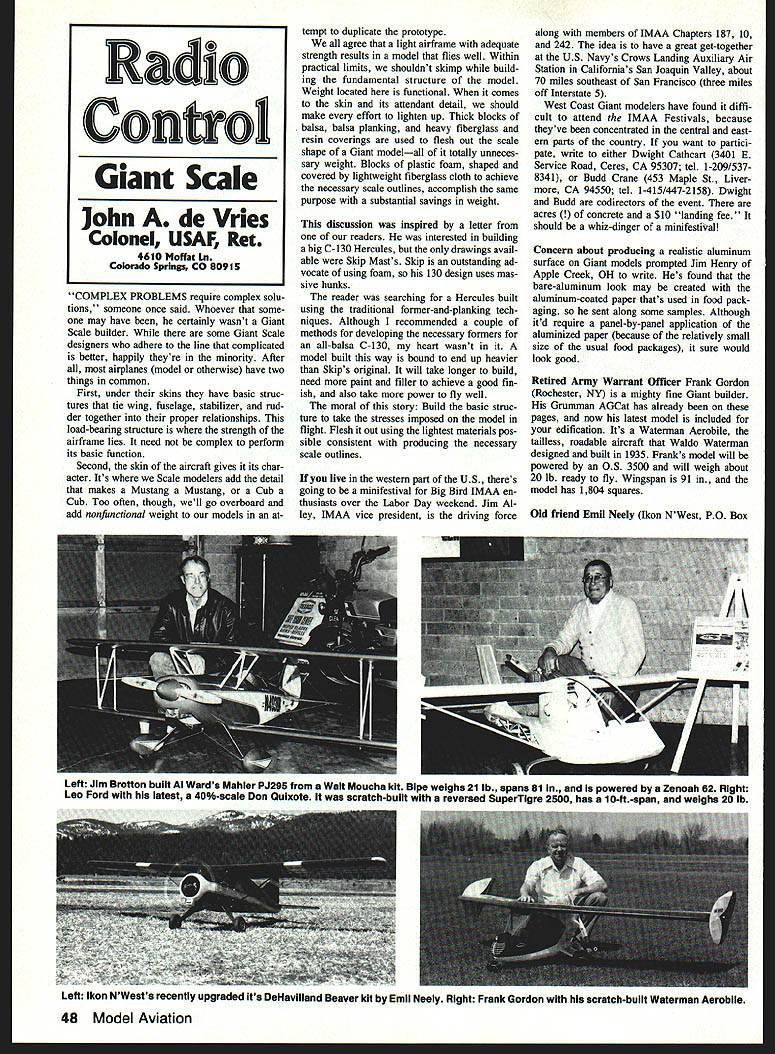
Retired Army Warrant Officer Frank Gordon (Rochester, NY) is a mighty fine Giant builder. His Grumman AG-Cat has already been featured, and now his latest model is included for your edification. It's a Waterman Aerobile, the tailless, roadable aircraft Waldo Waterman designed and built in 1935. Frank's model will be powered by an O.S. 3500 and will weigh about 20 lb ready to fly. Wingspan is 91 in., and the model has 1,804 sq. in.
GM Plastics (Post Falls, ID 83854) has done something seldom seen in the Giant Scale kit business. Although he was marketing a kit for the DeHavilland Beaver, he felt it needed true scale upgrading. With some super-accurate three-views, he's completely revamped his kit to dead-on scale. Even the airfoil is properly duplicated. I've flown the Air Force version of the bird — an L-20 on floats and skis — so Emil's spiffy new kit brings back a lot of Alaskan memories!
Toledo Finds
I saw a couple of items at Toledo this year that caught my eye:
- A scale retractable tailwheel designed for WWII Navy warbirds, particularly the F4U Corsair, that is really super. GM Plastics makes it and includes a scale tailhook installation.
- L.A.W. Racing Products' radio-transmitter tray (1229 Capitol Dr., Addison, IL 60101). Adjustable to size for most radios, the tray has two padded aluminum hooks that suspend it over one's shoulders. The tray itself is made of Komatex closed-cell PVC (an insulator) and is infinitely adjustable to fit just about any two-stick transmitter. I know it'll fit mine—they were using a radio just like my 1991 PCM to demonstrate the tray at Toledo.
Scale Engine Detail
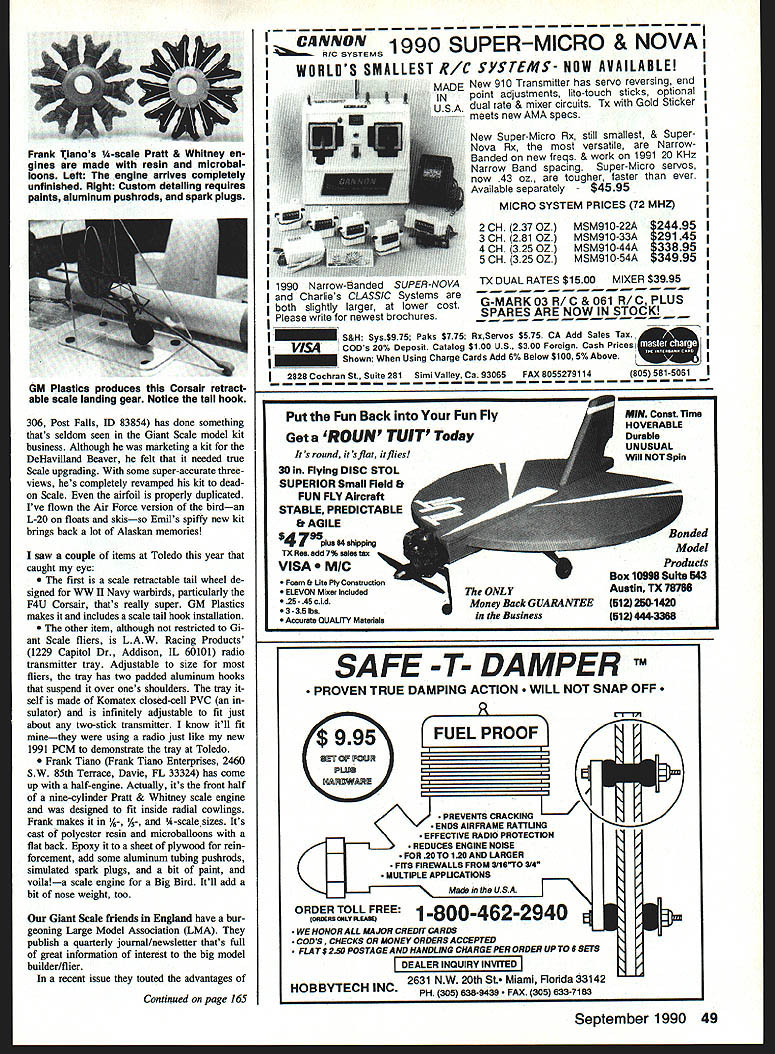
Frank Tiano (Frank Tiano Enterprises, 2460 S.W. 88th Terrace, Davie, FL 33324) has come up with a half-scale—actually, the front half of a nine-cylinder Pratt & Whitney scale engine—designed to fit inside radial cowlings. Frank makes it in 1/6-, 1/3-, and 1/4-scale sizes. It's cast of polyester resin and microballoons with a flat back. Epoxy a sheet of plywood to it for reinforcement, add some aluminum-tubing pushrods, simulated spark plugs, and a bit of paint, and voila — a scale engine for a Big Bird. It'll add a bit of nose weight, too.
Large Model Association and Petrol Engines
Our Giant Scale friends in England have a burgeoning Large Model Association (LMA). They publish a quarterly journal/newsletter full of great information for the big modeler/builder/flyer. In a recent issue they touted the advantages of using gasoline engines to power large models. A listing titled "Petrol — The Main Benefits" included the following:
- Low initial cost
- Low running costs
- Rugged design
- Reliable
- Long lasting
- Good low-end torque
- Swings large props
- No batteries needed
- Built-in fuel pump
- Self-contained ignition system
- No more oil-soaked model
- No service-valve fiddling
- Easy starting
- Longer life for your model
- Minimum support equipment needed at the flying field (all you need to take to the field is your model and a petrol can)
- Light weight
- Sheer power
That pretty well sums up the positive reasons why we heartily agree with our British counterparts. Gas engines require care when mixing their fuel and when refueling a model, but good safety practices will minimize any fire danger.
'Nuff reading about it!
Let's go flying!
Transcribed from original scans by AI. Minor OCR errors may remain.

