
Radio Control: Giant Scale
John A. de Vries
Colonel, USAF, Ret. 4610 Moffat Ln. Colorado Springs, CO 80915
Giant RC scale has been perking along for 15-plus years. With the advent of the Quadra and other gas burners, more aeromodelers have been attracted to the big side of the hobby. IMAA now has over 7,000 members and continues to grow at a healthy rate. Many more R/Cers are building giant scale models, even without formal affiliation, because the birds just fly better.
Over the years we've seen the development of truisms about big scale miniature aircraft that newcomers are just now learning. To help them along, here are a few of those observations:
- Construction techniques for the big ones combine model-building and full-scale practice. Examples include built-up wing ribs, fully sprung landing gears, and widespread use of metal fittings for attaching wing struts and tailwheel assemblies. The extensive use of spruce for longerons and wing spars parallels full-scale practice.
- All fuselage joints should be gusseted with 1/32" or 1/64" plywood. This adds substantial strength with minimal weight increase.
- Many builders use easily formed chunks of inexpensive plastic foam rather than costly balsa blocks. With a lightweight covering of fiberglass cloth and resin, models can be fleshed out economically while gaining structural strength.
- It is just as important to balance a model laterally (wingtip to wingtip) as it is fore and aft.
- Laminated outlines are preferred for curved scale tail surfaces. Lamination results in a lighter tail and makes balancing big models much easier. Curved wing tips also benefit from lamination techniques; strips of 1/16" plywood laminate well and make strong tips.
Safety and electronics
- Safety has been a strong consideration since the earliest days of giant scale; engine kill switches are required. Backup servo-controlled kill switches duplicate the function from the transmitter.
- Because giants usually have a great weight-carrying capacity, redundant battery packs are insurance for safe, uninterrupted onboard radio/servo function.
- Big, powerful servos have been developed that provide positive control through all regimes of giant scale flight.
- Split controls — a servo operating each aileron and a pair to move each half of the elevator — provide redundancy, and thus safety and reliability.
- Noise traps, electronic devices that make long servo wire runs reliable by eliminating RF feedback to the model's receiver, are common installations.
Finishing and paint
- Model-finishing techniques have evolved. Envelopes made of inexpensive Dacron fabric, which shrinks in place with heat, have gained favor; material can be bought at the local fabric store, paralleling full-scale homebuilt practice.
- Automotive paints, particularly acrylics, are favored over traditional aircraft-dope finishes. Krylon spray enamels have been used to paint giants. Since gas burners don't pose the same fuelproofing problems found with glow fuel engines, practically any paint is suitable for the big ones.
Starting, access, and transport
- Starting giant scale model engines is a bit easier than on smaller R/C birds. Onboard servo-controlled starters are available and the weight is easily accommodated. Recoil-starter fixtures from converted chainsaw engines have been used. Cranking the propeller a couple turns against an installed torsion spring eases the starting problem substantially.
- Access to the innards of big R/C models is easier than with smaller counterparts; designers include access panels as part of the model design. In one instance, aileron servos mounted outboard in the wing have removable covers; loosening four screws gives immediate access for servo adjustments.
- External wing-fixing screws aren't necessary on smaller models; the process may be reversed on giants — wing bolts may be tightened inside the fuselage with wooden nuts fixed to the wing structure. High-wing monoplanes often feature scale doors to permit the pilot to enter the cockpit for scale effect.
Giant models are here to stay. If you haven't tried one, do it. If you've built and flown one — keep up the good work!
Radio Control: Giant Scale
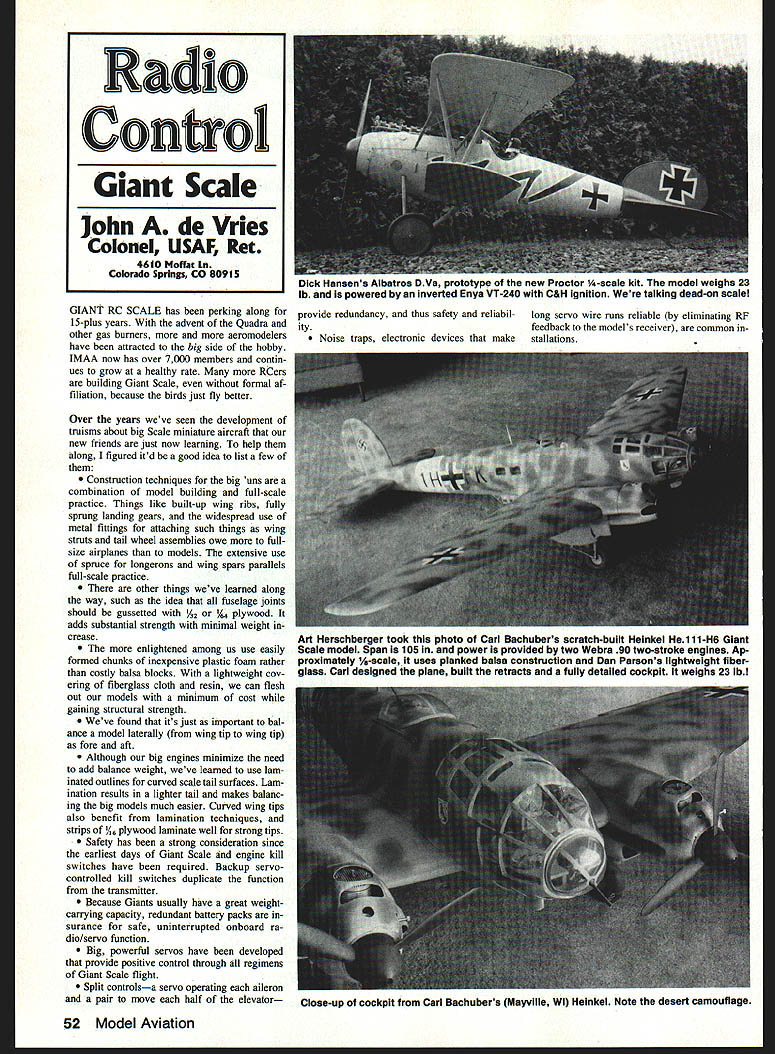
Hansen built the prototype model, and it's a stunner (it's in one of this month's photos). Dick Hansen also runs Hansen Scale Video (10807 S.E. Stief Ct., Portland, OR 97266; tel. 503-653-2578) and has a two-hour tape featuring the model. The tape includes construction, radio installation, and flight tests. Price of the tape is $19.95 plus $3 S&H. Dick flew the bird at the recent Top Gun meet in Mesa, AZ.
Art Herschberger and the Giant P-61
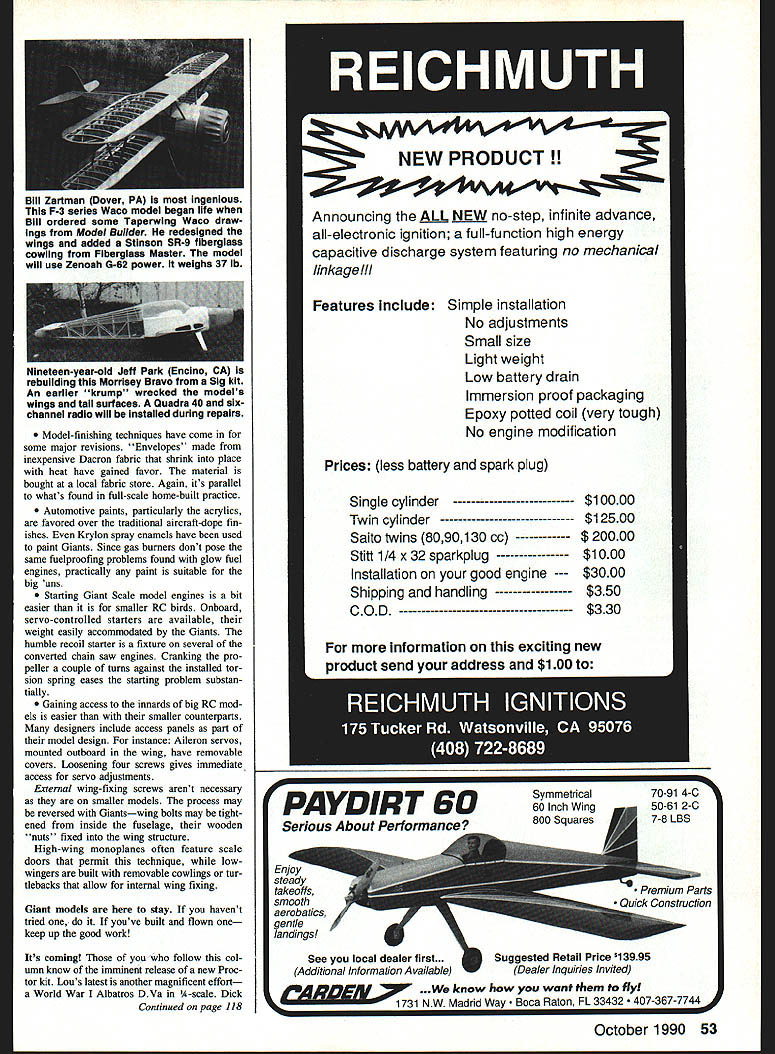
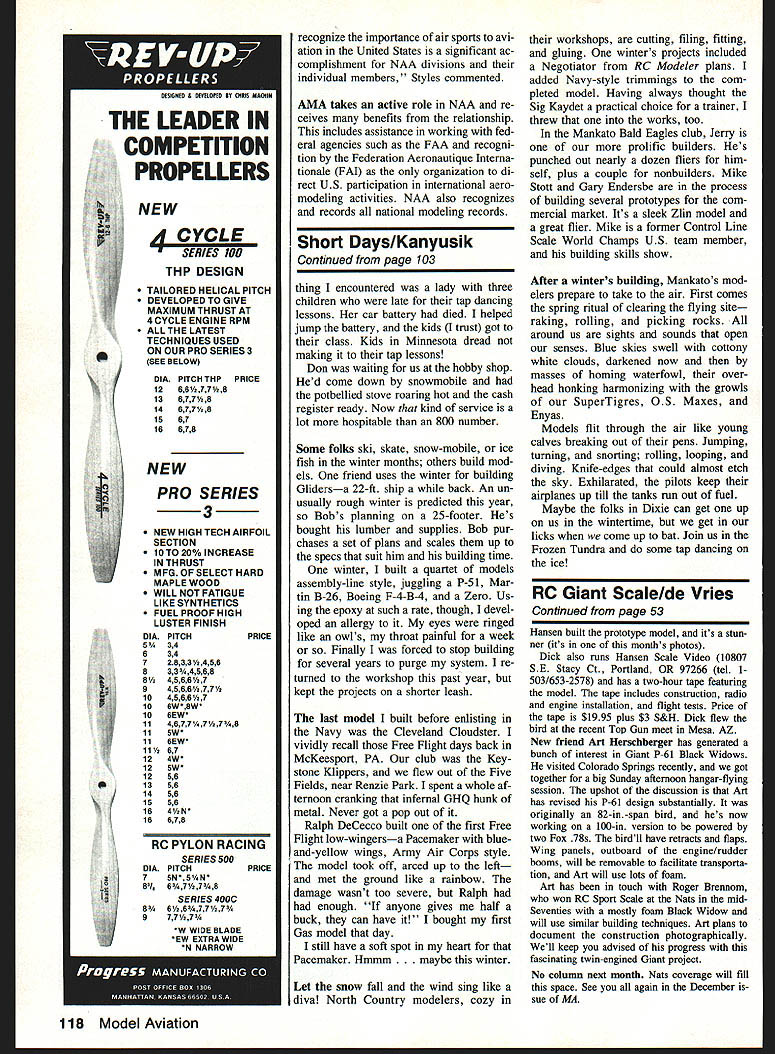
New friend Art Herschberger has generated a bunch of interest in giant P-61 Black Widows. He visited Colorado Springs recently, and we got together for a big Sunday afternoon hangar-flying session. As a result, Art has revised his P-61 design substantially. It was originally an 82-inch span bird, and he's now working on a 100-inch version to be powered by two Fox .78s. The bird will have retracts and flaps. Wing panels outboard of the engine/nacelle bows will be removable to facilitate transportation, and Art plans to use lots of foam.
Art has been in touch with Roger Brennon, who won RC Sport Scale at the Nats in the mid-Seventies with a mostly-foam Black Widow and used similar building techniques. Art plans to concentrate on photographic documentation of construction techniques. We'll keep you advised of his progress with this fascinating twin-engined giant project.
No column next month. Nats coverage will fill this space. See you all again in the December issue of MA.
Transcribed from original scans by AI. Minor OCR errors may remain.

