
Radio Control: Giants
By
John A. de Vries 4610 Moffat Lane Colorado Springs, CO 80915
This column almost didn't make it!
The trusty, rusty computer in my office needed major surgery. Its hard drive literally died, and the death rattle sounded as if someone had dumped rocks in a garbage disposal and flipped the switch. Happily I have a friend, Bill Bellingham, who's a computer whiz. He confirmed my diagnosis and installed a new hard drive in my machine in a couple of days. Although I know how to work this infernal device, its innards are a complete mystery to me. Having a friend like Bill is really great when it comes to chips and cards and computer circuitry.
A similar situation pertains when it comes to Giant Scale models. There are a host of modelers who are competent to build and fly them, but at some point all will run up against a problem they don't know how to solve. Oftentimes it concerns the operation of the gas burners that power their birds. Carburetion and ignition systems baffle them—particularly how to use kill switches.
Then, too, acquiring the necessary documentation for a Scale RC model becomes a knotty problem for those modelers who don't have an extensive library of aircraft lore. Happily, most RC clubs have resident experts to whom a puzzled builder/flier may turn to solve his or her more involved problems. A last resort may be a letter to a magazine columnist, who, if he doesn't have the necessary problem-solving info at hand, may know who does. About half the letters I get involve requests for addresses or phone numbers of Giant Scale experts or companies. I'm always happy to respond since it's a way to help the hobby, even as Bill helps me with my computer problems.
Rich Uravitch: Plans & Plastics
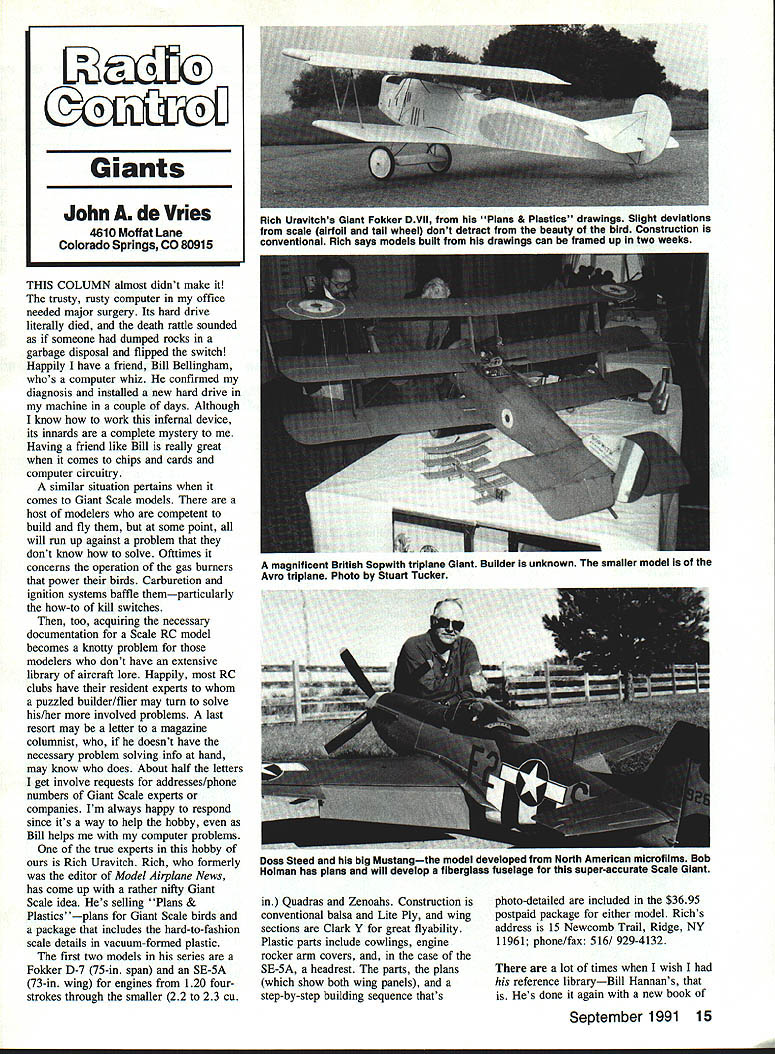
One of the true experts in this hobby is Rich Uravitch. Rich, who formerly was the editor of Model Airplane News, has come up with a nifty Giant Scale idea. He's selling "Plans & Plastics"—plans for Giant Scale birds and a package that includes the hard-to-fashion scale details in vacuum-formed plastics.
The first two models in his series are:
- Fokker D-7: 75 in. span
- SE-5A: 73 in. wing
Both are suited for engines from 1.20 four-strokes through the smaller (2.2 to 2.3 cu. in.) Quadras and Zenoahs. Construction is conventional balsa and Lite Ply, and wing sections are Clark Y for great flyability.
Plastic parts include:
- cowlings
- engine rocker arm covers
- SE-5A headrest
The parts, the plans (which show both wing panels), and a step-by-step, photo-detailed building sequence are included in the $36.95 postpaid package for either model. Contact Rich at: 15 Newcomb Trail, Ridge, NY 11961; phone/fax: 516/929-4132.
Bill's Model Plans and Three-Views International (P&3)
Plans for a bunch of fantastic and marvelously obscure aircraft are available. Have you ever seen drawings for a Nemeth Umbrellaplane with its circular wing? Or a Mummert Sportplane? They, and 17 others, are covered in Bill's Model Plans and Three-Views International (P&3). As he says, the book will serve as documentation for everything from Pistachios to Pachyderms. It's a fascinating volume and costs $9.95 plus $2.75 packing and postage. Contact Bill at Hannan's Runway, P.O. Box 210, Magalia, CA 95954.
RC Unlimited Air Races and Air Show
It surely looks like it's going to happen. Cliff and Tom, the spark plugs of the first annual RC Unlimited Air Races and Air Show competition, have acquired facilities at the Madera (California) Municipal Airport for their big event. As of the first of May they had 67 registered entrants, and more surely will participate. Registration ended on June 30, 1991, for the event that will take place October 3–6. It should be a gala affair, with Giant Scale Reno racers bending around the pylons!
Scale Speeds for RC Models
This brings to mind the subject of scale speeds for RC models—racers and stock models alike. Having flown a few of my uncle's warbirds in their full-scale incarnations, I find it hard to reconcile the performance of models with their prototypes.
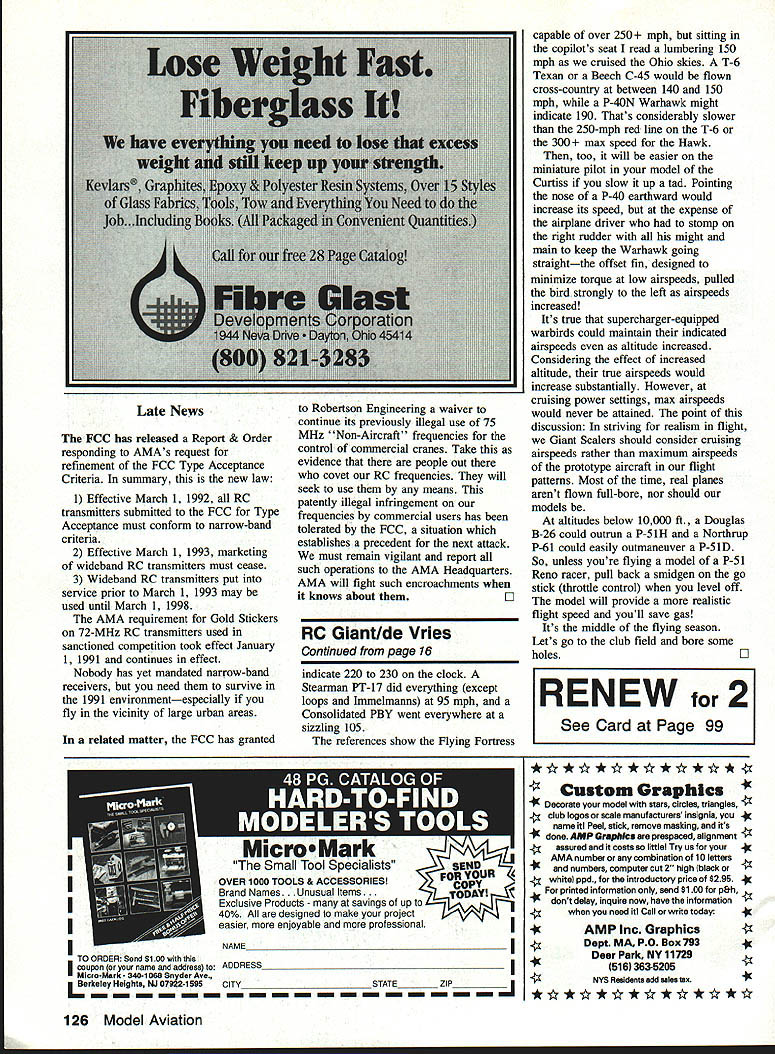
Most of the flight performance specifications listed in the various references include the maximum speed the real birds could attain. Sometimes the data include the stalling speed, but few, if any, of the references note the cruising speed of the aircraft. It's all well and good that the venerable Mustang could attain 400+ mph at full bore at its best altitude, but most P-51s weren't operated at such speeds most of the time. Going somewhere in a P-51D at cruising throttle and propeller settings would show 200 to 210 on the airspeed indicator. Under the same conditions, a P-51H would indicate 220 to 230. A Stearman PT-17 did everything (except loops and Immelmanns) at about 95 mph, and a Consolidated PBY went everywhere at a sizzling 105.
The references show the B-17 Flying Fortress capable of over 250+ mph, but sitting in the copilot's seat I read a lumbering 150 mph as we cruised the Ohio skies. A T-6 Texan or a Beech C-45 would be flown cross-country at between 140 and 150 mph, while a P-40N Warhawk might indicate 190. That's considerably slower than the 250-mph red line on the T-6 or the 300+ max speed for the Hawk.
Then, too, it will be easier on the miniature pilot in your model of the Curtiss if you slow it up a tad. Pointing the nose of a P-40 earthward would increase its speed, but at the expense of the airplane driver who had to stomp on the right rudder with all his might to keep the Warhawk going straight—the offset fin, designed to minimize torque at low airspeeds, pulled the bird strongly to the left as airspeeds increased!
It's true that supercharger-equipped warbirds could maintain their indicated airspeeds even as altitude increased. Considering the effect of increased altitude, their true airspeeds would increase substantially. However, at cruising power settings, max airspeeds would never be attained. The point of this discussion: in striving for realism in flight, we Giant Scalers should consider cruising airspeeds rather than maximum airspeeds of the prototype aircraft in our flight patterns. Most of the time, real planes aren't flown full bore, nor should our models be.
At altitudes below 10,000 ft, a Douglas B-26 could outrun a P-51H and a Northrop P-61 could easily outmaneuver a P-51D. So, unless you're flying a model of a P-51 Reno racer, pull back a smidgen on the go stick (throttle control) when you level off. The model will provide a more realistic flight speed and you'll save gas!
It's the middle of the flying season. Let's go to the club field and bore some holes.
Transcribed from original scans by AI. Minor OCR errors may remain.

