
Radio Control: Giants
John A. de Vries 4610 Moffat Lane Colorado Springs, CO 80915
Ralph Beck and the Proctor kits
His name isn't a household word amongst Giant Scalers, but it certainly should be. He spent over 3,000 hours researching and drawing the plans for the Proctor Albatros D.5A kit. His Curtiss "Jenny" plans ate up 1,500 hours of drawing and design time before Proctor could kit the model. A lot of the time was consumed in getting the details of the Mercedes engine just right for the Albatros and the OX5 just right for the Curtiss. If things go as planned, his next project will be a Giant Scale Fokker DVII that he'll be drawing this coming winter. The name of this truly dedicated model designer: Ralph Beck of Beloit, Wisconsin.
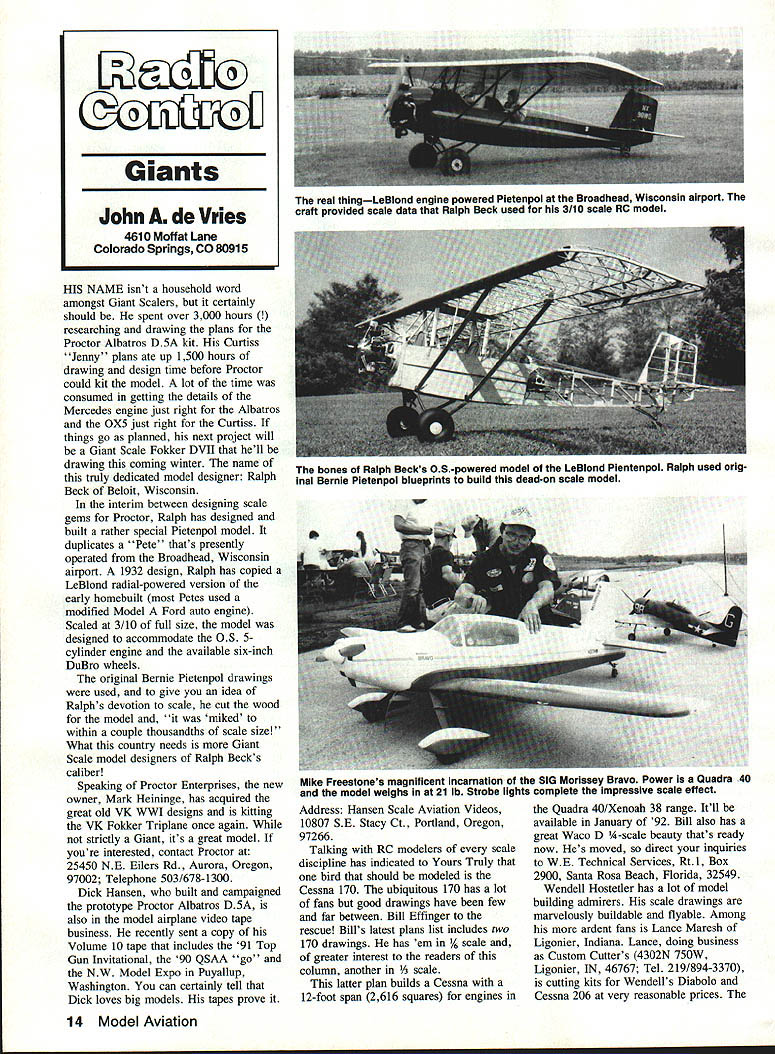
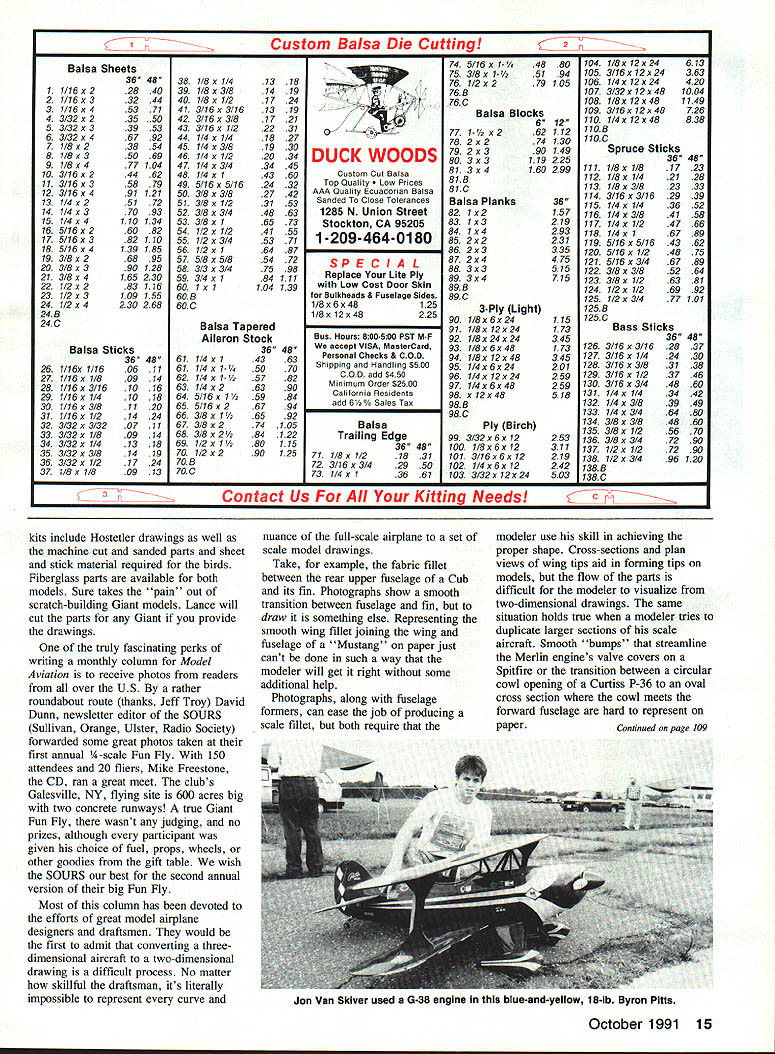
In the interim between designing scale gems for Proctor, Ralph has designed and built a rather special Pietenpol model. It duplicates a "Pete" that's presently operated from the Broadhead, Wisconsin, airport. A 1932 design, Ralph has copied a LeBlond radial–powered version of the early homebuilt (most Petes used a modified Model A Ford auto engine). Scaled to 3/10 of full size, the model was designed to accommodate the O.S. 5‑cylinder engine and the available six‑inch DuBro wheels.
The original Bernie Pietenpol drawings were used, and to give you an idea of Ralph's devotion to scale, he "cut the wood" for the model and "it was miked to within a couple thousandths of scale size!" What this country needs is more Giant Scale model designers of Ralph Beck's caliber!
Proctor Enterprises and other kits
Speaking of Proctor Enterprises, the new owner, Mark Heininger, has acquired the great old WWI designs and is kitting the VK Fokker Triplane once again. While not strictly a Giant, it's a great model. If you're interested, contact Proctor:
- Proctor Enterprises, 25450 N.E. Eilers Rd., Aurora, Oregon 97002
- Telephone: 503/678-1300
Videos and Big Models
Dick Hansen, who built and campaigned the prototype Proctor Albatros D.5A, is also in the model airplane videotape business. He recently sent a copy of his Volume 10 tape that includes the '91 Top Gun Invitational, the '90 QSAA "go" and the N.W. Model Expo in Puyallup, Washington. You can certainly tell that Dick loves big models. His tapes prove it.
Plans: Cessna 170 and Waco
Talking with RC modelers of every scale discipline has indicated to yours truly that one bird that should be modeled is the Cessna 170. The ubiquitous 170 has a lot of fans but good drawings have been few and far between. Bill Effinger to the rescue! Bill's latest plans list includes two 170 drawings. He has them 1/6 scale and, of greater interest to the readers of this column, another in 3/8 scale. This latter plan builds a Cessna with a 12‑foot span (2,616 sq. in.) for engines in the Quadra 40 / Xenoah 38 range. It'll be available in January '92. Bill also has a great Waco D 1/4‑scale beauty that's ready now. He's moved, so direct your inquiries to:
- W.E. Technical Services, Rt. 1, Box 2900, Santa Rosa Beach, Florida 32549
Wendell Hostetler drawings and Custom Cutters
Wendell Hostetler has a lot of model‑building admirers. His scale drawings are marvelously buildable and flyable. Among his more ardent fans is Lance Maresh of Ligonier, Indiana. Lance, doing business as Custom Cutters, is cutting kits for Wendell's Diabolo and Cessna 206 at very reasonable prices. Kits include Hostetler drawings as well as the machine‑cut and sanded parts and sheet‑and‑stick material required for the birds. Fiberglass parts are available for both models. Sure takes the pain out of scratch‑building Giant models. Lance will cut the parts for any Giant if you provide the drawings.
- Custom Cutters, 4302 N 750W, Ligonier, IN 46767
- Telephone: 219/894-3370
SOURS 1/4‑scale Fun Fly
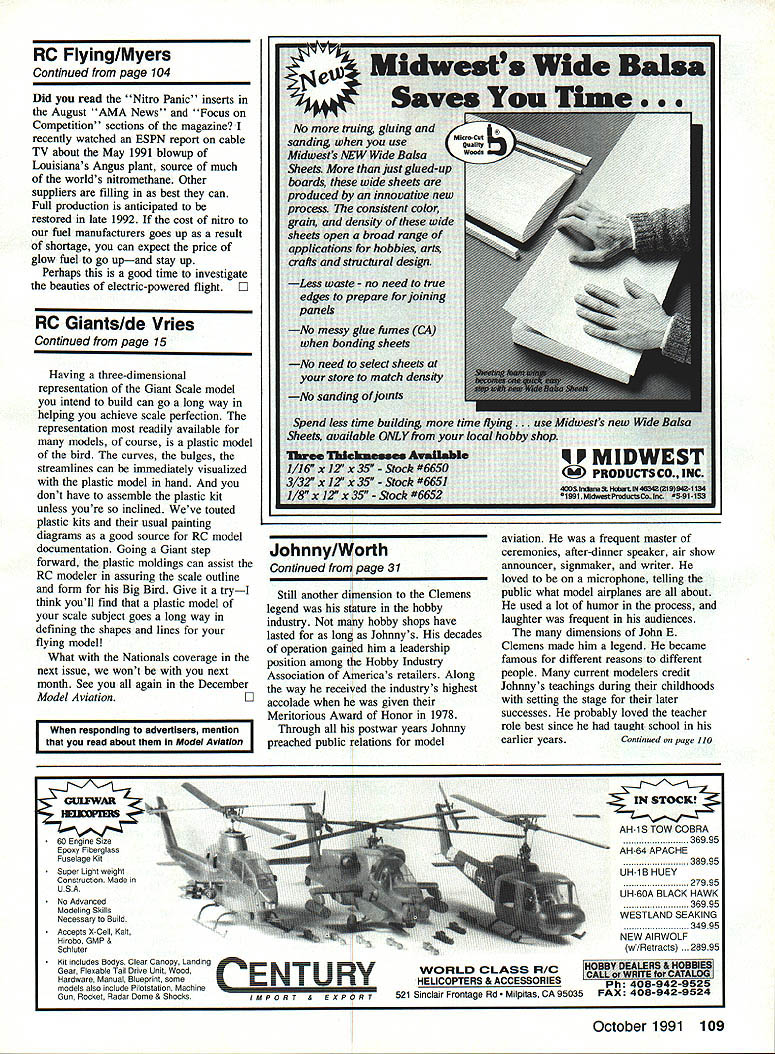
One of the truly fascinating perks of writing a monthly column for Model Aviation is to receive photos from readers from all over the U.S. By a rather roundabout route, thanks to Jeff Troy, David Dunn, newsletter editor of the SOURS (Sullivan, Orange, Ulster Radio Society), forwarded some great photos taken at their first annual 1/4‑scale Fun Fly. With 150 attendees and 20 fliers, Mike Freestone, the CD, ran a great meet. The club's Galesville, N.Y., flying site is 600 acres big with two concrete runways! A true Giant Fun Fly: there wasn't any judging, and no prizes, although every participant was given his choice of fuel, props, wheels, or other goodies from the gift table. We wish the SOURS our best for the second annual version of their big Fun Fly.
The limitations of two‑dimensional drawings
Most of this column has been devoted to the efforts of great model airplane designers and draftsmen. They would be the first to admit that converting a three‑dimensional aircraft to a two‑dimensional drawing is a difficult process. No matter how skillful the draftsman, it's literally impossible to represent every curve and nuance of the full‑scale airplane in a set of scale model drawings.
Take, for example, the fabric fillet between the rear upper fuselage of a Cub and its fin. Photographs show a smooth transition between fuselage and fin, but to draw it is something else. Representing the smooth wing fillet joining the wing and fuselage of a Mustang on paper just can't be done in such a way that the modeler will get it right without some additional help.
Photographs, along with fuselage formers, can ease the job of producing a scale fillet, but both require that the modeler use his skill in achieving the proper shape. Cross‑sections and plan views of wing tips aid in forming tips on models, but the flow of the parts is difficult for the modeler to visualize from two‑dimensional drawings. The same situation holds true when a modeler tries to duplicate larger sections of his scale aircraft. Smooth "bumps" that streamline the Merlin engine's valve covers on a Spitfire or the transition between a circular cowl opening of a Curtiss P‑36 to an oval cross section where the cowl meets the forward fuselage are hard to represent on paper.
Three‑dimensional representations and plastic models
Having a three‑dimensional representation of the Giant Scale model you intend to build can go a long way in helping you achieve scale perfection. The representation most readily available for many models, of course, is a plastic model of the bird. The curves, the bulges, the streamlines can be immediately visualized with the plastic model in hand. And you don't have to assemble the plastic kit unless you're so inclined. We've routed plastic kits and their usual painting diagrams as a good source for RC model documentation. Going a Giant step forward, the plastic moldings can assist the RC modeler in assuring the scale outline and form for his Big Bird. Give it a try—I think you'll find that a plastic model of your scale subject goes a long way in defining the shapes and lines for your flying model!
What with the Nationals coverage in the next issue, we won't be with you next month. See you all again in the December Model Aviation.
Transcribed from original scans by AI. Minor OCR errors may remain.

