
RADIO CONTROL: GIANTS
John A. de Vries, 4610 Moffat Ln., Colorado Springs, CO 80915
When you pull out onto the runway for your first flight in a North American Mustang, you feel all alone. After lining up the P-51 with the centerline, you apply the brakes and take a deep breath. It's now or never, so you ease the throttle forward, and the fire‑breathing Merlin engine flattens you back against the seat. For what seems an eternity, the bird rumbles along the ground. When the pounding stops, you know you're airborne, and you reach for the gear handle. Gear up, and the Mustang comes alive. You think a maneuver, and it's an accomplished fact.
But—it wasn't as easy as all that. Before your first Mustang flight, you had to follow an extended ritual. It included such things as six landings from the backseat of an AT‑6—to give you the perspective of having a long nose out in front of you. About 20 hours were spent studying the pilot's manual, with an emphasis on emergency procedures.
Since yours truly checked out in an operational squadron, there was also an oral test given by the operations officer. The oral test included questions about throttle and propeller settings for various flight conditions, speeds to be observed before lowering the landing gear and flaps—a host of performance details. Ten hours were spent just sitting in the P‑51's cockpit, to learn the locations of every instrument and control.
The final act before you were turned loose in the bird was the blindfold cockpit check. After your eyes were bound with your "hot pilot scarf," you were expected to point to any instrument or go directly to any control with your hand when commanded to do so by your check pilot. So when you heard the Merlin's takeoff roar for the first time from the cockpit, you knew the airplane.
Applying full‑scale procedures to Giant Scale models
It's unfortunate that there isn't a parallel checkout procedure for our Giant Scale models. We do have the advantage of having built our own airplanes, so we know their strengths and weaknesses. But do we know how an airplane will fly or what our reactions will be if the first test flight develops into an emergency situation? Taking a leaf from the full‑scale airplane book, maybe we can take preflight steps that will ensure a successful flight.
As model builders, we have a decided advantage over full‑scale pilots. Since we've built our models, we know everything about their structure. We've run in our engines, so we know how they work and how they're controlled. We installed the radio, so we're sure of how it functions and how the flight surfaces are connected. We know our airplanes—inside and out. That's a decided plus in our favor.
Continuing the full‑scale/model parallels, there is one more area for consideration—emergency procedures. Prethinking the first flight, what can go wrong? What if the engine quits on the runway or just after takeoff? What if the model climbs too steeply or appears out of trim? Anticipating problems and considering potential solutions make good sense. And if you can arrange to have another skilled pilot at your shoulder when you shove the throttle forward, your first flight with a new model should be a successful one.
At the flying field, the equivalent of the full‑scale pilot's preflight walkaround inspection is the safety check. This is a given for the conscientious Giant Scaler. Electronic and mechanical connections are checked and the flight controls exercised. With no reversed ailerons, the engine needle valve set, and a radio range check completed, you've done everything you can to get the bird up and down successfully. Lots of luck on your first solo!
Notes and developments
- Back in the July issue we dealt at length with Dick Smith's methods of modifying engine mufflers to quiet our gas burners. That article inspired Dennis Vollrath of South Milwaukee, Wisconsin, to write and tell us about a new Briggs & Stratton muffler that has potential application to our engine installations. It's oval, 2‑1/4 x 3‑1/2 in. in size and uses a standard 1/2‑in. pipe fitting for the input.
Dennis, an electric sailplane flier, tried it on a three‑horsepower Briggs & Stratton engine that runs an alternator he uses to charge his power packs. He says that it really quiets things down. The muffler may be a bit difficult to locate, but the larger Ace Hardware dealers do stock it.
- Prolific publisher Bill Hannan (Hannan's Runway, P.O. Box 210, Magalia, CA 95954) has produced volume number two of his Stick and Tissue books. The center spread in volume 2 is an outstanding set of Pitts Special biplane drawings. Like the drawings in all of Bill's books, they're eminently enlargeable to Giant Scale sizes.
- You may not have noticed it in his ads, but Bill Effinger (W.E. Technical Services, P.O. Box 420144, Atlanta, GA 30342) has moved back from Florida. He offers a bunch of great plans for Giant Scale models in his Plan 'n Pattern sets. Soon to be available from him will be a Fairchild 24 and an Aeronca C—both birds in 1/6th and 1/3rd scale—and a quarter‑scale World War I Nieuport 28. Like his other drawings, the new trio should be doozers!
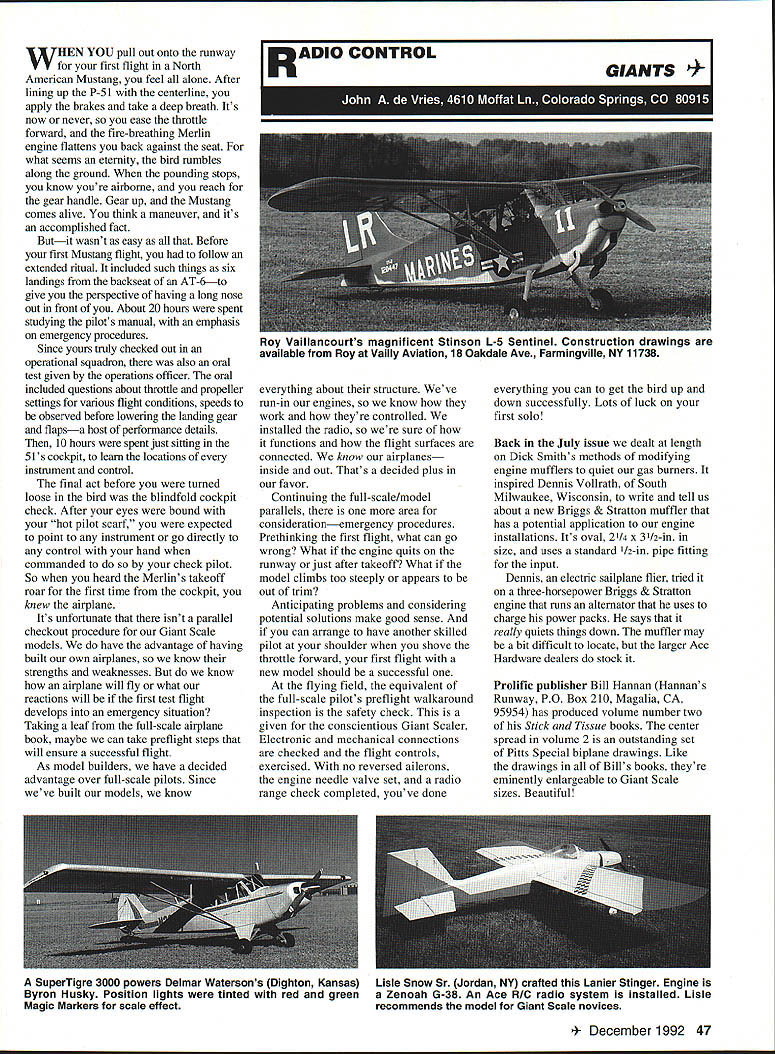
- In the August issue we featured a photo of Dick Tichenor's big Stinson L‑5 model. Hard on the heels of that issue, we received notice of the availability of another version of the Sentinel. Roy Vaillancourt (Vailly Aviation, 18 Oakdale Avenue, Farmingville, NY 11738) has produced construction drawings in quarter scale for the L‑5 and has a host of accessory items that fit it. A welded landing‑gear structure and a fiberglass cowling as well as landing‑gear strut covers and dummy exhaust stacks are available. The plans detail the liaison airplane's flaps so that the prototype's STOL characteristics can be duplicated.
From the number of letters we've received about the Sentinel, a bunch of Giant modelers have the hots for the wartime Stinson. For the big‑bird lovers, Roy promises a full 1/3‑scale version soon.
Gene Falda's floatplane and large‑scale offerings
Giant Scale floatplane drawings are few and far between, and Gene Falda (22707 Byron St., Addison, IL 60101) seems to have a corner on the market. A skilled draftsman, Gene offers some pretty exotic plans. His library includes:
- Albatros W‑4 WW I naval fighter (1/4‑scale, 93‑in. span)
- 1938 Fleet Freighter, a Canadian bush twin‑engined aircraft (1/5‑scale, 108‑in. span)
- Blohm & Voss BV‑138C twin‑boomed trimotor reconnaissance aircraft (1/5‑scale, 11‑ft. span)
- 1934 Fairchild Super 71 bush freighter (1/6‑scale, 116‑in. span)
- Blohm & Voss Ha 139B (V3) Nordstern, a diesel four‑engined trans‑Atlantic seaplane (1/12‑scale, 96‑in. span)
Gene also has drawings for the Northrop Delta, a large single‑engine follow‑on to the Gamma series. Topping off his fantastic list of plans is the Northrop Gamma, from which 11 different incarnations of the sleek single‑engined, all‑metal craft may be built. Mr. Falda's drafting efforts are truly mind‑boggling!
Have you decided on your Giant Scale project for this winter yet?
Transcribed from original scans by AI. Minor OCR errors may remain.

