
Radio Control: Giants
By
John A. de Vries 4610 Moffat Ln., Colorado Springs, CO 80915
Wheels from Baby Carriages
Admit it—one of the most difficult parts of "building big" is finding a suitable pair of wheels. Although there are several makers of Giant Scale wheels, it's impossible for them to manufacture every kind, shape, and size to fit the panoply of scale models we can envision. They've done a good job, but many models are built to an odd scale and call for uniquely sized wheels. To the scale purist, a wheel that's an eighth of an inch oversize just won't do.
Take heart—the solution to the wheel size problem is at hand. It won't be easy and will take a major research effort plus a bit of work. Thanks to Leo Ford, of Lakewood, Colorado, the task should be simplified. Leo's solution: baby carriages and fiberglass.
Perambulator wheels come in all shapes and sizes, many eminently suitable for conversion to model airplane landing gear. They may be made of plastic or metal, and their tires may be fat or thin, but baby carriage wheels come in diameters right in the Giant Scale ballpark. Happily, many are affixed to 1/4-in. axles, a music-wire size we most frequently use for our big birds.
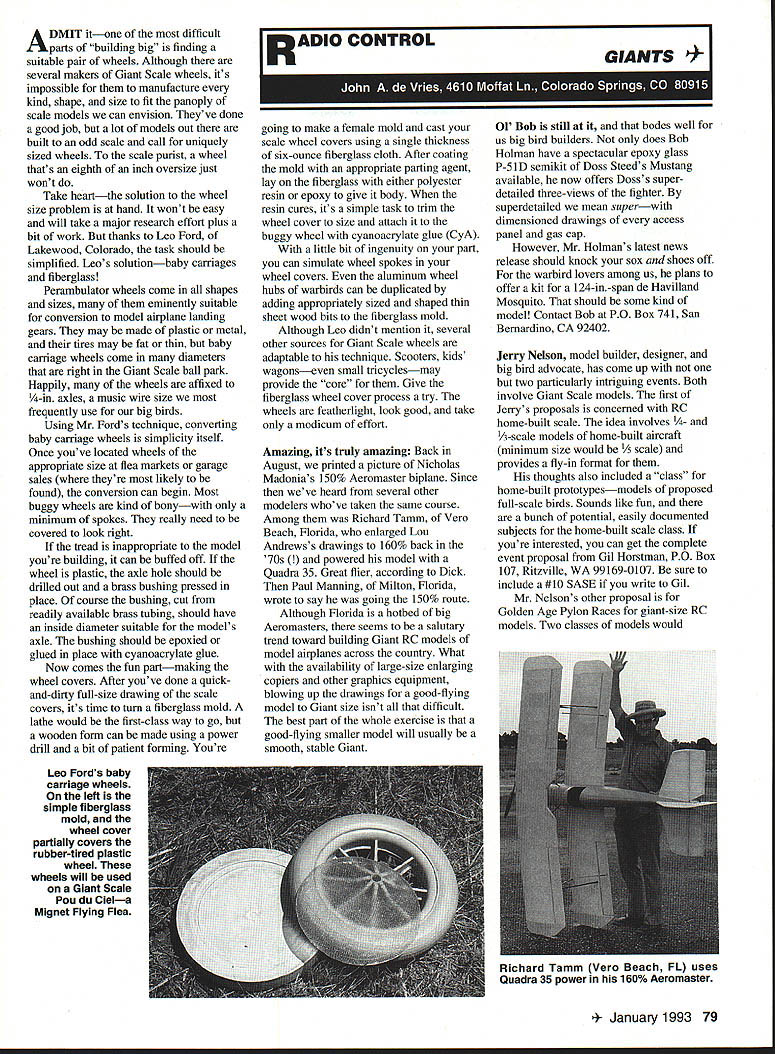
Using Mr. Ford's technique, converting baby carriage wheels is simplicity itself. Once you've located wheels of the appropriate size at flea markets or garage sales (where they're most likely to be found), the conversion can begin. Most buggy wheels are kind of bony—with only a minimum of spokes. They really need to be covered to look right.
If the tread is inappropriate to the model you're building, it can be buffed off. If the wheel is plastic, the axle hole should be drilled out and a brass bushing pressed in place. The bushing, cut from readily available brass tubing, should have an inside diameter suitable for the model's axle and should be epoxied or glued in place with cyanoacrylate (CyA) glue.
Now comes the fun part—making the wheel covers. After you've done a quick-and-dirty full-size drawing of the scale covers, turn a fiberglass mold. A lathe would be the first-class way to go, but a wooden form can be made using a power drill and some patient forming. Make a female mold and cast your scale wheel covers using a single thickness of six-ounce fiberglass cloth. After coating the mold with an appropriate parting agent, lay fiberglass on either polyester resin or epoxy to give it body. When the resin cures, trim the wheel cover to size and attach it to the buggy wheel with CyA.
With a little ingenuity, you can simulate wheel spokes in your covers. Even aluminum wheel hubs of warbirds can be duplicated by adding appropriately sized and shaped thin sheet-wood bits to the fiberglass mold.
Conversion steps (suggested)
- Locate suitable baby carriage, scooter, wagon, or tricycle wheels at flea markets or garage sales.
- Buff off unwanted tread.
- Drill out axle hole (if plastic) and press in brass bushing sized for your axle. Glue with epoxy or CyA.
- Make a full-size drawing of the scale cover.
- Create a female mold (lathe or wooden form). Apply parting agent.
- Lay a single thickness of six-ounce fiberglass cloth in the mold using polyester resin or epoxy.
- Trim cured covers and attach to wheel with CyA.
- Add simulated spokes or hubs using thin sheet wood in the mold if desired.
Other sources for Giant Scale wheels adaptable to this technique include scooters, kids' wagons, and small tricycles. The fiberglass wheel-cover process yields featherlight, attractive wheels with modest effort.
Aeromaster enlargements
Amazing: back in August we printed a picture of Nicholas Madonia's 150% Aeromaster biplane. Since then we've heard from several other modelers who've taken the same course.
- Richard Tamm, of Vero Beach, Florida, enlarged Lou Andrews' drawings to 160% in the '70s and powered his model with a Quadra 35. According to Dick, it was a great flier.
- Paul Manning, of Milton, Florida, wrote to say he was going the 150% route.
Although Florida is a hotbed of big Aeromasters, there seems to be a salutary trend toward building Giant RC models across the country. With the availability of large-size enlarging copiers and other graphics equipment, blowing up drawings for a good-flying model to Giant size isn't that difficult. The best part is that a good-flying smaller model will usually be a smooth, stable Giant.
Kits and new releases
Ol' Bob is still at it, and that bodes well for us big-bird builders. Not only does Bob Holman have a spectacular epoxy-glass P-51D semikit of Doss Steed's Mustang available, he now offers Doss's super-detailed three-views of the fighter. By super-detailed we mean super—with dimensioned drawings of every access panel and gas cap.
Mr. Holman's latest news should knock your socks off—for warbird lovers, he plans to offer a kit for a 124-in. span de Havilland Mosquito. That should be some kind of model! Contact Bob at: P.O. Box 741, San Bernardino, CA 92402.
Jerry Nelson's event proposals
Jerry Nelson, model builder, designer, and big-bird advocate, has proposed two intriguing Giant Scale events.
- RC home-built scale models
- Focus on 1/4- and 1/3-scale models of home-built aircraft (minimum size 1/3 scale).
- Provides a fly-in format for home-built prototypes—models of proposed full-scale birds.
- Sounds like fun, and there are many potential, easily documented subjects.
- For the complete event proposal, contact Gil Horsman, P.O. Box 107, Ritzville, WA 99169-0107. Include a #10 SASE.
- Golden Age Pylon Racers for giant-size RC models
- Two classes: Greve Trophy (inline-engined) and Thompson Trophy (round-engined) aircraft.
- Competition would be similar to the current Reno miniature re-creation heavy iron and AT-6 races.
- Draft rules prepared for 1/4- and 1/3-scale events would require models to duplicate Gee Bees, Wedell-Williamses, Folkerts, and Chester racers of the '30s. Models must look like their prototypes, but scale-like paint jobs would be permitted to reduce pylon-judge confusion.
- Check the September '92 issue of Scale RC Modeler magazine for more specific data.
P-47 model appeal
We get a lot of correspondence from old fighter pilots. One such letter arrived from Donald E. Glass, a retired flight colonel.
Don is involved with a great fighter museum in Millville, New Jersey, which was a fixed gunnery training base during WWII. The people building the museum need a good Giant Scale model of the Republic P-47 Thunderbolt. The Jug was the bird used by the gunnery school, and there aren’t enough of the “real” birds to give credence to the museum’s displays. If you have a good-looking but flown-out P-47 model you’d like to donate, contact: Millville Army Airfield Museum Building 1A, Millville Municipal Airport Millville, NJ 08332.
It'll serve as a focal point for the museum.
RC Giants / de Vries
As a parting shot this month, new friend Arthur W. Hillis of Aurora, Colorado, has done what many of us old airplane drivers aspire to—built a model of a bird he flew during his early flying days.
Art built a scale version of the Fleet 16B, the aircraft of his first solo flight in September 1945. A retired Frontier Airlines captain, Art scratch-built the scale biplane and powered it with an O.S. 300 five-cylinder engine. To keep things in scale, Art had an R/N Models Fleet rubber-powered model drawing enlarged to match the engine's diameter. With a lot of home-built engineering, he produced a smooth-flying 15-lb., 65-in.-span model.
If you are considering building a Giant Scale model based on existing rubber-model drawings, stay tuned—next month I'll give some hints on how to go about it.
Hope that Santa is good to you and brings all manner of Giant Scale goodies! In any event, have a Merry and a Happy, and we'll be back with you next year.
Transcribed from original scans by AI. Minor OCR errors may remain.

