
Radio Control: Giants
John A. de Vries, 4610 Moffat Ln., Colorado Springs, CO 80915
Access and maintenance
ACCESS is the magic word this month. Life will be more pleasant if you keep it in mind as you glue and bolt your Giant scale model together. Later on, getting at the innards of your bird with a minimum of fuss can go a long way toward keeping the frustration factor down. Let's take a brief look at how full-scale aircraft historically provided for access and maintenance.
Many aircraft produced during World War I laced the fuselage covering together. By undoing the laces, early mechanics reached into the aircraft's structure to attend to maintenance chores. Between the wars, fabric-covered aircraft were often provided with zippers for the same purpose.
The World War II warbirds, made of metal, posed new access problems. Removable skin panels were designed and were held in place with Dzus fasteners or their equivalent. A warbird with its maintenance panels removed and its access/inspection panels open looks rather like a big piece of metallic Swiss cheese!
Design mistakes to avoid
Would you believe that some Giant scale model drawings exist suggesting to the builder that when he installs the fuel tank, he makes sure that the lines aren't kinked, "because you won't be able to get at it after the fuselage is planked"? Man, that's dumb!
Even if the lines are arrow-straight, what happens if the clunk works itself off the fuel line? Other drawings show elevator horns literally buried in the rear of the fuselage or aileron pushrods out of sight (and totally inaccessible) within the wing. Clevises have been known to crystallize and break; locknuts or plastic tubing have been known to unscrew; and, under severe air loads, are prone to come adrift. The consequences of the loss of a connection between servo and control surface are too well-known to require further discussion. If you can't get at 'em, how can you fix 'em?
If you can't see that a wire has parted company in the radio installation, you won't know why it isn't responding as it should. Solder joints are prone to vibration breakage with genuinely ugly consequences.
Make hatches and access ports
What is suggested here is to consider modifying the Giant scale model to include hatches and access ports wherever there's a mechanical or electronic connection that might fail with dire results. The scale appearance of the bird doesn't have to be destroyed, either. Check the documentation closely for the full-scale access and inspection panels, and make them functional on the model! It'll take a bit of "horseback engineering," but things such as the fuel tank can be removed and replaced without cutting into the beautiful paint job. With a bit more effort, it is possible to inspect all the control linkages and be assured that the radio's battery wires are secure.
There are a couple or three techniques that'll make the addition of inspection panels and hatches not only more scale-like, but also more functional.
- On fabric-covered birds, inspection panels can be boxed in by installing vertical strips between stringers or between stringers and longerons. A close-fitting balsa-strip box that fits within the fuselage (or wing) structure may be constructed. It, in turn, is covered with fabric (or covering film) before it's slipped into place. Friction holds the panel in place. When necessary, it may be opened by slipping a thin metal strip into the joint and prying it loose. Scale-size screws or bolts may be used to hold things together if you're worried about panels coming loose in flight.
- When installing inspection panels on a "metal" scale model, consider lining the edges of both the panel and the orifice with thin (3/32 in. or 1/16 in.) plywood. The use of the harder wood achieves a well-defined and stable peripheral joint. It also helps maintain the panel's shape, particularly in planked surfaces.
- Larger panels and hatches may not stay in place with only friction holding them. Hinges and simple interior latches to keep them closed under negative air loads are a prime consideration. A simple way to keep things closed is to add a hook to the interior of a panel and anchor a rubber band to the model's interior structure to hold it in place. The hook in such an installation (dress hooks work well) should be epoxied to an interior plywood "scab" that, in turn, is glued to the removable panel.
The ideal situation would be a model that could be "field stripped," and any component replaced without affecting its scale appearance. With a bit of care and preplanning during construction, that ideal may be closely approached.
Resources and recent items of interest
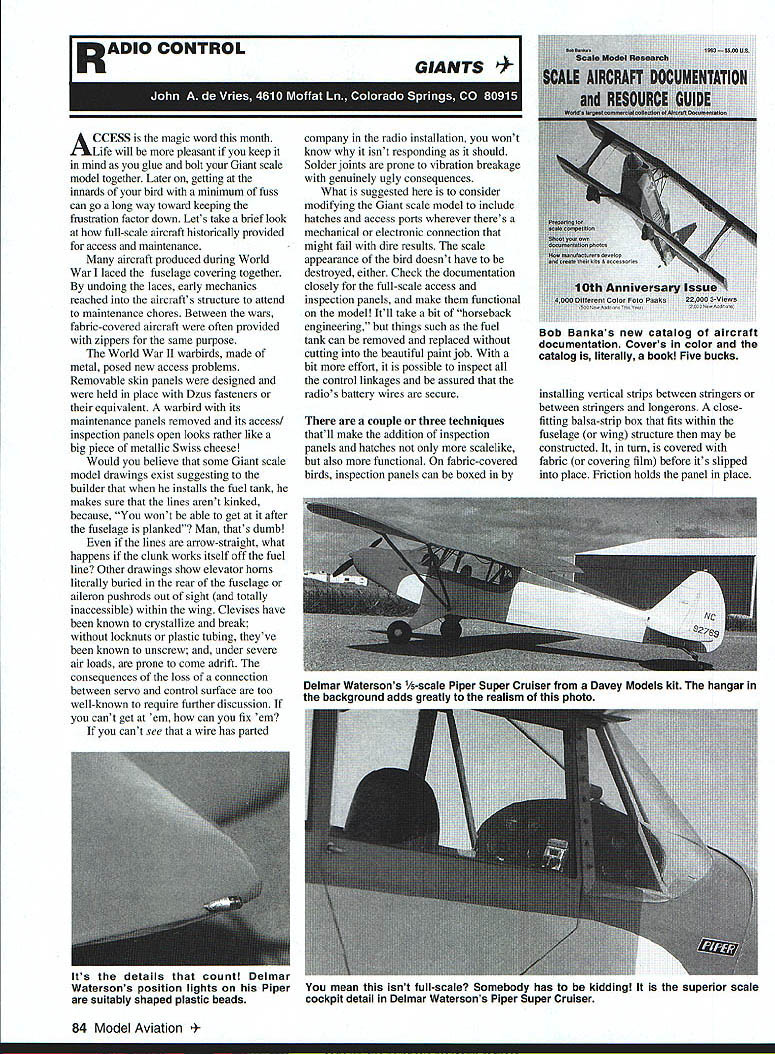
Scale Aircraft Documentation and Resource Guide (Bob Banka)
Old friend Bob Banka has just published a new offering, Scale Aircraft Documentation and Resource Guide, and it's a doozer!
Bob's latest catalog is literally a book and well worth the five-buck price. Bob, of course, is Scale Model Research (2334 Ticonderoga Way, Costa Mesa, CA 92626).
The book includes a listing of all Bob's Foto-Paks and available three-view drawings for a variety of sources. It also includes a host of articles of interest to scale modelers. For example, there's one by international scale expert Cliff Tacito on how to document scale models for competition. Another, by Bob himself, provides a guide for photographing full-size aircraft for documentation purposes. The new book will go a long way toward helping modelers produce miniature aircraft!
Kits and scratch-building
Talk about versatility — Nick Ziroli's designs have found great favor among the Giant scale fraternity. They build well and fly even better. Now Chuck Gill (The Aeroplane Works, 2134 Gilbride Road, Martinsville, NJ 08836) is kitting Nick's designs in a variety of forms. Chuck features full kits and wing and empennage kits for use with fiberglass warbird fuselages. He advises that plans, canopies, and cowls can be obtained directly from Nick (29 Edgar Drive, Smithtown, NY 11787).
Scratch-building suddenly has become a lot easier! Chuck also has kits for Rich Uravitch's WW I giants. Rich provides the drawings and plastic detail parts (15 Newcomb Trail, Ridge, NY 11961).
Historical note: Giant scale anniversary
Doug Dahlke posed an interesting dilemma. He suggested that we should be celebrating the 60th anniversary of Giant scale. He backed up his suggestion with a Xerox copy of a G.H.Q. Model Airplane Company ad from the March 1935 issue of Air Trails. The ad featured "five-foot flying scale models for a dollar!" Yours truly built G.H.Q.'s Big Monocoupe back then. It was rubber powered and flew tolerably well. G.H.Q. more than stretched the truth when it touted the models as being "One-third the Size of Real Planes," though a 15-foot span "real" Monocoupe would be kind of small!
In my reply to Doug, I intimated that RC Giant scale was a lot younger than 60. If you consider that it began with the availability of the Quadra and other gas-burning big engines, we're looking at 1976. That'll make for a 20th anniversary — in 1996. What do YOU think?
Recommended reading
I've just finished reading a fascinating book by Dave Thornburg titled Do You Speak Model Airplane? — a history of model aviation. Exhaustive research of the subject sticks out all over the book, and Dave's facile writing style makes it an easy read. The subject is covered from the Penaud Planophore to the latest ducted fan and helicopter models and includes (among a host of other topics) the history of the National Model Airplane Championships.
So if you're interested in learning things like when balsa was first used in model construction or who won the first national RC contest, get the book. Contact Dave at 5 Monticello Drive, Albuquerque, NM 87123, and enclose a #10 SASE for purchase particulars.
Photos and storage
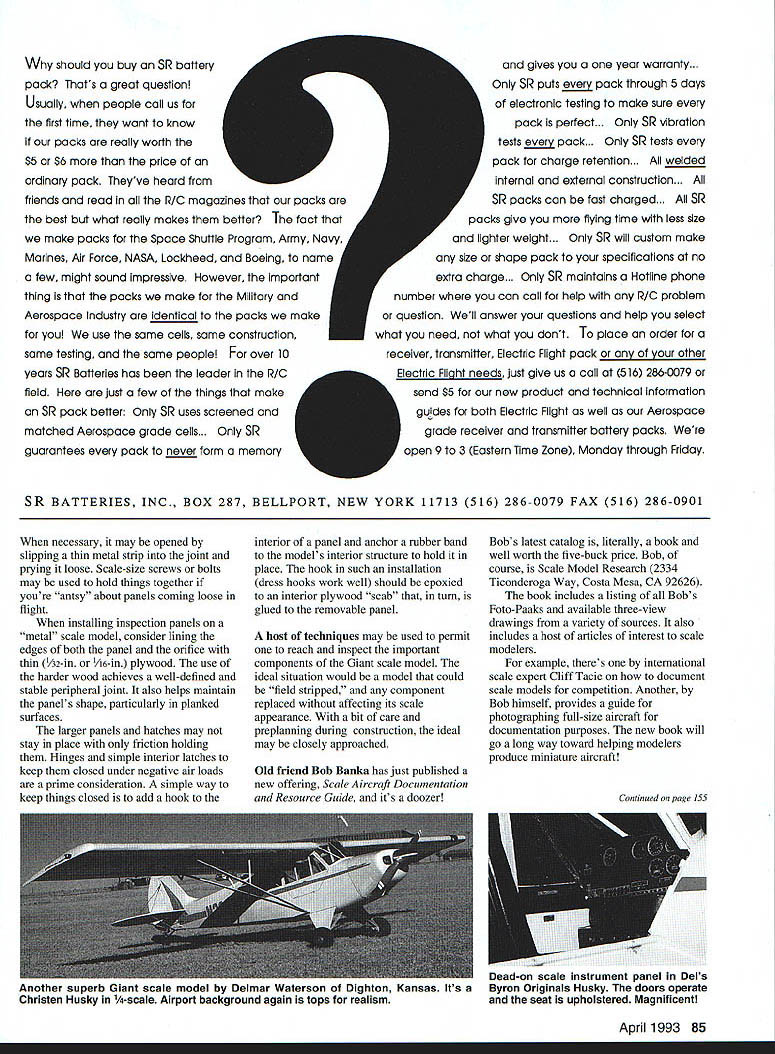
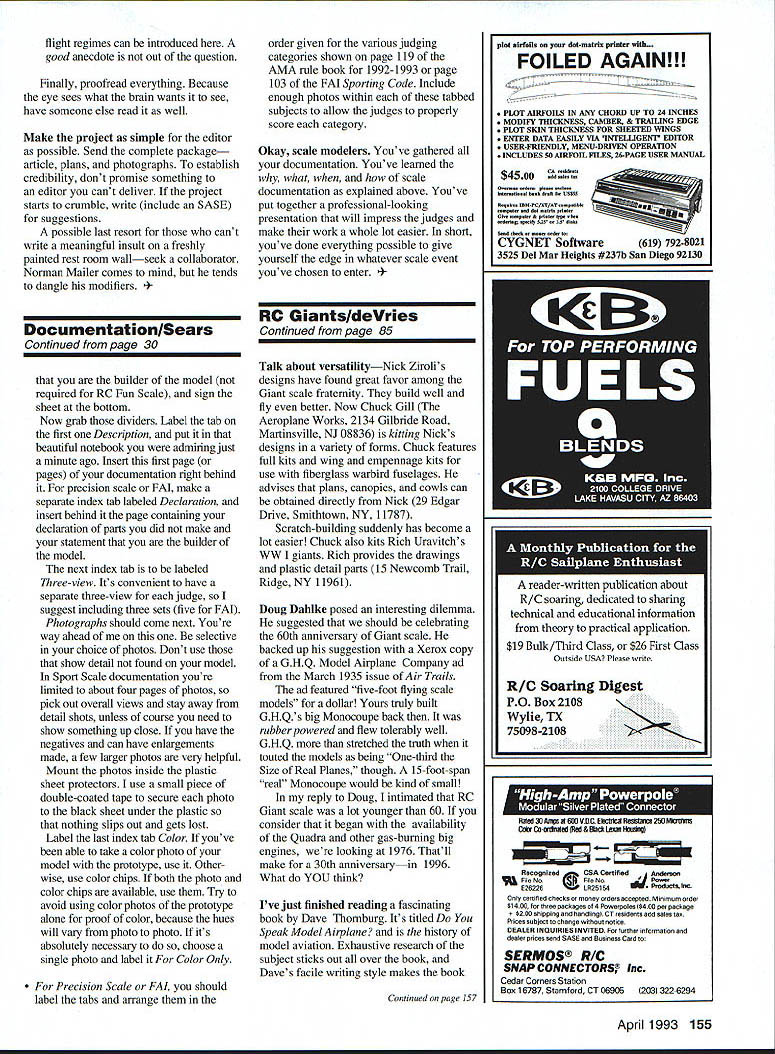
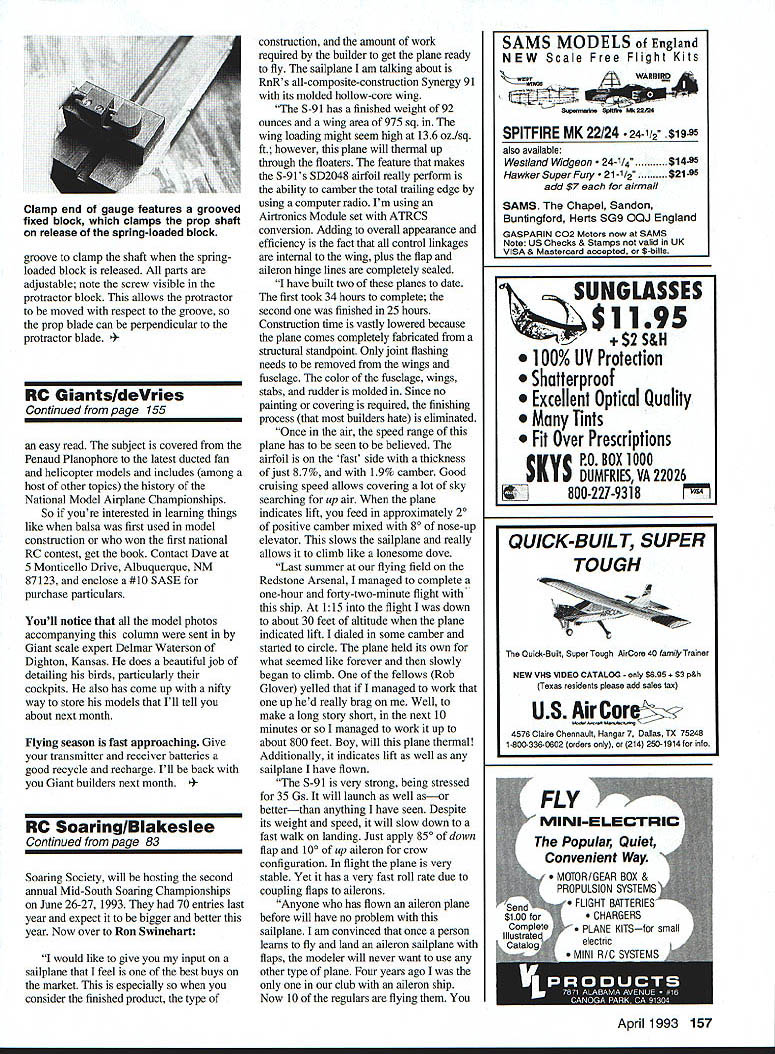
You'll notice that all the model photos accompanying this column were sent in by Giant scale expert Delmar Waterson of Dighton, Kansas. He does a beautiful job of detailing his birds, particularly their cockpits. He has also come up with a nifty way to store his models that I'll tell you about next month.
Closing
Flying season is fast approaching. Give your transmitter and receiver batteries a good recycle and recharge. I'll be back with you Giant builders next month.
Transcribed from original scans by AI. Minor OCR errors may remain.

