
RADIO CONTROL GIANTS
John A. de Vries 4610 Moffat Ln., Colorado Springs, CO 80915
Early powerplant problems
In the early days of the giant-scale business there was a shortage of suitable powerplants. Before the venerable Quadras came into general use, resourceful model builders adapted Ropers or Ohlsson & Rice engines to power large-size RC models.
Another common solution was the use of speed-reduction drives. Modelers geared down a high-revving .60 glow-plug engine using a toothed rubber belt and two drive pulleys — a small one on the engine’s prop shaft and a much larger one supported in a metal framework. The engine would run at its normal 10,000–12,000 rpm while the larger-than-normal prop mounted on the bigger pulley spun at about 5,000–6,000 rpm. This system worked well for the smaller, lighter giants of the day.
Commercial reduction drives
Several reduction drives were available commercially. Most featured cast-aluminum housings with machined flats for mounting the engine and a ball-bearing subshaft where the propeller was bolted. The propeller subshaft was adjustable for proper belt alignment and tension. Propellers up to 18 inches in diameter were used with a high degree of efficiency.
When more powerful two-stroke gas engines like the Quadras, Zenoahs, and Kioritzes appeared, they largely displaced reduction drives: the superior power of the gas burners overcame the older 10cc glow-plug predecessors and enabled construction of larger, heavier RC models.
Revival: the Torquemaster
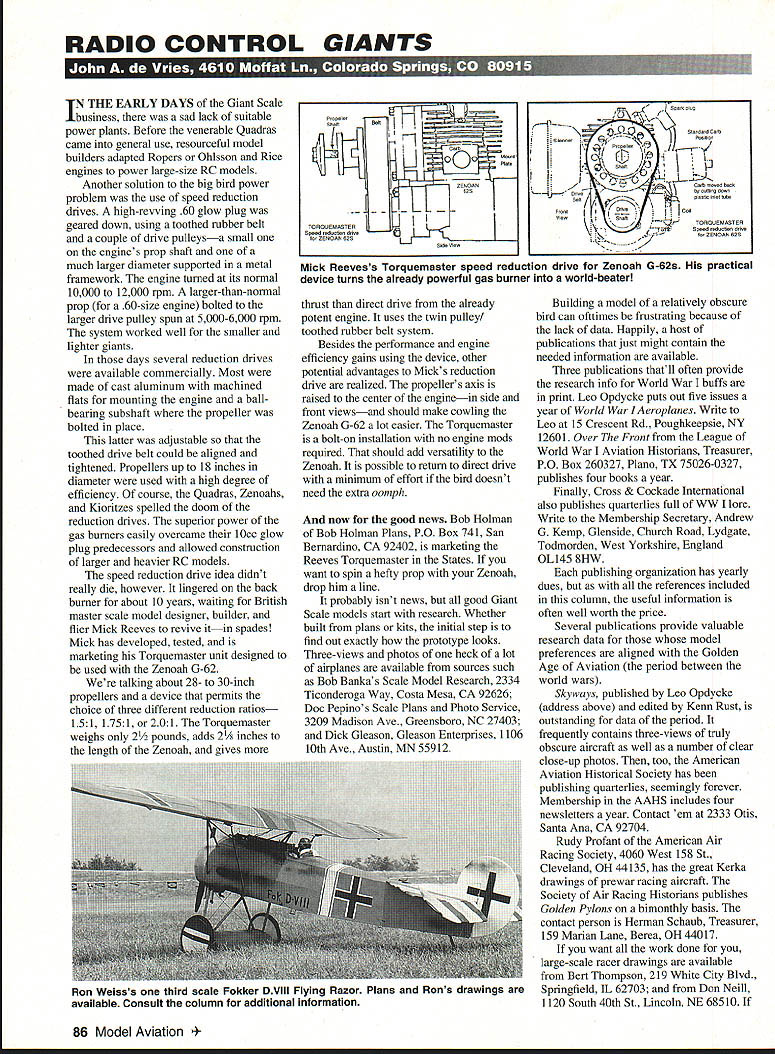
The reduction-drive concept did not die completely. About ten years later British scale designer, builder, and flier Mick Reeves revived it with the Torquemaster unit, designed for use with the Zenoah G-62.
Key features:
- Designed for 28–30 inch propellers.
- Three selectable reduction ratios: 1.5:1, 1.75:1, or 2.0:1.
- Weight: about 2.5 pounds; adds roughly 2.5 inches to the length of the Zenoah G-62.
- Uses a twin-pulley / toothed rubber belt system.
- Bolt-on installation; no engine modifications required.
- Raises the propeller axis to the center of the engine in side and front views, making cowling the Zenoah easier.
- Allows easy return to direct drive if extra reduction/torque is not needed.
U.S. distributor:
- Bob Holman, Bob Holman Plans, P.O. Box 741, San Bernardino, CA 92402.
Research and references for scale builders
Good giant-scale models start with research. Whether building from plans or kits, the initial step is to find out exactly how the prototype looks. Three-views and photos are available from several sources:
- Bob Bankas — Scale Model Research, 2334 Ticonderoga Way, Costa Mesa, CA 92626.
- Doc Pepino — Scale Plans & Photo Service, 3209 Madison Ave., Greensboro, NC 27403.
- Dick Gleason — Gleason Enterprises, 1106 10th Ave., Austin, MN 55912.
For World War I research:
- World War Aeroplanes (Leo Opdycke) — five issues a year. Write: Leo Opdycke, 15 Crescent Rd., Poughkeepsie, NY 12601.
- Over the Front (League of World War I Aviation Historians) — four issues a year. Treasurer: P.O. Box 260327, Plano, TX 75026-0327.
- Cross & Cockade International — Membership Secretary Andrew G. Kemp, Glenside Church Road, Lydgate, Todmorden, West Yorkshire, England, OL14 5HW.
Golden Age (interwar) references:
- Skyways (published by Leo Opdycke; edited by Kenn Rust).
- American Aviation Historical Society — quarterlies and membership information: 2333 Otis, Santa Ana, CA 92704.
Air racing and prewar racers:
- Rudy Profant, American Air Racing Society, 4060 West 158 St., Cleveland, OH 44135 (Kerka drawings).
- Society of Air Racing Historians — Golden Pylon (bimonthly). Contact: Herman Schaub, Treasurer, 159 Marian Lane, Berea, OH 44017.
Large-scale racer drawings available from:
- Bert Thompson, 219 White City Blvd., Springfield, IL 62703.
- Don Neill, 1120 South 40th St., Lincoln, NE 68510.
Other specific notes:
- For Gee Bee information: write Henry Haffke, RR #1, Box 22, Londonderry, VT 05148.
Each organization has yearly dues or purchase costs, but the information is often well worth the price.
Example: Ron Weiss’s 1/3-scale Fokker D.VIII
Ron Weiss built a 1/3-scale Fokker D.VIII “Flying Razor”:
- Wingspan: 9 ft 3 in.
- Wing area: about 1,650 square inches.
- Fuselage length: 74 in.
- Weight: 30 lb.
- Power: Kioritz 2.4 cc engine.
- Research sources for Ron’s three-views: World War I Aeroplanes and Heinz J. Nowarra’s work for Harleyford Publications.
The model has been flying since 1985 and closely duplicates the original's flight characteristics. It can be a bit lively on landings but handles like a big Cub in the air.
Ron Weiss offers his drawings:
- Contact: Ron Weiss, 20 Linda Pl., Huntington, NY 11743 — include a large SASE. He also offers a definitive 1/3-scale plan for the 1930 Fleet 2 biplane.
Final notes
Columnists receive many useful news releases, but some are confusing or poorly explained. Keep documentation and instructions clear.
Make ’em big, fly ’em big. Back with you next month! —J
Transcribed from original scans by AI. Minor OCR errors may remain.

