
RADIO CONTROL GIANTS
John A. de Vries 4610 Moffat Ln., Colorado Springs, CO 80915
Dornier Do-335 (Giant Scale)
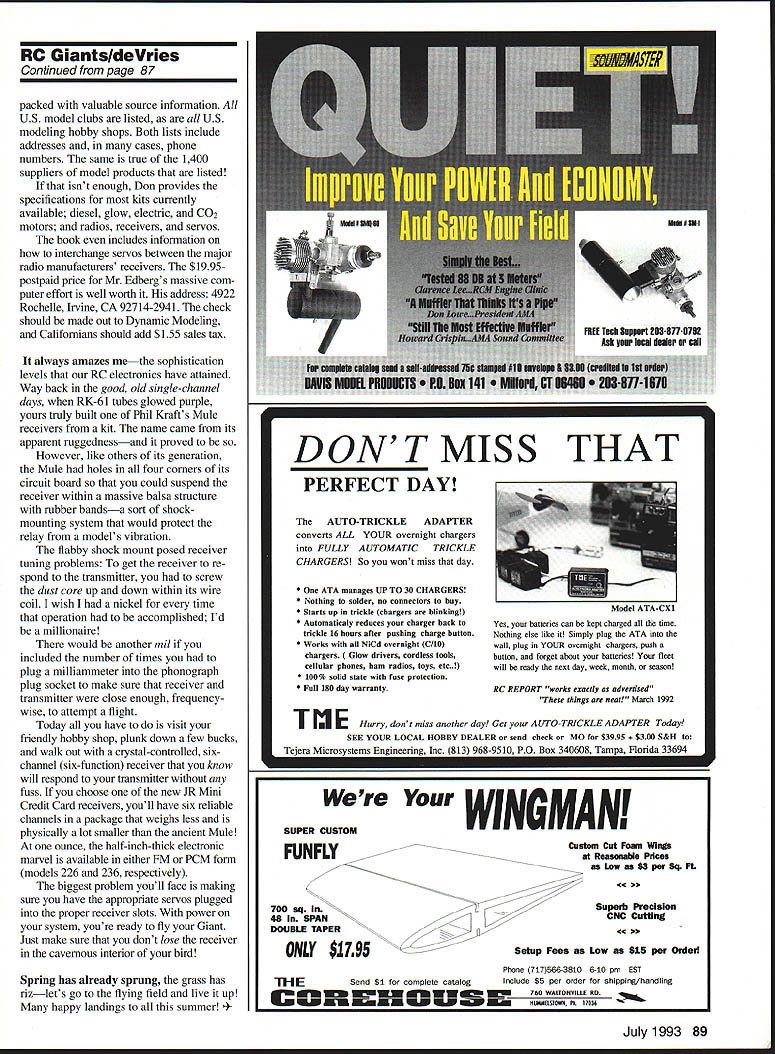
The stack gets bigger, and time, shorter. The latest addition to the wish list arrived by priority mail, as it should. Al Masters (20026 Frazier Dr., Rocky River, OH 44116) sent a set of his Giant Scale drawings for the Dornier Do-335 push-pull German World War II fighter. A prizewinner in its smaller incarnations, the 81-inch-span version is a knockout.
The model is square — the fuselage is 81 inches long as well. Built-up weight of the Dornier is 18 to 21 pounds, including two tanks totaling 28 ounces of fuel. Power for the big fighter comes from two O.S. .60s, and Al included glow-assist provisions for both engines. The 1:6.7 scale produces a model with 1,333 squares.
The airplane is completely built-up; it's sheeted and covered with fiberglass. In addition to the three-sheet drawings ($35 rolled, postage paid in the U.S.), Al offers a set of two fiberglass cowls for $40. With the gear retracted and two engines snarling — that's what Giant Scale is all about!
Kit Modification: Piper Tri-Pacer (1/4 scale)
Longtime readers know I'm a firm believer in using existing plans or kits as the basis for unique Giants. With a bit of engineering, documentation, and the desire to have something different from the usual Mustangs and Cubs, kit/plans modification is the way to go.
That's exactly what Russell Davis did to produce his magnificent Piper Tri-Pacer in quarter scale. Russ started with a Sig J-3 kit. He shortened the wing by one rib section on each side and shortened the rear of the fuselage three inches. He reversed a Cub main gear supplied by Bob Shattleroe and added a 1/4-scale Super Cub fiberglass cowling from Fiberglass Specialties.
A firewall-mounted nose gear is spring-loaded. Voila! A Tri-Pacer that flies beautifully. Russ allows that the model's landing runouts are a bit tricky, but the mods are well worthwhile. A member of the Tucson (Arizona) Radio Control Club, Russ lives at 1671 N. Clifton St., Tucson, AZ 85745.
Douglas SBD-3 Dauntless (C. W. Armand)
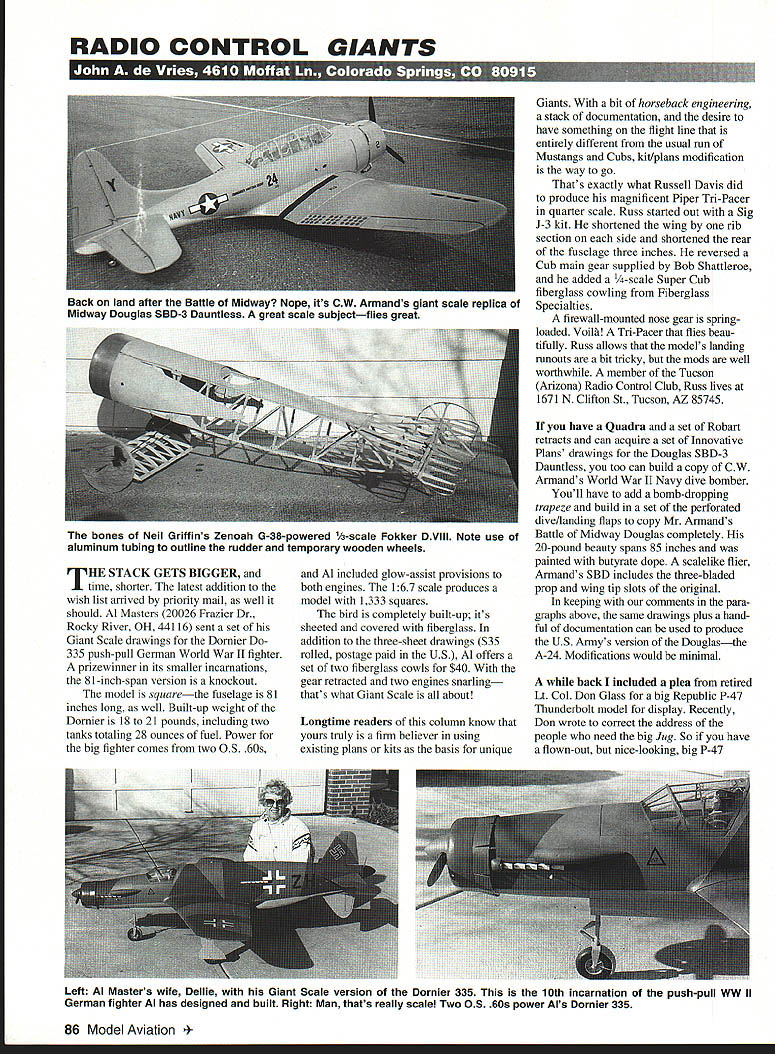
If you have a Quadra set of Robart retracts and can acquire a set of Innovative Plans' drawings for the Douglas SBD-3 Dauntless, you too can build a copy of C. W. Armand's World War II Navy dive bomber.
To copy Armand's Battle of Midway Douglas completely you'll need to add a bomb-dropping trapeze and build in perforated dive/landing flaps. His 20-pound beauty spans 85 inches and was painted with butyrate dope. A scale-like flier, Armand's SBD includes the three-bladed prop and wingtip slots of the original.
The same drawings plus a handful of documentation can be used to produce the U.S. Army's version of the Douglas — the A-24 — with minimal modifications.
P-47 Thunderbolt Donation
A while back I included a plea from retired Lt. Col. Don Glass for a big Republic P-47 Thunderbolt model for display. Recently, Don wrote to correct the address of the people who need the big Jug. So, if you have a flown-out but nice-looking big P-47 model that you'd like to donate, contact:
Thunderbolt Mission—Millville 4 W. Judith Dr., Blue Anchor, NJ 08037 Tel.: (609) 567-4983
Neil Griffin’s 3/4-scale Fokker D.VIII
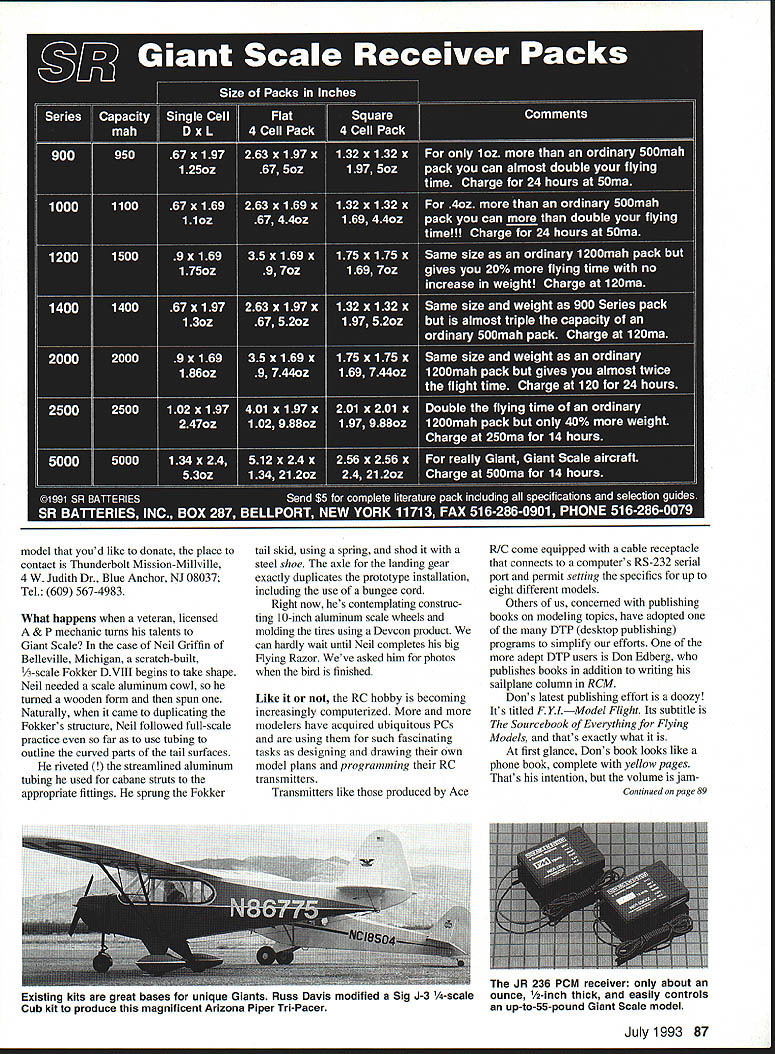
What happens when a veteran, licensed A&P mechanic turns his talents to Giant Scale? In the case of Neil Griffin of Belleville, Michigan, a scratch-built 3/4-scale Fokker D.VIII begins to take shape.
Neil needed a scale aluminum cowl, so he turned a wooden form and then spun one. In duplicating the Fokker's structure, Neil followed full-scale practice, even using tubing to outline the curved parts of the tail surfaces. He riveted the streamlined aluminum tubing he used for cabane struts to the appropriate fittings. He sprung the Fokker tail skid using a spring and shod it with a steel shoe. The axle for the landing gear exactly duplicates the prototype installation, including the use of a bungee cord.
Right now he's contemplating constructing 10-inch aluminum scale wheels and molding the tires using a Devcon product. We can hardly wait until Neil completes his big Flying Razor. We've asked him for photos when the bird is finished.
Computers, DTP, and Modern RC
Like it or not, the RC hobby is becoming increasingly computerized. More and more modelers have acquired PCs and are using them for tasks such as designing and drawing their own model plans and programming their RC transmitters.
Transmitters like those produced by Ace R/C come equipped with a cable receptacle that connects to a computer's RS-232 serial port and permit setting the specifics for up to eight different models.
Others of us, concerned with publishing books on modeling topics, have adopted DTP (desktop publishing) programs to simplify our efforts. One of the more adept DTP users is Don Edberg, who publishes books in addition to writing his sailplane column for RCM.
F.Y.I.—Model Flight (Don Edberg)
Don's latest publishing effort is a doozy: F.Y.I.—Model Flight, subtitled The Sourcebook of Everything for Flying Models. At first glance the book looks like a phone book, complete with yellow pages — that's his intention — and the volume is jam-packed with valuable source information.
Contents highlights:
- All U.S. model clubs listed (addresses and, in many cases, phone numbers)
- All U.S. modeling hobby shops listed
- 1,400 suppliers of model products listed
- Specifications for most kits currently available
- Data on diesel, glow, electric, and CO2 motors
- Information on radios, receivers, and servos
- Instructions on how to interchange servos between the major radio manufacturers' receivers
The $19.95 postpaid price for Mr. Edberg's massive computer effort is well worth it. His address: 4922 Rochelle, Irvine, CA 92714-2947. Make checks payable to Dynamic Modeling. Californians should add $1.55 sales tax.
From Mule Receivers to Modern Minis
It always amazes me how sophisticated RC electronics have become. Way back in the single-channel days, when RK-61 tubes glowed purple, I built one of Phil Kraft's Mule receivers from a kit. The name came from its apparent ruggedness — and it proved to be so.
However, like others of its generation, the Mule had holes in all four corners of the circuit board so you could suspend the receiver within a massive balsa structure with rubber bands — a sort of shock-mounting system to protect the relay from vibration. The flabby shock-mount posed receiver-tuning problems. To get the receiver to respond to the transmitter, you had to screw the dust core up and down within its wire coil. I wish I had a nickel for every time that operation had to be accomplished!
There would be another mill if you included the number of times you had to plug a milliammeter into the phonograph-plug socket to make sure the receiver and transmitter were close enough frequency-wise to attempt a flight.
Today all you have to do is visit your friendly hobby shop, plunk down a few bucks, and walk out with a crystal-controlled, six-channel (six-function) receiver that will respond to your transmitter without fuss. If you choose one of the new JR Mini Credit Card receivers, you'll have six reliable channels in a package that weighs less and is physically a lot smaller than the ancient Mule.
The half-inch-thick electronic marvel is available in either FM or PCM form (models 226 and 236, respectively). The biggest problem you'll face is making sure you have the appropriate servos plugged into the proper receiver slots. With power on your system, you're ready to fly your Giant — just make sure you don't lose the receiver in the cavernous interior of your bird!
Spring has already sprung, the grass has riz — let's go to the flying field and live it up! Many happy landings to all this summer!
Transcribed from original scans by AI. Minor OCR errors may remain.

