
RADIO CONTROL: GIANTS
John A. de Vries 4610 Moffat Ln., Colorado Springs, CO 80915
KEEPING YOUR COOL
Keeping your cool is sometimes difficult when installing an engine in a Giant Scale model. Gas burners (and some larger glow-plug power plants) are proportionately larger than engines installed in full-scale airplanes. Scale-sized air scoops and intakes are often too small to provide adequate cooling air, and scale exits for engine-heated air are usually inadequate. The problem becomes more acute when duplicating a prototype powered by a liquid-cooled engine: hiding the engine for scale appearance also hides much-needed cooling airflow.
There are several practical approaches:
- Choose a prototype whose engine wasn't cowled. Pioneer-era engines were uncowled, and airflow around an exposed engine meets both cooling and scale-appearance requirements.
- World War I aircraft:
- Rotary engines: invert the model's engine so cooling air can exhaust through the open lower rear area of the installation.
- Inline liquid-cooled engines: many WW I inline engines went uncowled; disguising the model engine as the first cylinder of a scale inline "6" keeps it in the breeze and preserves appearance.
- Between-the-wars aircraft: cylinders of radial engines were frequently left uncowled. Use one exposed cylinder as your model's “real” cylinder. For cowled prototypes with cooling gills, design the cowling gills in the open position.
- World War II warbirds:
- Radial-powered military aircraft can use the above suggestions—fly with cooling gills open.
- For inline fighters (Mustang, Spitfire, Me 109), it is often necessary to leave the model engine exposed to maintain cooling, sacrificing some scale appearance. Exposed engine parts, by AMA rules, will not affect static score in scale contests.
- Some advanced builders duct cooling air from scale radiator locations into the nose—if you have the skill, this works well.
General tips to improve cooling:
- Take advantage of all scale air inlets and outlets. Open up scale airscoops and design louvers to direct air out of the engine compartment.
- Chamfer the rear edge of a thick radial cowl to increase outgoing airflow.
- If not using scale exhaust-pipe locations for the muffler, open and smooth their interiors to vent cooling air.
- Open machine-gun blast tubes or troughs that intersect the engine compartment and use them as intakes or exhausts.
- If installing a visible scale engine, position the model engine cylinder behind the space between two of the scale engine's "jugs."
- For modern birds with flat-four or flat-six engines, install the model engine horizontally to catch air on one side of the cowling, and duct the intake on the other side into the engine compartment.
- Judiciously enlarge all cooling air outlets.
Overheated model engines don't last long. Keeping them cool in scale models is a challenge that must be met if your bird is to fly right.
AERO COMMANDER U-4 — MODELER'S CHOICE KIT
Back in the days when many military aircraft had propellers, I flew a rather rare type—the Aero Commander U-4—out of Bolling Field across the river from Washington, D.C. They were stable, easy to fly, and very comfortable on long cross-country flights. The USAF Aero Commanders were equipped with civilian VHF radios rather than the UHF sets installed in other military aircraft. A Giant Scale model of the Aero Commander ought to inherit those smooth flying characteristics.
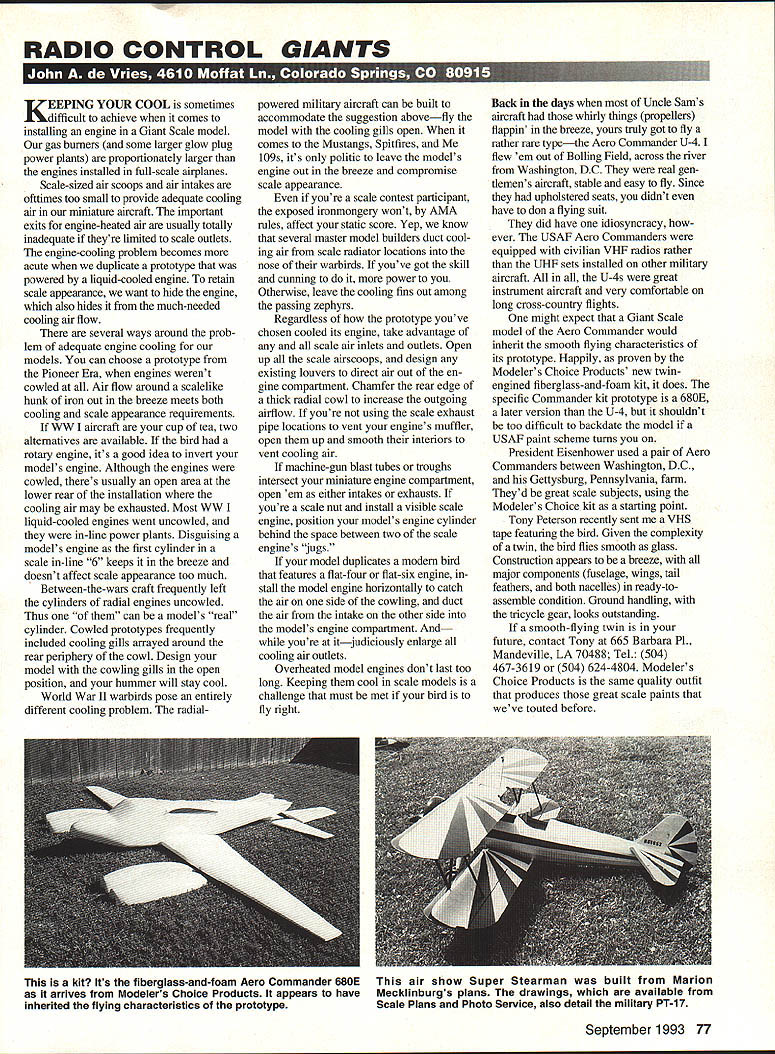
Modeler's Choice Products produces a twin-engined fiberglass-and-foam kit depicting a Commander 680E. The kit flies smoothly, and construction appears straightforward: major components (fuselage, wings, tail, and both nacelles) are in ready-to-assemble condition. The 680E can be backdated to a U-4 if you want a USAF paint scheme. President Eisenhower used a pair of Aero Commanders between Washington and his Gettysburg farm—great scale subjects.
For information, contact: Tony Peterson 665 Barbara Pl., Mandeville, LA 70448 Tel.: (504) 467-3619 or (504) 624-4804
Modeler's Choice Products is the same quality outfit that produces well-regarded scale paints.
HOME-PRINTED WATER-BASED DECALS
Old friend Bob Jacquot, who flies RC in Germany, sent a decal made with a computer, a desktop-publishing program, and a laser printer (a 24-pin dot-matrix will work nearly as well). He used decal paper supplied by LABCO:
LABCO 27563 Dover, Warren, MI 48093
A starter set of decal paper costs about $10. Print decals in black-and-white unless you have a color printer, then spray a couple of clear coats to fix them and make them fuel-resistant. Apply decals the usual way: dip in water and position them on the model. With thousands of typefaces available, making appropriate scale decals is easy for those with the necessary equipment.
DOC PEPINO — STEARMAN PT-17 PLANS & CATALOGS
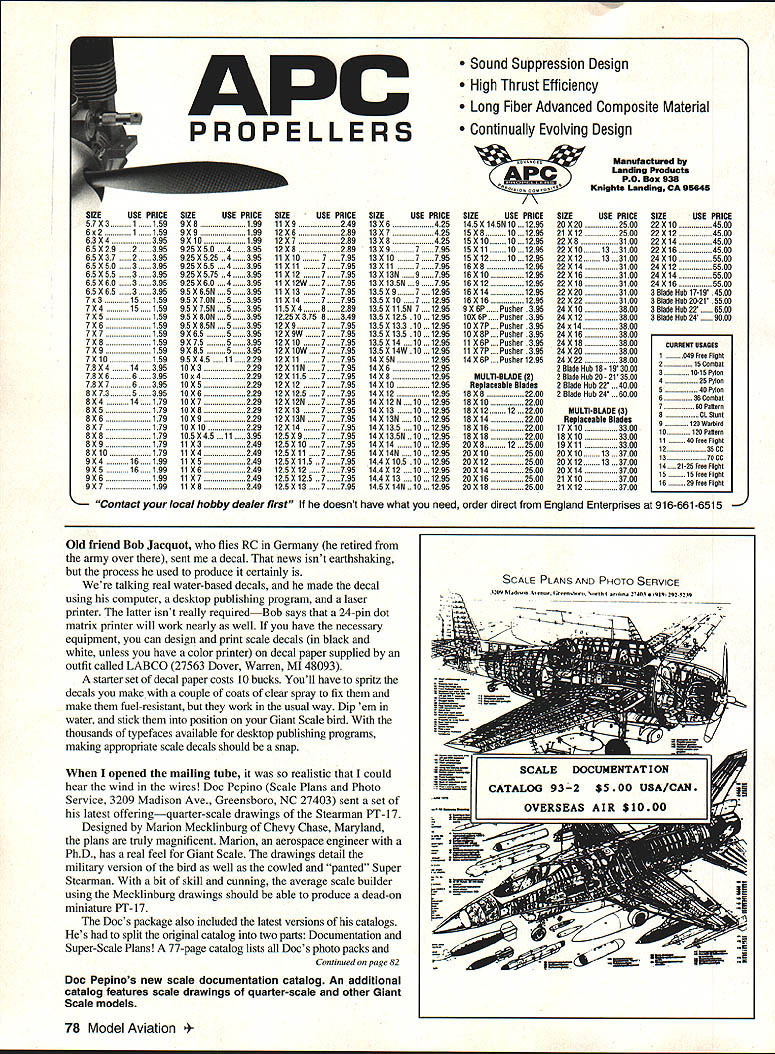
Doc Pepino (Scale Plans and Photo Service) sent quarter-scale drawings of the Stearman PT-17, designed by Marion Mecklinghury of Chevy Chase, Maryland. Marion, an aerospace engineer with a Ph.D., produced detailed drawings that include the military version as well as the cowled and "painted" Super Stearman. With these drawings, an average scale builder should be able to produce a very accurate miniature PT-17.
Doc also updated his catalogs, splitting the original into two parts: a documentation catalog and a Super-Scale Plans catalog. A 77-page documentation catalog lists photo packs and related materials; the additional catalog features scale drawings of quarter-scale and other Giant Scale models.
Doc Pepino 3209 Madison Ave., Greensboro, NC 27403
Transcribed from original scans by AI. Minor OCR errors may remain.

