
Radio Control: Giants
John A. de Vries
4610 Moffat Lane Colorado Springs, CO 80915
The dive is steep and the Giant Scale model is picking up airspeed. Faster and faster—it's time to pull out! The flier tugs gently on the transmitter's right stick, and the model begins to level out. A bit too much up elevator and then it happens. The wing folds and the tips clap hands. Gravity takes over, and what was once a beautiful flying creation becomes a random collection of shattered balsa, split plywood, and stripped servo gears strewn in disarray on the ground.
At the inevitable postmortem, we come to a common conclusion. Excessive G-forces caused the wing to fail at its center section. While the wing spars were adequate for straight and level flight, their strength was not sufficient for the pullout. The plywood doublers and, as is sometimes the case, the fiberglass "scab" weren't sufficiently strong to overcome the aerodynamic forces imposed on them. A lot of time, effort, and money went down the tubes!
The folding-wing scenario is all too common. We're all aware that the load on the wing of an aircraft in flight varies substantially across its span. The load is light toward the wing tips and increasingly heavy toward the wing's center. That's why designers of both full-scale and model airplanes must beef up the structure in the middle of the wing. In model design, plywood wing panel joiners and wing spar webbing are used to provide center-section strength. Sometimes it isn't enough.
In a moderate 5-G pullout, the typical 20-lb Giant experiences a hundred pounds of pressure on the wing's center section. That's a bunch, and only a hefty spar can endure that much pressure. When it doesn't, it's re-kitting time. I'd like to suggest a construction technique that may prevent wing folding—particularly for low- and mid-wing models. It's based on the use of steel or aluminum tubing for wing spars.
Tubular spars
For lighter Giants (less than 20 lb), aluminum tubing should be adequate. An interesting source for the spar may be found in the bath-supplies section of your friendly hardware store. Shower curtain rods made of thin-walled aluminum tubing work well as wing spars. For heavier birds, steel tubing in a number of diameters may be found at local airport/home-built airplane supply houses. Choose thin-walled tubes; look for chrome-moly material.
If you're buying tubular spars, pick up some stock tube with an inner diameter matching the outer diameter of the spar that will allow you to build plug-in wing panels if the model calls for it. Of course, if you go the tubular-spar route you'll have to modify wing ribs by drilling circular spar holes. A short length of spar material with the end sharpened and notched like a hole saw will make quick work of the task of cutting holes. Try to make a tight slip-fit spar. You'll need to use a few drops of cyanoacrylate glue to hold ribs in place permanently.
A tubular-spar wing panel center section should extend outboard about half the span of the wing panel. Beyond the mid-wing, nesting tubing of smaller diameters may be used toward the wing tip. This will provide the necessary spar strength while minimizing weight. In assembly, outboard spars may be pinned in place by drilling holes through the nesting tubes and inserting a bolt through, or epoxied together. If you use epoxy, make sure there's plenty of tubing overlap and the epoxy is evenly distributed.
Mounting and reinforcement
Mounting wing tubular spars to the fuselage of the model isn't difficult. Sailplane compatriots use the technique to attach high-aspect-ratio wing panels on silent fliers. Another short bit of tubing and a fixed plywood former will permit wing panels to plug into place. Whichever method you choose, make sure the spars meet at the center fuselage mount with spar ends dead-on square. You will have to devise a method to keep the panels from slipping outboard in flight. Wire hooks or rubber bands are adequate for lightly loaded, slow-flying sailplanes, but Giant Scale models require something substantial. Aircraft control cable bolted or welded to the wing spars, with a turnbuckle between panels, will keep the panels tight and flush against the fuselage with minimal weight penalty.
Old friend Bill Sheaves has used the tubular-spar center section technique for his B-17F Flying Fortress model. He went one step better and came up with a fascinating wing mount. Before he mounted the steel-tubing fuselage spar mount, he did two things: he split one side of the mount tube from end to end (with a circular saw), and silver-soldered two pairs of brackets to it on either side of the saw's kerf. The simple sheet-metal brackets included an Allen-head bolt hole on one side and a soldered-in-place nut on the other. After the wing panels are slipped in place, Bill can tighten the bolts, thus squeezing the mounting tube firmly around the spars. Like the man who wears a belt and suspenders, Bill went one step further and installed the aircraft-cable-turnbuckle system to be doubly sure that his wing panels will stay firmly in place.
Tools and small supplies
Don't know about you all, but yours truly is addicted to the use of dental instruments for a host of model-building purposes. I recently ran across a dental mirror that allows you to see obscure areas of your big bird, and forceps (hemostats) are just the thing for holding smaller parts in place while the glue dries. A set of those metal scrapers and picks that the dentist uses have many less painful functions when you're assembling a Giant. All of this song and dance is to note the availability of something called Pic-n-Stic from the Pulpdent Corp. (P.O. Box 780, Watertown, MA 02272-0780). These Pic-n-Stics are like sticky Q-Tips, and they're mighty handy for holding and positioning small parts. Servo screws and grommets, new engine gaskets—things like that—are often difficult to handle, and Pic-n-Stics keep 'em off the floor. Pulpdent says that they'll sell them direct to modelers. Price is $15.95 for 6" of them and they can be reused quite a few times. The price includes postage and handling.
Kits, plans, and resources
Many of the Giant Scale birds that you see on the local flying line are scratch-built from plans. The process, of course, takes time. The most satisfactory method for plans building is to make up a kit of the necessary parts before beginning actual construction—a tedious task at best. Chuck Gill comes to the rescue! His company, Airplane Works (2134 Gilbride Rd., Martinsville, NJ 08836) is kitting all of those great Nick Ziroli designs at reasonable prices. Chuck does all of the hard work and provides the parts with or without the associated set of drawings. If you want to get right to the building process, check with him (a big SASE will be appreciated).
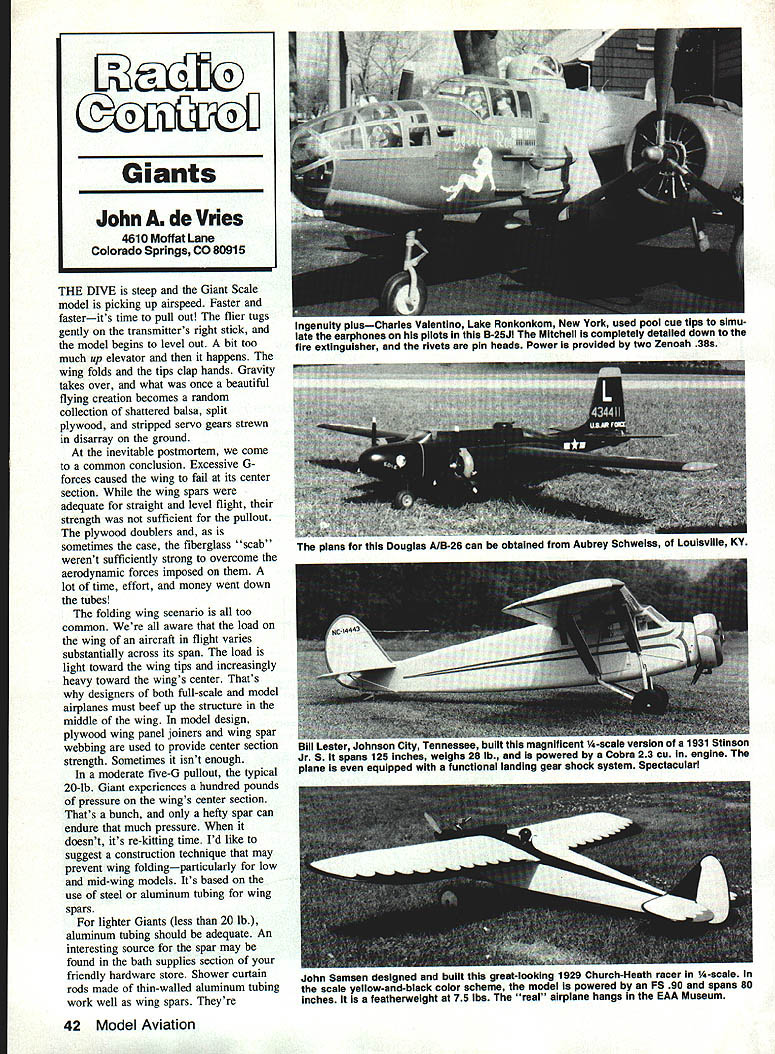
If you're looking for Giant Scale drawings, Douglas A/B-26 and other drawings are available from Aubrey C. Schweiss (135 Tanglewood Trail, Louisville, KY 40223). He has some neat drawings in 1/6 scale, along with a 1/4-scale SE.5A and a nifty 72-in.-span sport biplane.
The people at N.A.S.A. (National Association of Scale Aeromodellers) have recently completed a substantial update of their Scale Data Source List. As with the original publication, Claude McCullough put the latest revision together—so you know that it's authoritative. If you join the outfit, you'll get both publications as well as the association newsletter. Contact Bert Dugan, N.A.S.A. secretary/treasurer (11909 Phyllis Drive, Clio, MI 48420) for membership info.
Conclusion
It's nice to be back with you after a month's vacation. Keep on building and flying the big 'uns. They fly great!
Transcribed from original scans by AI. Minor OCR errors may remain.

