
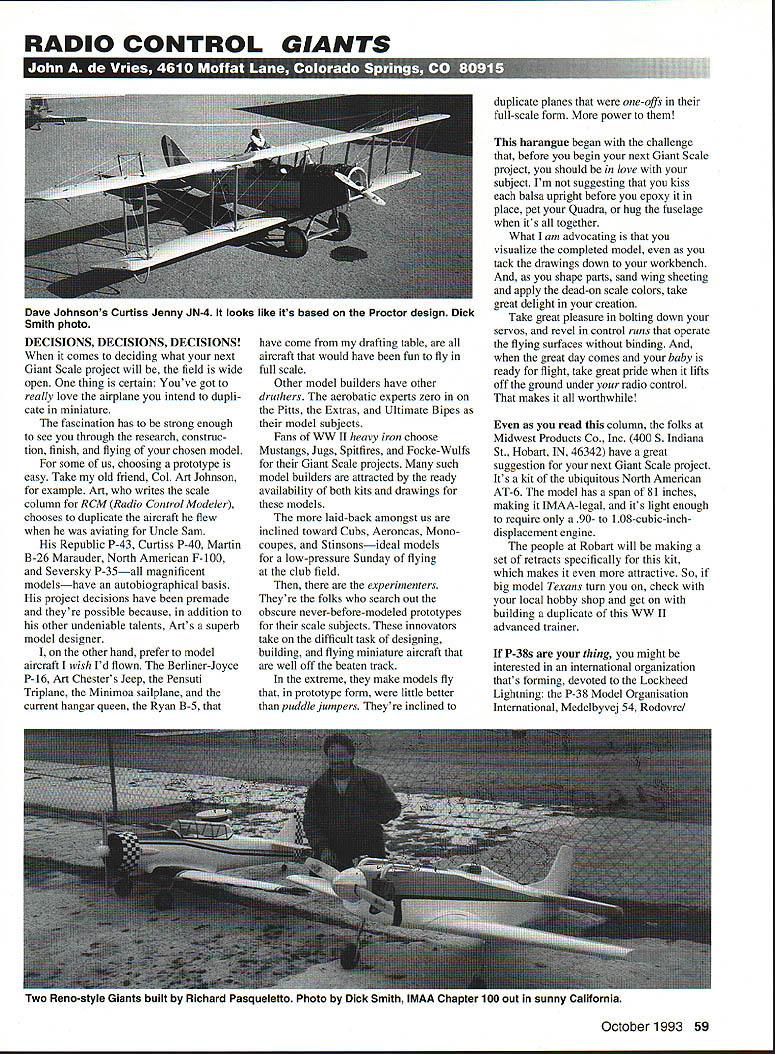
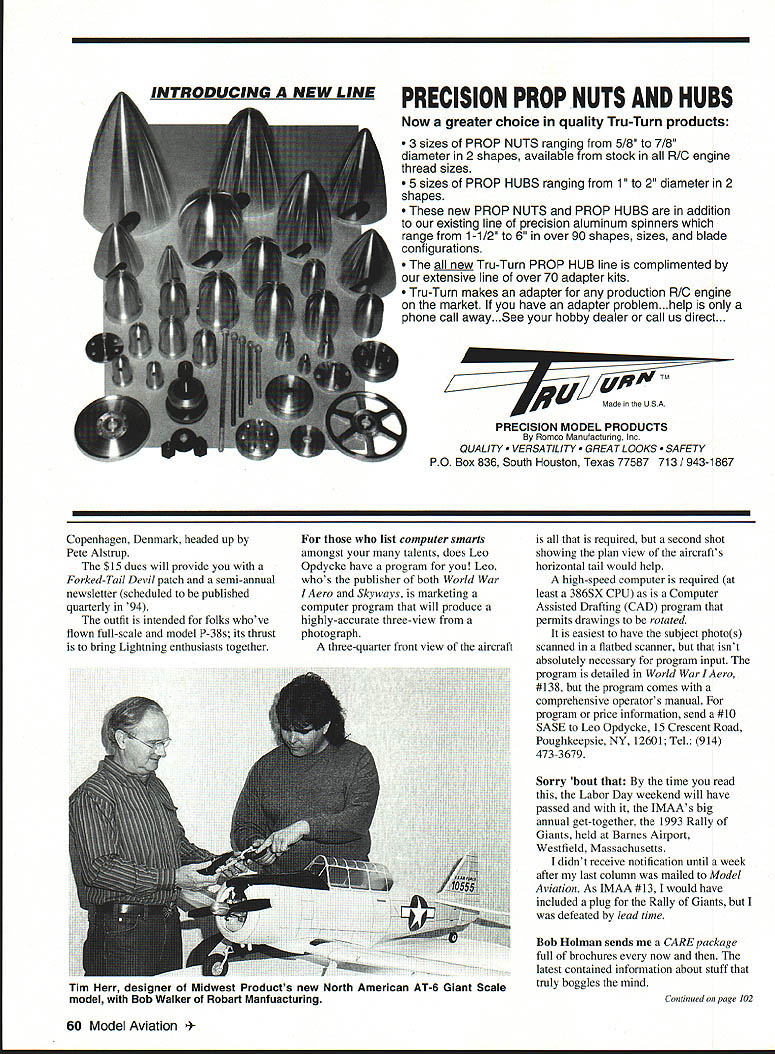
RADIO CONTROL GIANTS
John A. de Vries 4610 Moffat Lane, Colorado Springs, CO 80915
DECISIONS, DECISIONS, DECISIONS!
When it comes to deciding what your next Giant Scale project will be, the field is wide open. One thing is certain: you've got to really love the airplane you intend to duplicate in miniature.
The fascination has to be strong enough to see you through the research, construction, finish, and flying of your chosen model.
For some of us, choosing a prototype is easy. Take my old friend Col. Art Johnson, for example. Art, who writes the scale column for RCM (Radio Control Modeler), chooses to duplicate the aircraft he flew when he was aviating for Uncle Sam. His Republic P-43, Curtiss P-40, Martin B-26 Marauder, North American F-100, and Seversky P-35—all magnificent models—have an autobiographical basis. His project decisions have been pre-made and they're possible because, in addition to his other undeniable talents, Art's a superb model designer.
I, on the other hand, prefer to model aircraft I wish I'd flown. The Berliner-Joyce P-16, Art Chester's Jeep, the Pensuti Triplane, the Minimoa sailplane, and the current hangar queen, the Ryan B-5, that have come from my drafting table are all aircraft that would have been fun to fly in full scale.
Other model builders have other druthers:
- Aerobatic experts zero in on the Pitts, the Extras, and Ultimate bipes.
- Fans of WWII heavy iron choose Mustangs, Jugs, Spitfires, and Focke-Wulfs for their Giant Scale projects; many are attracted by the ready availability of kits and drawings.
- The more laid-back among us are inclined toward Cubs, Aeroncas, Monocoupes, and Stinsons—ideal models for a low-pressure Sunday at the club field.
- Then there are the experimenters. They search out obscure, never-before-modeled prototypes for their scale subjects and take on the difficult task of designing, building, and flying aircraft well off the beaten track. In the extreme, they make models fly that, in prototype form, were little better than puddle jumpers or one-offs in full scale.
This harangue began with the challenge that, before you begin your next Giant Scale project, you should be in love with your subject. I'm not suggesting that you kiss each balsa upright before you epoxy it in place, pet your Quadra, or hug the fuselage when it's all together.
What I am advocating is that you visualize the completed model, even as you tack the drawings down to your workbench. As you shape parts, sand wing sheeting, and apply dead-on scale colors, take great delight in your creation. Take great pleasure in bolting down your servos, and revel in control runs that operate the flying surfaces without binding. And, when the great day comes and your baby is ready for flight, take great pride when it lifts off the ground under your radio control. That makes it all worthwhile!
Projects and resources
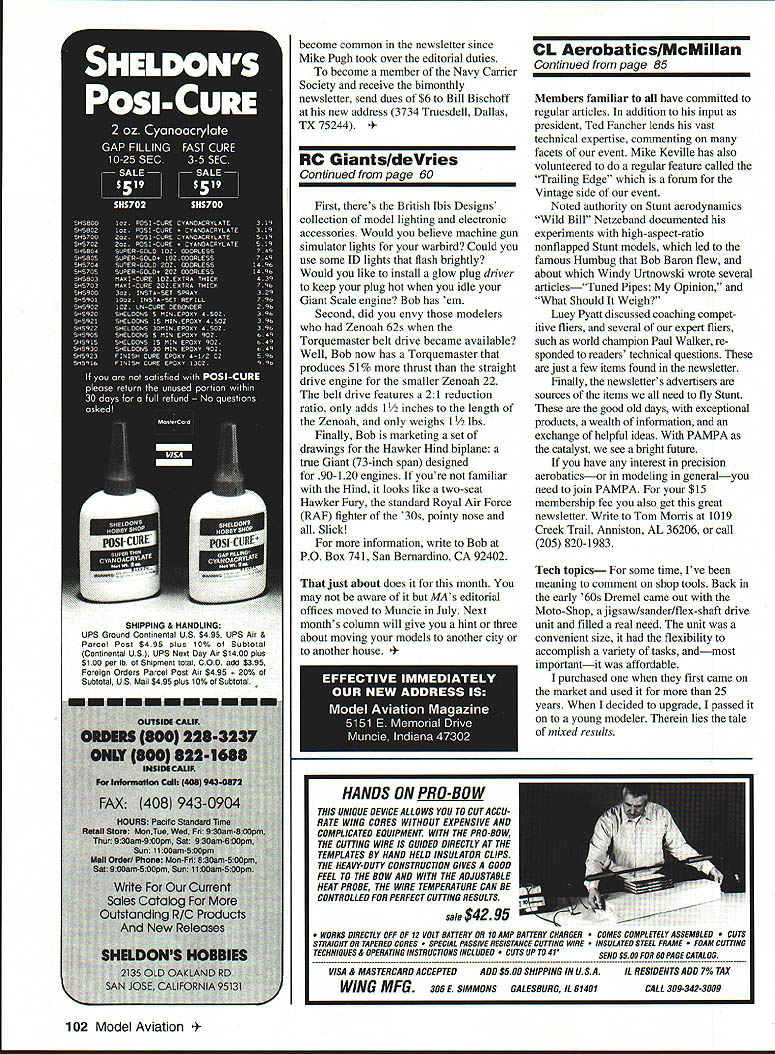
Even as you read this column, the folks at Midwest Products Co., Inc. (400 S. Indiana St., Hobart, IN 46342) have a great suggestion for your next Giant Scale project: a kit of the ubiquitous North American AT-6. The model has a span of 81 inches, making it IMAA-legal, and it's light enough to require only a .90- to 1.08-cubic-inch-displacement engine. Robart will be making a set of retracts specifically for this kit, which makes it even more attractive. If big model Texans turn you on, check with your local hobby shop.
If P-38s are your thing, you might be interested in an international organization that's forming, devoted to the Lockheed Lightning: the P-38 Model Organisation International, Medelbyvej 54, Rodovre/Copenhagen, Denmark, headed by Pete Aistrup. A $15 membership will provide a Forked-Tail Devil patch and a quarterly newsletter. The organization is intended for folks who've flown full-scale model P-38s; its thrust is to bring Lightning enthusiasts together.
List computer smarts among his talents, and Leo Opdycke has a program that will produce a highly accurate three-view from a photograph. A three-quarter front view of the aircraft is all that is required, but a second shot showing the plan view of the horizontal tail helps. A high-speed computer is required (at least a 386SX CPU) as is a Computer Assisted Drafting (CAD) program that permits drawings to be rotated. It is easiest to have the subject photo(s) scanned on a flatbed scanner, but that isn't absolutely necessary for program input. The program is detailed in World War I Aero, #138, and comes with a comprehensive operator's manual. For program or price information, send a #10 SASE to Leo Opdycke, 15 Crescent Road, Poughkeepsie, NY 12601; Tel.: (914) 473-3679.
By the time you read this, Labor Day weekend will have passed and with it the IMAA's big annual get-together, the 1993 Rally of Giants, held at Barnes Airport, Westfield, Massachusetts. I didn't receive notification until a week after my last column was mailed to Model Aviation. As IMAA #13, I would have included a plug for the Rally of Giants, but I was defeated by lead time.
Bob Holman sends me a CARE package full of brochures now and then. The latest contained information about items that truly boggle the mind:
- British Ibis Designs' collection of model lighting and electronic accessories. Machine-gun simulator lights for your warbird, ID lights that flash brightly, and a glow-plug driver to keep your plug hot at idle—Bob has them.
- A Torquemaster belt drive for the smaller Zenoah 22 that produces roughly 51% more thrust than the straight-drive engine. The belt drive features a 2:1 reduction ratio, only adds 1½ inches to the length of the Zenoah, and weighs about 1½ lb.
- A set of drawings for the Hawker Hind biplane: a true Giant (73-inch span) designed for .90–1.20 engines. If you're not familiar with the Hind, it looks like a two-seat Hawker Fury—the standard RAF fighter of the '30s—with a pointy nose.
For more information from Bob Holman, write P.O. Box 741, San Bernardino, CA 92402.
That just about does it for this month. You may not be aware of it, but Model Aviation's editorial offices moved to Muncie in July. Next month's column will give you a hint or three about moving your models to another city or to another house.
Transcribed from original scans by AI. Minor OCR errors may remain.

