
RADIO CONTROL GIANTS
By John A. de Vries
4610 Moffat Ln., Colorado Springs, CO 80915
ARF! ARF! ARF! No, it isn't my German shepherd Wolfgang barking to be let in. It's my reaction to the latest issue of modelSPORT Video Magazine, which includes an extensive demonstration of the "completion" of an ARF (Almost Ready-to-Fly) Midget Mustang.
As with other models of its ilk, the dogsbody work has been completed by the manufacturer, and the "fiddly bits" are left to the model builder. The ads read, "just install your radio and engine—and you're ready to fly."
No criticism is intended, but there's a great deal of labor to be exercised—even with the most sophisticated ARF. Part of the problem is that most ARFs are precovered. Therefore, stuffing your servos into the covered wing (before you've joined the wing halves) requires rather complex measuring. You have to dig into the already prepared place to find the aileron servo wells.
The same exacting bit of cutting will be required to find the exit points for rudder and elevator pushrods, after you've bolted your fuselage servos into the built-in servo tray.
Locating the engine on the bare plywood firewall will also be a challenge. If you were building the model from a kit or from scratch, you would have installed the engine mounts before you installed the firewall! The blind nuts could easily be installed to hold the mount—you could get to them without having to reach into the blind cavity of the covered fuselage.
It would also be much easier to install the fuel tank in the kit- or scratch-built model. With the ARF, it has to be fished through the dark hole forward of the wing(s).
If your ARF has a premolded cowling, it will be tough to locate the hole for the glow-plug driver and the aperture for the needle valve.
The Midget Mustang featured in the videotape has a particularly attractive way of handling this problem. A clear plastic partial cowl is furnished, and it can be pinned in place. Marking the necessary holes is a snap, and transferring them to the fiberglass cowling is even easier, since the clear part fits directly over it.
I'm not knocking ARFs; I'm all for them. They certainly have their place in the great scheme of RC. I just want to make sure you understand that you'll have to do some work before your new ARF model is ready to take out to the club field.
modelSPORT Video Magazine and Giant Scale Coverage
Speaking of modelSPORT tapes, the current edition (MS0303) does include a Giant Scale portion. There are some short shots of the Madera (CA) races, which are truly fascinating. I was surprised at the large size of the expensive models. If you're interested in a great video, the address is:
- modelSPORT Video Magazine, Box 12557, Jacksonville, NC 28546.
Curtiss-Reid Biplane — Ray Gareau (Canada)
Canadian scale modeler Ray Gareau sent some interesting photos of his current project—a Curtiss-Reid biplane. The prototype was a sesquiplane, with a vestigial lower wing. Ray is the model's designer, builder, and, probably by this time, flier.
Of great interest are the following features:
- Wing trailing edges and wingtips formed from pieces of wire clothes-hanger.
- Scale instrument panel made from walnut veneer.
- Tail feathers laminated from balsa/walnut strips.
- Possible fiberglass cowling under consideration.
- All bellcranks mounted with ball bearings to smooth out their action.
- Wing spars are carbon-fiber tubes (duplicating the aluminum tubing spars of the prototype).
- Tail skid "cheat": a small steerable wheel made from a rubber O-ring.
- Exhaust pipe braced with parts from an old typewriter; many other parts of the model were made from the same machine.
- Fuel fed by two five-ounce hair-dye bottles arranged in series.
Giant Scale Condor — Inquiry from William Pfannenstiel
William Pfannenstiel (14405 Inca Ct., Westminster, CO 80020) has a problem. He purchased a Giant Scale Condor model at an auction. He thinks the aircraft is of European origin—probably French—but he isn't sure. William would like some information about the model—particularly the specific location for the center of gravity.
If you can help with the model's derivation, contact William at (303) 920-0280.
Frank Beatty — Scale Projects
Old friend Frank Beatty of Granite City, Illinois is still at it—designing and building gorgeous scale models.
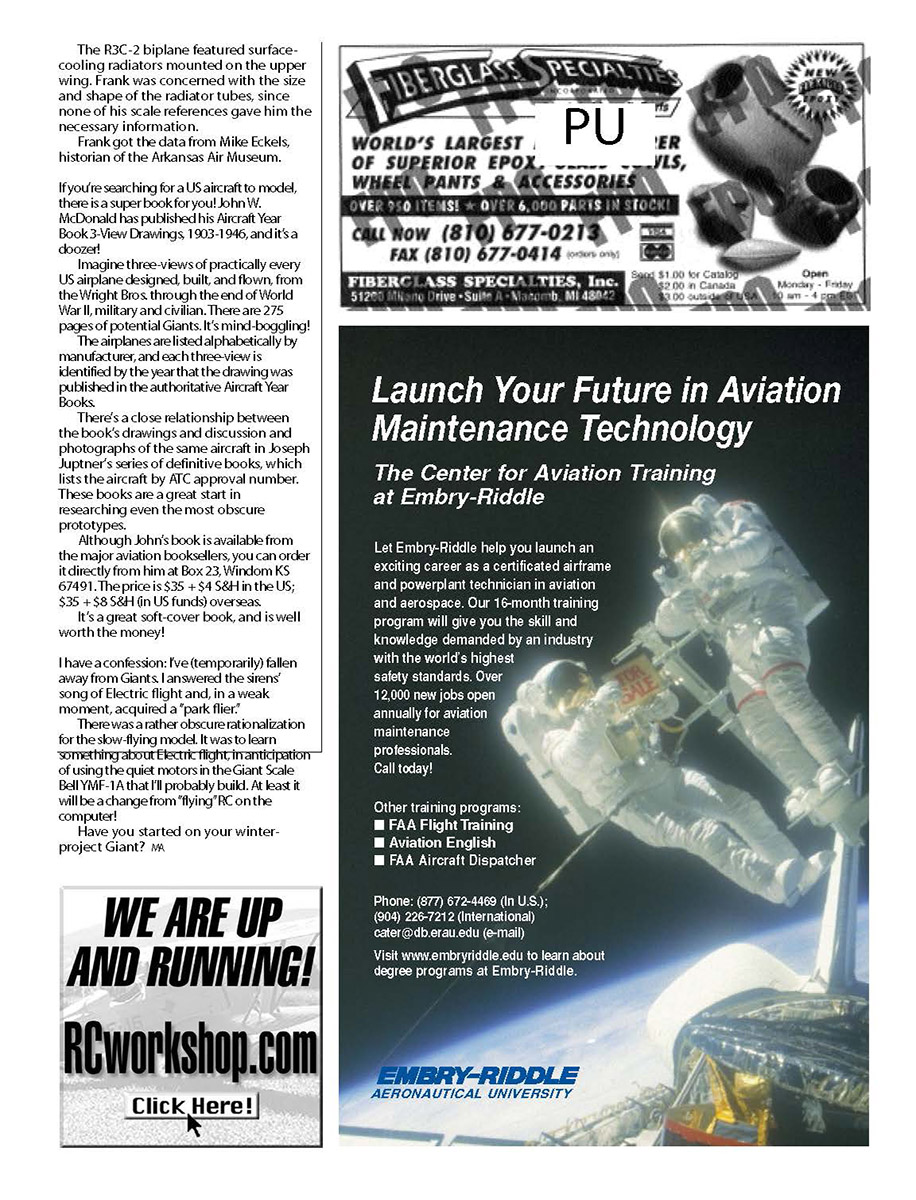
Frank's latest project is a Rose Parakeet, as modified in prototype form by Richard Borg in 1980. Richard was most cooperative in Frank's modeling effort, and he provided a host of photos and drawings of this stunning biplane.
The model is built to 2½ inches = 1 foot scale, and is painted with Brodak dope—Ag-Cat Yellow matches the prototype scheme perfectly. Frank built up a scale propeller using 1/32" basswood laminations, and he had the model's markings duplicated with custom-made decals.
My last contact with Frank was regarding a Curtiss racer he was designing. The R3C-2 biplane featured surface-cooling radiators mounted on the upper wing. Frank was concerned with the size and shape of the radiator tubes, since none of his scale references gave him the necessary information. Frank got the data from Mike Eckels, historian of the Arkansas Air Museum.
Aircraft Reference Recommendation
If you're searching for a US aircraft to model, there is a superb book for you! John W. McDonald has published his Aircraft Year Book 3-View Drawings, 1903–1946, and it's a doozer!
Imagine three-views of practically every US airplane designed, built, and flown from the Wright brothers through the end of World War II, military and civilian. There are 275 pages of potential Giants. The airplanes are listed alphabetically by manufacturer, and each three-view is identified by the year that the drawing was published in the authoritative Aircraft Year Books.
There's a close relationship between the book's drawings and the discussions and photographs of the same aircraft in Joseph Juptner's series of definitive books, which list aircraft by ATC approval number. These books are a great start in researching even the most obscure prototypes.
Although John's book is available from the major aviation booksellers, you can order it directly from him at:
- John W. McDonald, Box 23, Windom, KS 67491.
- Price: $35 + $4 S&H in the U.S.; $35 + $8 S&H (in U.S. funds) overseas.
It's a great soft-cover book and is well worth the money!
Confession: Electric Flight
I have a confession: I've (temporarily) fallen away from Giants. I answered the siren's song of electric flight and, in a weak moment, acquired a "park flier."
There was a rather obscure rationalization for the slow-flying model. It was to learn something about electric flight, in anticipation of using the quiet motors in the Giant Scale Bell YMF-1A that I'll probably build. At least it will be a change from "flying" RC on the computer!
Have you started on your winter-project Giant? MA
Transcribed from original scans by AI. Minor OCR errors may remain.

