
RADIO CONTROL GIANTS
John A. de Vries 4610 Moffat Ln., Colorado Springs CO 80915
WHEN YOU DECIDE to "import" a new kit, radio, or engine into the home, you might expect to be berated by your husband or wife. "You spent that much—on a model airplane?" might be the usual reaction.
However, things will (usually) be all hearts and flowers if you bring a new tool into the mansion. And there are many tools required to build your new Giant Scale model. Let's take a look at which tools will help create the new airplane.
Safety equipment
The first purchase should be a pair of safety glasses or a plastic safety hood. The former will fit over your reading glasses (if you have to wear them), and the latter protects your whole face from errant bits of wood or metal.
You probably already own a set of X-Acto knives, so you don't have to purchase them. But it's nice to have a small box of new #11 blades, so you can keep things sharp.
Cutting and grinding
The next item in relative importance is a Dremel rotary hand grinder—particularly if you also purchase a sanding mandrel. There are actually three versions of the rotary grinder, and each has multiple uses:
- the standard multispeed hand tool
- the miniature battery-powered twirler
- the hand piece with a flexible drive shaft (the last one works great when you have to work on something inside your model)
A 90° attachment will help if you have to grind around a corner.
If you're a skilled woodworker or metalworker, and you have the wherewithal, a Taig or Unimate lathe will provide all the neat cylindrical wood or metal bits and pieces for your model. If you have the dollars, the milling attachment for your lathe will be more than useful.
Small power tools
There is a host of small-size power tools that can make your building tasks easier. They include:
- band saws
- jigsaws
- power sanders
Most only take up a little room on your workbench, and they save you a lot of work. These powered helpers often combine functions. Small band saws and jigsaws provide circular sanders as part of the tool. Adhesive-backed sanding disks can be acquired, and they provide a variety of grits for shaping and smoothing.
There are some fine small drill presses available, and they're just the thing to assure that drilled holes are dead-on straight and properly located. It's nice to have a press with variable speeds, since drilling plastic has to be done slowly (to keep things from melting) and drilling wood and metal has to be done quickly.
Hand tools and small hardware
Your toolbox probably holds a variety of screwdrivers (including a set of small watchmakers' drivers) and razor saws. These stiff-backed steel saws are great when they're used with a miniature miter box—particularly if you're trimming 1/4-inch square spruce for fuselage longerons or thick spruce wing spars.
You probably noticed that I haven't mentioned hammers. They aren't necessary, but having a small one handy will help firm up the pins you might use in the construction process or make sure that blind nuts are firmly seated into the plywood firewall.
A small (25- to 30-watt) soldering iron may be necessary—particularly if you're adept at making long aileron servo leads. And there are times when a small soldering torch (one that takes fuel and oxygen cylinders) is required, such as when you silver-solder music wire landing-gear struts.
Flight box and fire safety
Many tools are needed in your flight box, but I won't list them all at this time. However, one item should absolutely be in the field box: a portable fire extinguisher. It's mandatory if you're operating a gas-burner in your Giant Scale model. Keep the extinguisher handy in your workshop as well—you can never tell if your torch or soldering iron will ignite the building materials or adhesives you keep on the workbench.
ARFs and alignment
Given the geometric increase of Almost Ready-to-Fly models (ARFs), particularly in larger sizes, this discussion of tools may be academic. With the possible exception of a power drill press or a Dremel tool, most ARFs can be completed with the simplest hand tools. A steel ruler might be of use to check wing and stabilizer alignment if you're going "ARFing."
I don't know if you've noticed it, but almost all of the radio-control magazines are running reviews of ARFs. U.S. and British magazines have welcomed them with open arms, as have a host of modelers.
Reader letter
I got an interesting letter from William D. Schierman, who lives in Creve Coeur, MO. At the tender age of 74, he noted that he built a Denny Condor rubber-powered free-flight model for his granddaughter. (I mentioned the Condor in the October 2000 column.)
William is a devoted Giant Scaler who uses the "old technique" of covering his models with fabric and dope. However, he has a problem with his radio. He has an Ace single-stick transmitter, and is having difficulties upgrading his RC system to current standards.
Bob Banka's Aircraft Documentation
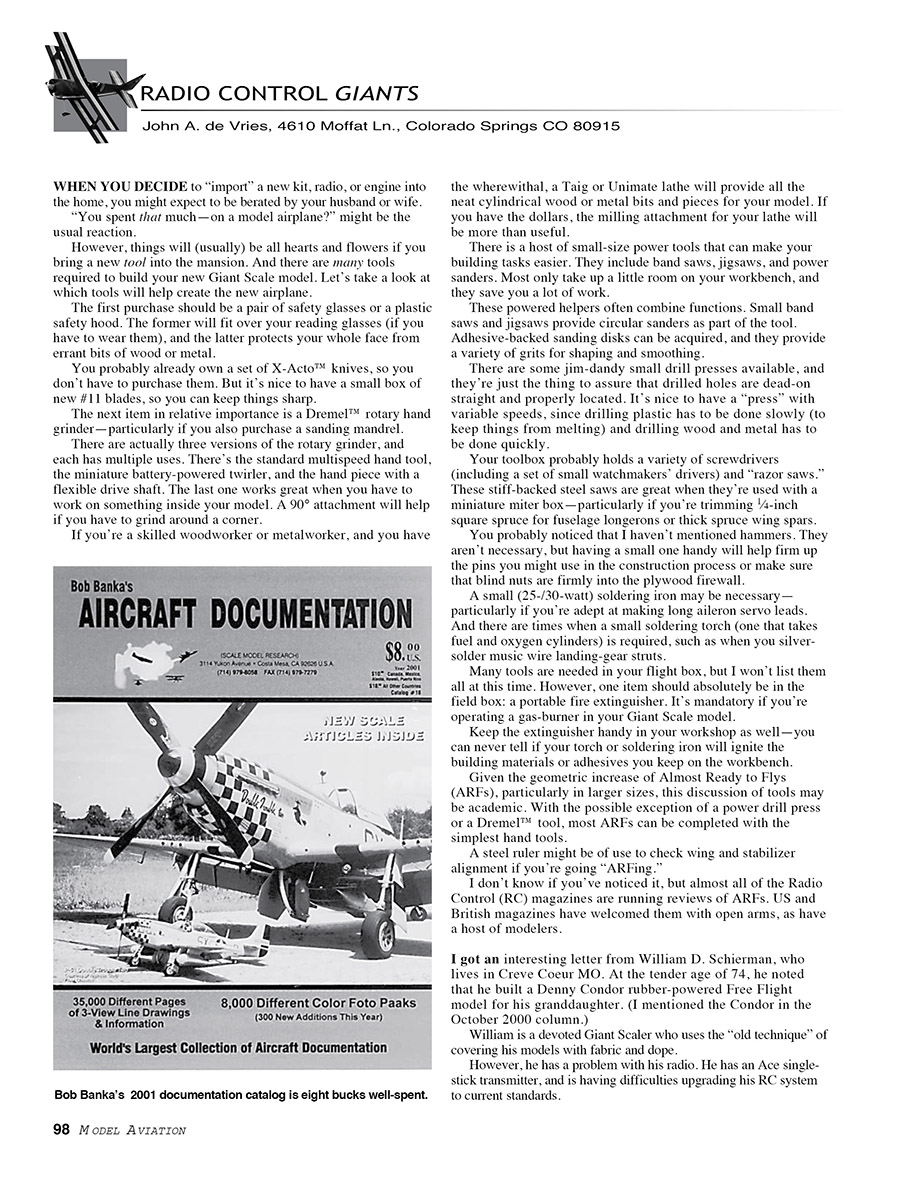
Ol' buddy Bob Banka has changed the name of his company. It used to be Scale Model Research; now it's Bob Banka's Aircraft Documentation—and he has a lot of it!
Bob has more than a half-million prints in stock! They're part of his 8,000 "Foto Paaks." His documentation photographs are true works of art, and they are designed for the scale model builder. Many of the Paaks include cockpit shots and detailed external coverage.
Probably the greatest value in scale documentation is Bob's latest (#18) catalog. It's only eight bucks postpaid, and includes definitive articles on scale modeling and a listing of all the photos and scale drawings in his inventory.
Now Bob's catalog and his other documentation can be paid for by credit card (MasterCard and Visa). Bob Banka's Aircraft Documentation is at 3114 Yukon Ave., Costa Mesa CA 92626. The telephone number is (714) 979-8058.
Parting Shot:
I wonder who the first Giant Scale modeler will be to adapt the colorful plastic wheels from one of the new aluminum scooters. And will he or she choose the green ones, the yellow ones, or the red ones?
I guess it will depend on the model's color scheme.
I sure hope the April showers won't affect the first test flights of your winter's Giant Scale project. Happy landings! MA
Transcribed from original scans by AI. Minor OCR errors may remain.

