
RADIO CONTROL GIANTS
Sal Calvagna 1335 Broadway Ave., Holbrook NY 11741 E-mail: ncalvagn@suffolk.lib.ny.us
In the July 2003 Radio Control (RC) Giants column, I wrote about the Sirius SuperTest from Peak Electronics. I referred to the SuperTest as a cycler. George Joy, "the Sirius Charger guy," wrote to thank me for the coverage in the column and informed me that the SuperTest is not a cycler, but a precision battery tester that only discharges batteries.
In the same column, while describing the ACE Dual Digital Variable Charger, I wrote that the output is adjustable from 5 mAh (milliampere-hours) to 500 mAh in 5 mAh increments. What I should have written was that the output is adjustable from 5 mA (milliamperes) to 500 mA in 5 mA increments. This certainly proves what my wife has been telling me for years: that I am far from perfect!
ARF Bashing:
Most of us know what kit-bashing is. For those who do not, it is the practice of making significant changes to a model kit during construction so that it looks like something else when it is finished. With the proliferation of Almost Ready-to-Fly (ARF) models, there are modelers who just won't leave well enough alone.
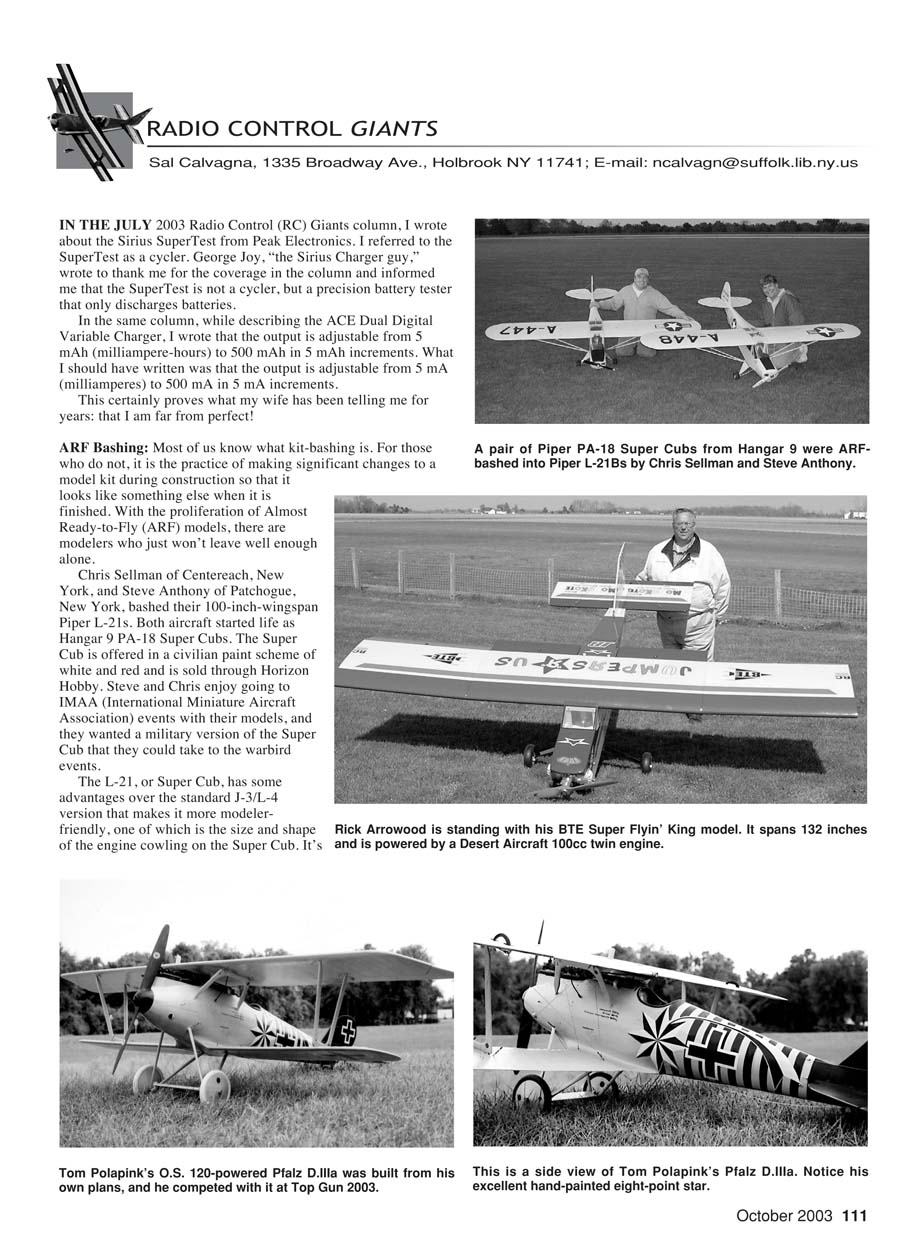
Chris Sellman of Centereach, New York, and Steve Anthony of Patchogue, New York, bashed their 100-inch-wingspan Piper L-21s. Both aircraft started life as Hangar 9 PA-18 Super Cubs. The Super Cub is offered in a civilian paint scheme of white and red and is sold through Horizon Hobby. Steve and Chris enjoy going to IMAA (International Miniature Aircraft Association) events with their models, and they wanted a military version of the Super Cub that they could take to the warbird events.
The L-21, or Super Cub, has some advantages over the standard J-3/L-4 version that make it more modeler-friendly, one of which is the size and shape of the engine cowling on the Super Cub. It's larger—more specifically, wider—which allows for a broader range of engine installations. It's nicer-looking to have an engine installed within a cowling where you do not have to hack up the cowling to accept the engine. Another advantage is that the Super Cub PA-18/L-21 has flaps. If you have flown a model with flaps, you know how much fun it is to change the aircraft's flight characteristics using them. This airplane is also an excellent flap trainer for those who are graduating from a four-channel model to a five-channel model.
Some of the changes Chris and Steve made to the ARF model included:
- Removal of red paint from the WorldTex covering using acetone.
- Removing covering material to make the greenhouse cockpit.
- Installing Robart 1/4-scale Cub landing gear.
- Repainting with acrylic latex paint available from The Home Depot and clear-coating with Krylon satin clear.
- Adding graphics from Major Decals and Rockin' Rose Grafix.
Chris powered his L-21 version with a Zenoah G-23, and Steve used a Zenoah G-38 to power his. Both engines were easy to install and both models fly well with their gas-burner power plants. Steve chose the G-38 because he also uses the L-21 as a glider tug. He says that he has no problem towing gliders as large as 4 meters in span and weighing 12 pounds.
Both L-21s were finished in the paint scheme of an L-21B owned by the North Coates Flying Club in England. Chris and Steve did a wonderful job with the conversion from the PA-18s to L-21s. They both agree that the ARF-bashing project and flying the L-21s are great fun.
Building on the success of the full-scale J-3 Cub, the tandem-seat PA-18 Super Cub featured a stronger airframe, additional fuel tanks, and a much larger engine. The Super Cub was ordered in large numbers by the US Army as the L-21 for liaison and observation duties. The Army began receiving them in 1953 and the last one was delivered in 1959.
Roughly 7,500 Super Cubs had been built when Piper decided to suspend production in 1981. A year later more were built for a Texas company, and 250 were eventually delivered by 1988. Limited production continued into the 1990s, and the last new airplane was delivered in 1995. The Super Cub is one of the longest-produced light aircraft in the world.
If you are interested in more information on the Super Cub ARF from Hangar 9, visit the Horizon Hobby Web site at www.horizonhobby.com.
Super Flyin' King
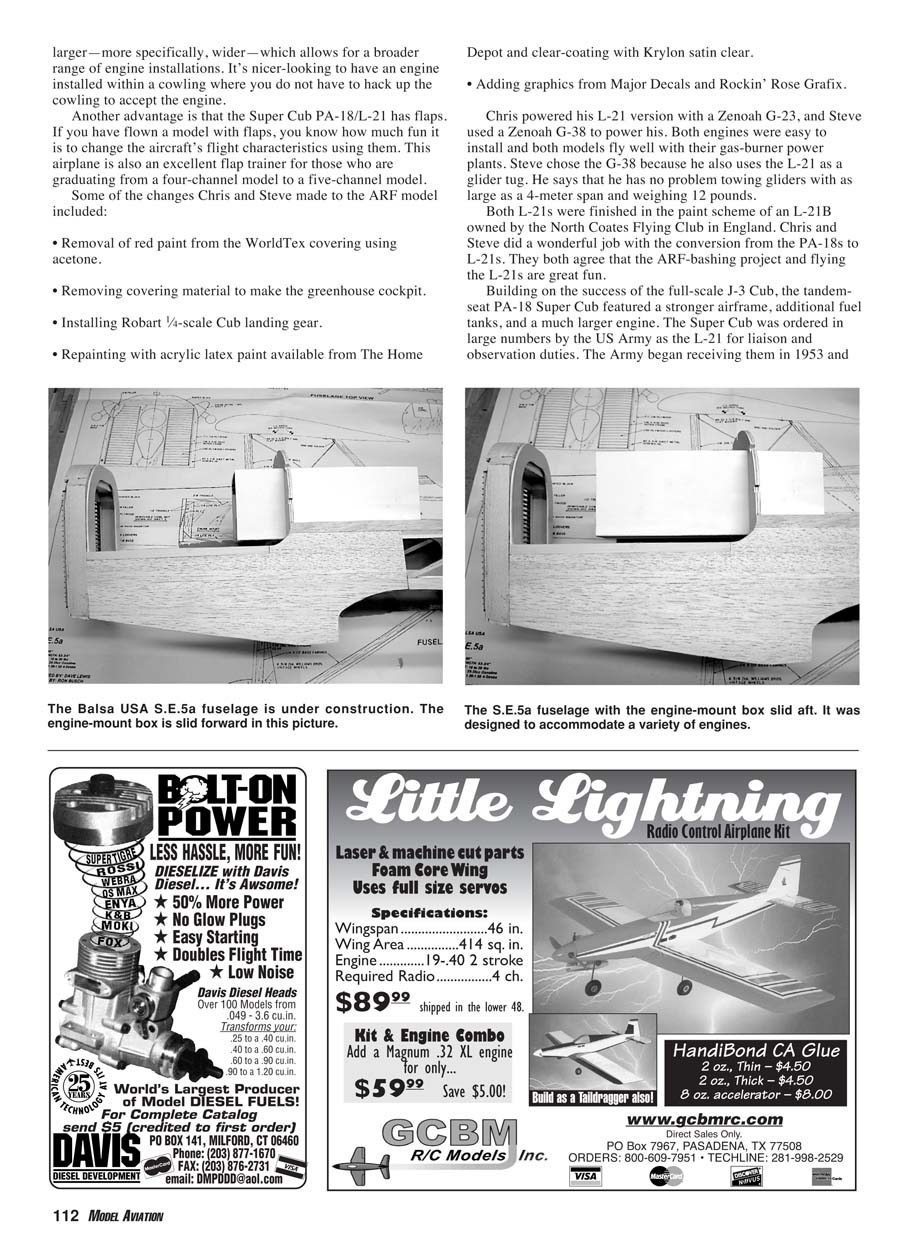
Rick Arrowood of Troy, Ohio, sent a photograph of his Super Flyin' King which was built from a Bruce Tharpe Engineering (BTE) kit. The model spans 132 inches and has a wing area of 3,380 square inches. It weighs 37 1/2 pounds and is powered by a Desert Aircraft 100cc twin gas engine swinging a 27 x 10 propeller. The kit comes with a pre-bent aluminum landing gear and 7-inch Sullivan wheels.
Rick uses high-torque metal gear servos, dual receivers, and two SR Batteries 2200 mAh receiver battery packs. Rick also installed a smoke system and a 50-ounce smoke tank. The model is covered in MonoKote which Rick says is "the modeler's number one covering choice." The graphics were made by Kirby's Kustom Vinyl Graphics.
The juvenile theme—Jumpers & 'Us—is a play on words that explains the main purpose of the model. It drops a 21-inch tall, 4 1/4-pound precision paratrooper that has a 59-inch-wide parasail. The jumper is also radio controlled. Rick says that in the future he plans to pull banners and sailplanes, take photos and videos, and drop candy.
At the Toledo Expo 2003, the Super Flyin' King took second place in the Sport Mono Plane competition and third place in the Best MonoKote class. It looks as though Rick has plenty of fun with his Super Flyin' King model! Great covering job!
For more information about this model and other BTE models, visit the company's Web site at www.btemodels.com or call (800) 557-4470.
Pfalz D.IIIa (Tom Polapink)
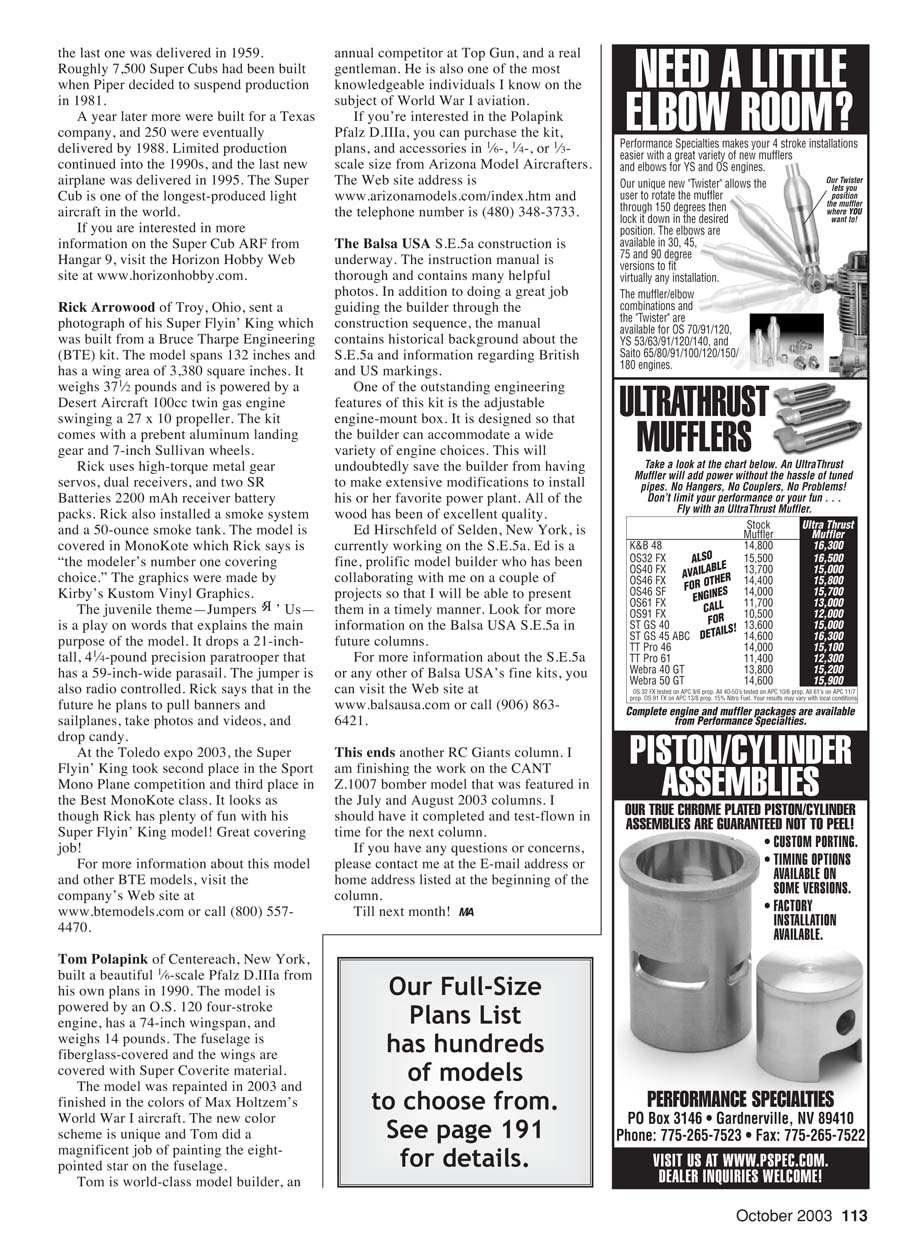
Tom Polapink of Centereach, New York, built a beautiful 1/6-scale Pfalz D.IIIa from his own plans in 1990. The model is powered by an O.S. 120 four-stroke engine, has a 74-inch wingspan, and weighs 14 pounds. The fuselage is fiberglass-covered and the wings are covered with Super Coverite material.
The model was repainted in 2003 and finished in the colors of Max Holtzem's World War I aircraft. The new color scheme is unique and Tom did a magnificent job of painting the eight-pointed star on the fuselage.
Tom is a world-class model builder, an annual competitor at Top Gun, and a real gentleman. He is also one of the most knowledgeable individuals I know on the subject of World War I aviation.
If you're interested in the Polapink Pfalz D.IIIa, you can purchase the kit, plans, and accessories in 1/6-, 1/4-, or 1/3-scale size from Arizona Model Aerocrafters. The Web site address is www.arizonamodels.com/index.htm and the telephone number is (480) 348-3733.
Balsa USA S.E.5a
The Balsa USA S.E.5a construction is underway. The instruction manual is thorough and contains many helpful photos. In addition to doing a great job guiding the builder through the construction sequence, the manual contains historical background about the S.E.5a and information regarding British and US markings.
One of the outstanding engineering features of this kit is the adjustable engine-mount box. It is designed so that the builder can accommodate a wide variety of engine choices. This will undoubtedly save the builder from having to make extensive modifications to install his or her favorite power plant. All of the wood has been of excellent quality.
A modeler of Selden, New York, is currently working on the S.E.5a. He is a fine, prolific model builder who has been collaborating with me on a couple of projects so that I will be able to present them in a timely manner. Look for more information on the Balsa USA S.E.5a in future columns.
For more information about the S.E.5a or any other of Balsa USA's fine kits, you can visit the Web site at www.balsausa.com or call (906) 863-6421.
This ends another RC Giants column. I am finishing the work on the CANT Z.1007 bomber model that was featured in the July and August 2003 columns. I should have it completed and test-flown in time for the next column.
If you have any questions or concerns, please contact me at the E-mail address or home address listed at the beginning of the column.
Till next month! MA
Transcribed from original scans by AI. Minor OCR errors may remain.

