
RADIO CONTROL GIANTS
Sal Calvagna, 1335 Broadway Ave., Holbrook NY 11741; E-mail: ncalvagn@suffolk.lib.ny.us
Kangke Super Kraft 96-inch Wingspan — 1/4-scale Rearwin Speedster (ARF)
Several months ago I wrote a construction article on the Kangke Industrial USA, Inc. Super Kraft 96-inch-wingspan, 1/4-scale Rearwin Speedster ARF. The write-up appeared in two successive columns, with the flight report appearing much later in the year because of poor weather conditions. Now, having logged more than a few hours on the Speedster, I feel compelled to share my observations on this outstanding model.
During the construction phase it was suggested that I install a 50cc gas engine to appreciate the aerobatic qualities this model possesses. The model was designed with a fully symmetrical, thick airfoil and large, movable surfaces for aerobatic flight performance.
Since I did not have a 50cc engine laying around, I borrowed a Zenoah G-45 from a good friend. The G-45 really pulled the Rearwin around, but the cold, blustery winter-weather conditions and a problem with the carburetor kept the model grounded for a time. A busy spring and summer at work and other ongoing projects prevented me from returning to the Rearwin until late summer.
Finally, during the dog days of August, I decided to yank out the G-45 and return it to my patiently waiting friend. Then I installed a Zenoah G-38 that I had sitting around. I have always been partial to the G-38s because they are truly reliable and easy to operate. Because the Speedster has a narrow cowling, the rear exhaust of the G-38 made installation simple. As a bonus, I did not have to hack apart the cowling. I knew the G-38 would have no problems flying the Rearwin, and I wasn't really interested in performing torque rolls with the model anyway.
As it turns out, the G-38 has more than enough power and the Rearwin's flight characteristics are truly outstanding. With a thick, fully symmetrical wing and light wing loading, the model has a magnificent flight envelope. From super-slow passes at nearly idle to high speed at full throttle, it is a joy to pilot.
The airplane is extremely maneuverable and has no problem performing aerobatics. Even at a dead-slow pace, the control surfaces are effective. Since I don't trust my own conclusions, I made sure that anytime I brought the model to the field, I passed the box to anyone who was interested in flying the Rearwin. All who flew it agreed that this model is an outstanding-flying machine.
Ground handling was equally superb. If you would like to replicate what I have in my Rearwin, my G-38 has a B&B Specialties cup mount and dual-stack muffler. It powers a Zinger 18 x 8 propeller. I used five Futaba S3305 metal-gear, heavy-duty servos that produce 99 ounces of torque at 4.8 volts and 124 ounces at 6.0 volts. There is one servo on each aileron, one for the rudder, and two for the elevators. I used a standard servo for the throttle. Since the elevator servos are installed in the rear of the fuselage, I used a Maxx MPI Miracle reversing Y harness so that the elevator halves travel in the same direction. I used a regular Y harness for the ailerons.
I have an SR Batteries 2200 mAh, 4.8-volt receiver battery pack installed under the stock fuel tank. With this setup, the model is slightly nose-heavy, which is perfect. No additional weight was added.
My hat is off to Kangke Industrial and those who are involved with the design of the Rearwin Speedster.
For more information about the Rearwin:
- Web: www.kangkeusa.com
- Phone: (877) 203-2377
- Mail: Kangke Industrial USA, Inc., 65 E. Jefryn Blvd., Deer Park NY 11729
Jerry Bates Plans
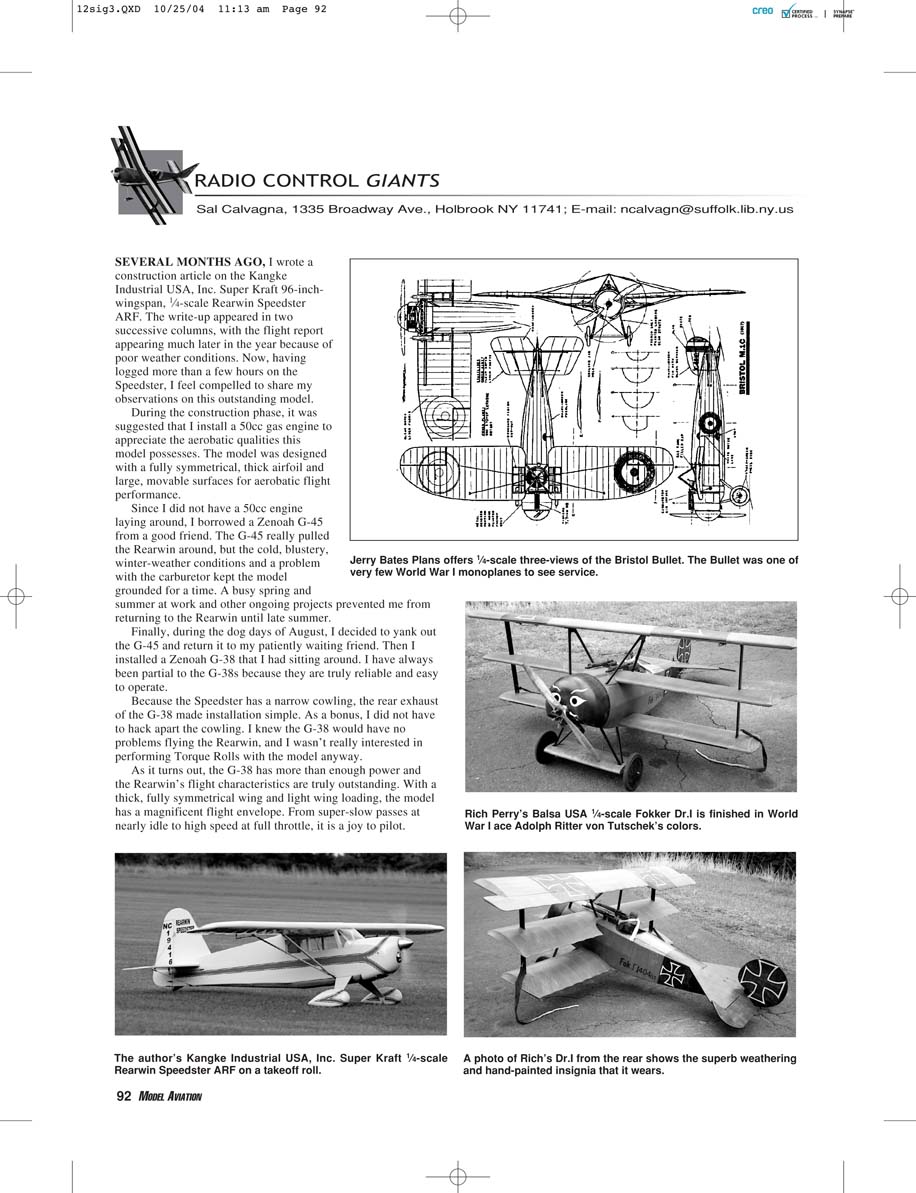
Jerry Bates of Mobile, Alabama, has acquired the rights for seven plan sets designed by Robert Swetizer, who has long been known in the Scale community for his design, drafting, and graphic presentations. The following new plans can be purchased from Jerry Bates Plans:
- Zlin Z-37 Cmelak — wingspan 57 inches
- Druine D.31 Turbulent — wingspan 58.25 inches
- Giant Astro-Hog — wingspan 90 inches
- Sequoia Aircraft Corp. F.8L Super Falco — wingspan 78.75 inches
- Bristol M.1C Bullet — wingspan 92.25 inches
- Stearman 4E-4EM — wingspan 76 inches
- Ryan PT-22 (Navy NR-1) — wingspan 90 inches
For more information on any of Jerry Bates' plans and accessories:
- Web: www.scalareco.com/jerrybates.htm
- Phone: (251) 478-6720
- Mail: Jerry Bates Plans, 102 Glenwood St., Mobile AL 36606
Rich Perry's First Giant
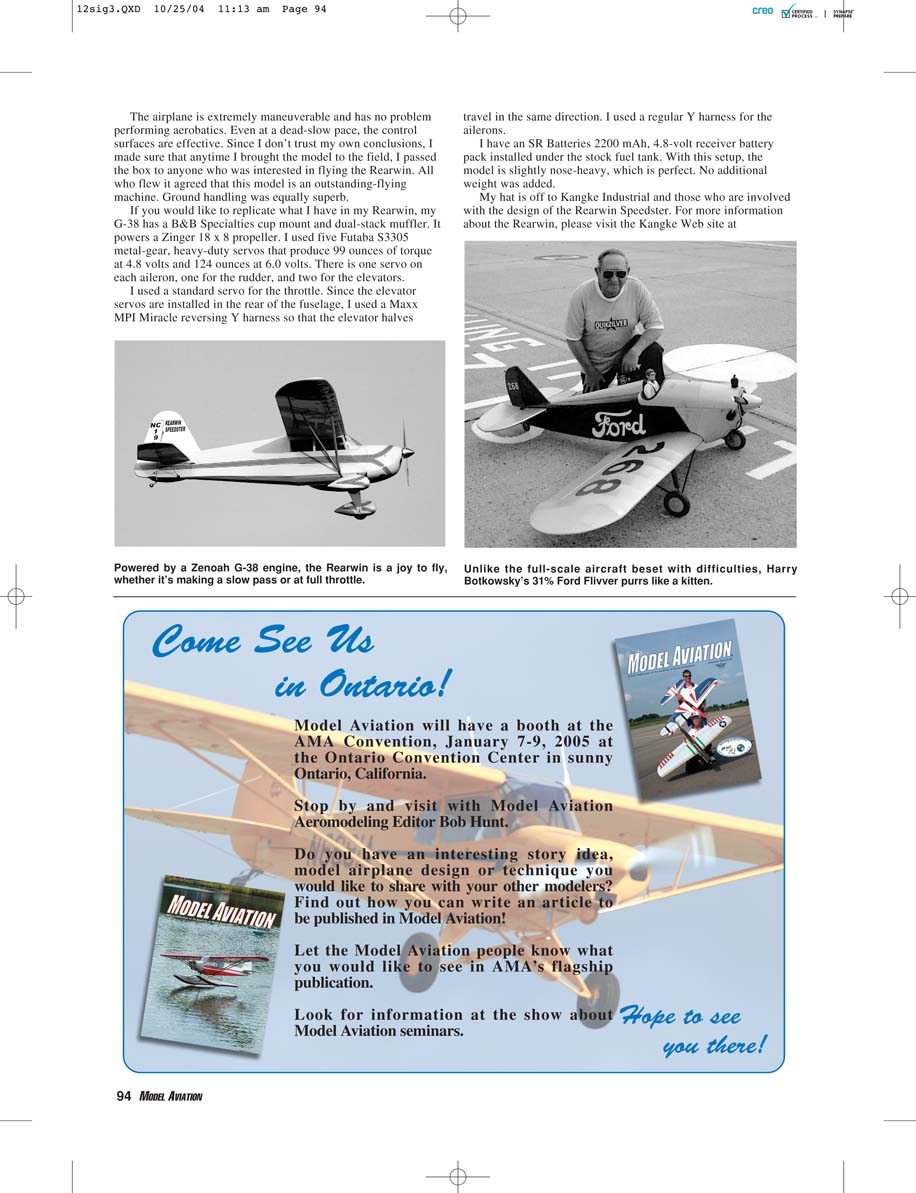
Rich Perry of Evergreen, Colorado, sent in some stunning photos of his first Giant Scale project: a Balsa USA 1/4-scale Fokker Dr.I triplane. Rich writes that he generally flies Open class and Scale Combat. When he saw the advertisement for the triplane, he had to have it.
A Saito 180 four-stroke glow engine spinning a 20 x 6 propeller powers the model. The aircraft's total weight is roughly 14 pounds, and Rich used Solartex to cover it. After mixing the paint himself to get just the right color from artist's latex paint bottles, he took the results to The Home Depot and had exterior latex house paint mixed for the finished paint job.
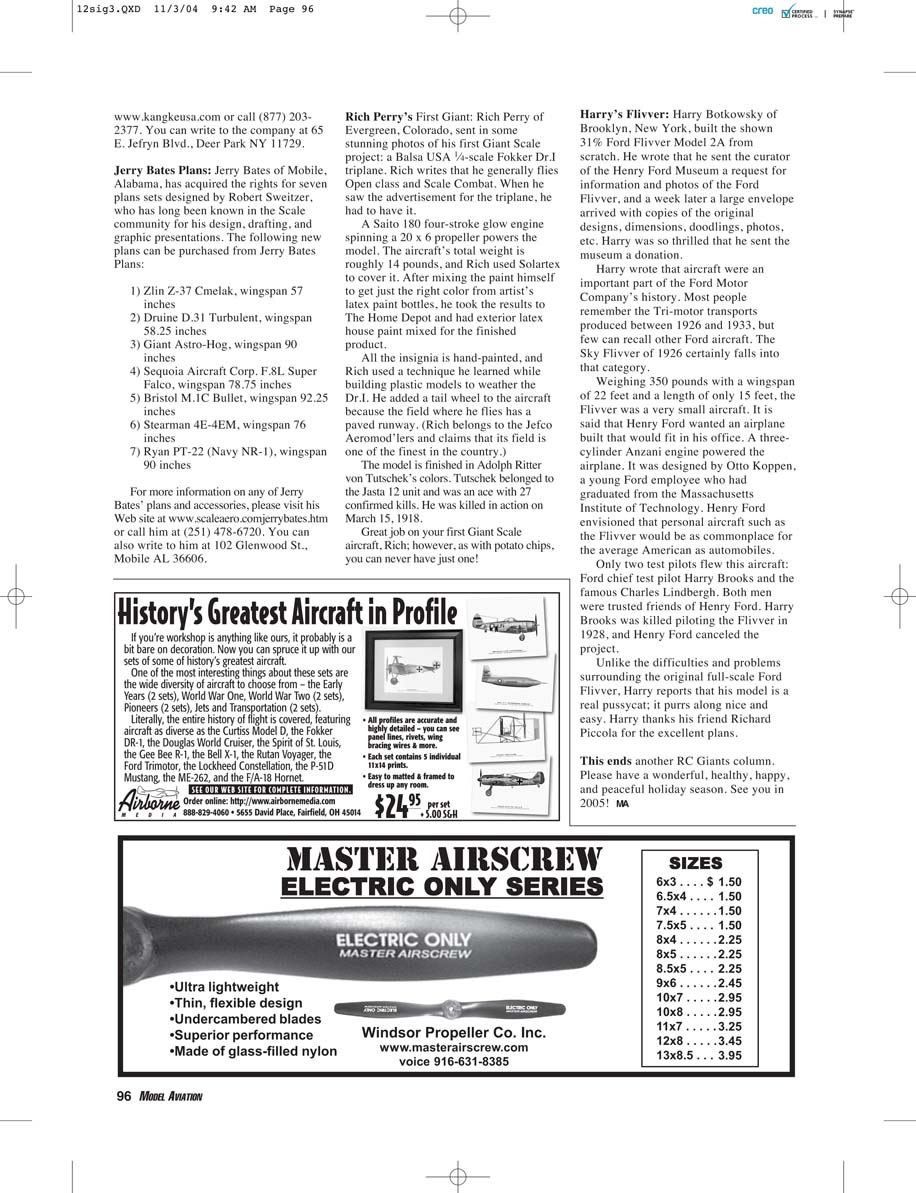
All the insignia is hand-painted, and Rich used a technique he learned while building plastic models to weather the Dr.I. He added a tail wheel to the aircraft because the field where he flies has a paved runway. (Rich belongs to the Jefco Aeromod'lers and claims that its field is one of the finest in the country.)
The model is finished in Adolph Ritter von Tutschek's colors. Tutschek belonged to the Jasta 12 unit and was an ace with 27 confirmed kills. He was killed in action on March 15, 1918.
Great job on your first Giant Scale aircraft, Rich; however, as with potato chips, you can never have just one!
Harry's Flivver
Harry Botkowsky of Brooklyn, New York, built the shown 31% Ford Flivver Model 2A from scratch. He wrote that he sent the curator of the Henry Ford Museum a request for information and photos of the Ford Flivver, and a week later a large envelope arrived with copies of the original designs, dimensions, doodlings, photos, etc. Harry was so thrilled that he sent the museum a donation.
Harry wrote that aircraft were an important part of the Ford Motor Company's history. Most people remember the Tri-Motor transports produced between 1926 and 1933, but few can recall other Ford aircraft. The Sky Flivver of 1926 certainly falls into that category.
Weighing 350 pounds with a wingspan of 22 feet and a length of only 15 feet, the Flivver was a very small aircraft. It is said that Henry Ford wanted an airplane built that would fit in his office. A three-cylinder Anzani engine powered the aircraft. It was designed by Otto Koppen, a young Ford employee who had graduated from the Massachusetts Institute of Technology. Henry Ford envisioned that personal aircraft such as the Flivver would be as commonplace for the average American as automobiles.
Only two test pilots flew the Flivver: Ford chief test pilot Harry Brooks and the famous Charles Lindbergh. Both men were trusted friends of Henry Ford. Harry Brooks was killed piloting the Flivver in 1928, and Henry Ford canceled the project.
Unlike the difficulties and problems surrounding the original full-scale Ford Flivver, Harry reports that his model is a real pussycat; it purrs along nice and easy. Harry thanks his friend Richard Piccola for the excellent plans.
This ends another RC Giants column. Please have a wonderful, healthy, happy, and peaceful holiday season. See you in 2005! MA
Transcribed from original scans by AI. Minor OCR errors may remain.

